Article 3 in the series — The Mythic Eye — Myths of Light-Bearers and Shadow-Walkers Across Cultures
© By Barbara Keller | Visica Co-Creation
This article draws from The Visica Compass — Navigating Why Light and Darkness Matter in a Time of Massive Transformation — a framework integrating inner work, systemic insight, and symbolic intelligence.
The Journey of Inquiry So Far …
Introduction — The Visica Compass: An Invitation to Inquiry
The journey opened by introducing The Visica Compass as an invitation into inquiry rather than certainty. It proposed that light and darkness are not fixed opposites but relational forces through which transformation unfolds.
By exploring the relationship between cosmos and Kosmos, symbolic and scientific ways of knowing, and the practice of seeing with both eyes open, the introduction laid the foundation for a different way of perceiving — one that invites us to pause before we conclude, and to discover wholeness and relationship where modern culture often sees separation.
Prelude — The Sound of Presence: Before the Word, There Was Resonance
We began before words and forms — in the field of vibration itself, the hum of existence.
Science explores the primordial vibrations and waves of the early universe; wisdom traditions have long spoken of creation through sound, vibration, or the voice of Being.
Within the symbolic language of this inquiry, presence can be imagined as emerging from that resonance — the silent grammar beneath all language and light. Every act of transformation begins in this resonance, not in reaction.
Article 1 — The Language of Light and Darkness: How Words Shape What We See
We turned our attention to the subtle force shaping how we perceive and understand the world — language.
We asked: What if our very understanding of light and darkness is shaped by the language we use to speak of them?
We explored how reclaiming symbolic, soulful, and precise language — especially in the inner world — can help us see the sacredness of both light and darkness with new eyes.
Article 2 — The Spark in the Dark: From Conception to Cosmos
We expanded both outward and inward — from black holes to embryonic light — tracing how the universe and the human body reflect the interplay between spark and shadow.
Creation itself emerges from darkness; life begins in hiddenness.
A Brief Reminder for Orientation
What has changed across time is not human suffering — but the relational field in which suffering is held.
Grief, fear, loss, longing, and despair have always been part of human life. What differs is not the pain itself, but the language, symbols, and relationships through which that pain could be expressed, shared, and transformed.
In many cultures where myth, ritual, and nature remained central to collective meaning-making, suffering was not understood solely as something isolated inside the individual psyche. It could be spoken through story, mirrored in nature, enacted in ritual, and held within a living Kosmos.
Darkness appeared as gods, underworlds, trials, and initiations — not because pain was imagined, but because human experience was given relational and symbolic form.
In Article 1, we explored how words like light and darkness hold many meanings. Here, in the mythic realm, we meet two of these forms most vividly: mythic light — the light of revelation, vision, and guidance — and mythic darkness — the symbolic night of trials, thresholds, descent, and transformation.
These are not cosmic forces or physical processes, as explored in Article 2, nor are they psychological wounds in the modern clinical sense, which we will encounter later in the series. They are archetypal expressions of human depths, spoken through mythic language.
By archetypal, I do not mean fixed roles or personality types. Archetypes can be understood as recurring patterns of human experience — relational fields through which cultures have given form to light, darkness, transformation, loss, power, love, death, and renewal.
They are not simply characters we “have,” but movements we may participate in, expressed through story, ritual, image, and imagination.
In Jungian thought, these patterns continue to find expression through what Jung called the collective unconscious — shaping how fear, longing, power, love, and meaning can surface in our lives, often outside conscious awareness.
From this perspective, the ancient stories have not simply disappeared because our language and cultures have changed. Their patterns may continue to appear in new forms.
In myth, light is rarely the clean certainty we sometimes associate with modern consciousness.
It is an illumination that reveals, not a spotlight that exposes.
And mythic darkness is not simply the dangerous void our culture often fears. It can be depth — a cave, an underworld, a night, a womb-space — where transformation begins before its outcome can be known.
The mythic realm can hold these contrasts without immediately collapsing them into moral binaries.
Myth does not always ask us to decide whether light is “good” and darkness is “bad.” It asks what each reveals.
Again and again, mythic stories show illumination emerging through shadow, and descent into darkness becoming a path of initiation.
Thinkers such as Carl Gustav Jung, James Hillman, and Mircea Eliade approached this territory in different ways. Each, however, challenged the idea that myth is merely an escape from reality.
Jung understood myth as an expression of psychic reality and the archetypal patterns through which human experience takes form.
Hillman insisted that psyche cannot be confined to the individual mind, but belongs also to the world in which we participate.
Eliade explored how myth and ritual enabled people in traditional societies to participate in a sacred reality rather than experience themselves as standing apart from it.
Seen through these different lenses, myth gives symbolic and relational form to experiences that might otherwise remain difficult to hold, express, or understand.
With this symbolic lens in place, we now enter the mythic eye — the realm where light and darkness take form through story, archetype, and imagination.
When the Larger Story Begins to Fade
As these relational languages have faded in many modern societies, suffering has not disappeared. Increasingly, however, it can become internalized and privatized — understood primarily as a problem located within the individual rather than also being encountered in relation to family, community, culture, land, meaning, and belonging.This does not mean that psychological or medical understanding is unnecessary. Nor does it mean that suffering in earlier societies was somehow better held.
It asks a different question:
What may become harder to see when the individual becomes the primary container for suffering?
Consider grief.
A person loses someone they love.
In a predominantly individual frame, we may ask:
How is this person coping?
Are they functioning again?
How long has the grief lasted?
Do they need professional support?
These can be important and compassionate questions.
But another way of holding grief might also ask:
Who grieves with this person?
What rituals mark the loss?
How is the person who died remembered within the family or community?
Where can sorrow be expressed without needing to be resolved?
What story helps the bereaved remain in relationship with life, death, ancestry, and those who continue living?
The grief has not changed.
The relational field holding the grief has.
The first lens locates much of the work within the grieving individual. The second widens the field to include relationship, ritual, community, memory, and meaning.
Neither needs to replace the other.
But if the second disappears entirely, the individual may be asked to carry alone what was once held, at least partly, together.
Perhaps this is also one meaning of re-membering.
Not simply remembering what happened, but bringing back into relationship what has become separated: the person and the community, grief and ritual, the living and the dead, memory and meaning, the individual story and the larger story in which it belongs.
Re-membering does not return us to the past.
It allows what has become separated to meet again — from where we stand now.
When relational languages weaken at a cultural level, the question may extend beyond individual suffering.
Across many societies today, declining birth rates, rising loneliness, and concerns about social cohesion are commonly discussed through economic, demographic, political, and social lenses. But viewed through the perspectives explored in this series — language in Article 1, cosmological belonging in Article 2, and now mythic orientation — another question becomes available:
What happens when people no longer experience their lives as held within a meaningful and trustworthy larger story?
I am not suggesting that the loss of myth causes declining birth rates, loneliness, or weakening social cohesion. These are complex phenomena shaped by many interacting conditions.
I am asking whether something less measurable may also belong in the conversation.
When connection to land, ancestry, shared narrative, and a sense of continuity weakens, the longer arc of life may become harder to feel — the arc linking those who came before us, those living now, and those yet to come.
From this perspective, questions of creation, care, parenthood, and continuity are not only private decisions. They also arise within the stories a culture tells about whether life is meaningful, whether the future can be trusted, and whether we belong to something that extends beyond ourselves.
Swedish philosopher Karl-Erik Edris, in Vart är världen på väg?, explores the loss of orienting values beneath modern progress — a forgetting not necessarily of knowledge, but of meaning.
This brings us back to myth.
Myth once offered forms through which orientation, belonging, suffering, continuity, and transformation could be held collectively. When those forms weaken, other forces — including performance, power, consumption, or control — may attempt to fill the space, while the deeper question of belonging remains.
Perhaps the question is therefore not whether modern societies should return to old myths.
It is whether we still need ways of remembering:
Where do I belong?
What holds me when I suffer?
What connects my life to those who came before — and those who may come after?
Introduction to Stories and Mythology
Now, in Article 3, moving from the measurable cosmos to the living Kosmos, we turn from explanation to imagination — into the mythic and psychological dimensions where light and darkness take form through beings, stories, and symbolic worlds.
From description to participation: myth restores something the modern gaze can easily forget — that the universe is not only observed, but also experienced, felt, imagined, and given meaning.
From the dawn of storytelling, human beings have sought to make sense of both light and darkness through narrative. Myths are among the oldest mirrors we possess — reflecting not only what we see, but how we see. They turn experience into image, chaos into pattern, and mystery into meaning.
Many stories begin at an edge — the place where the known world gives way to the unknown.
Here, fear may first appear — not only as something to escape, but sometimes as an invitation to pay closer attention.
Fear can, of course, warn us of real danger. Discernment matters.
But myth also gives fear another language.
Fear Can Mark a Threshold
The monster at the gate.
The descent into night.
The crossing of forbidden waters.
The forest beyond the familiar path.
In such stories, fear can become the trembling before encounter — the moment when what we know meets what we do not yet understand.
And alongside fear, something else often appears: wonder.
Perhaps this is one of myth's enduring tensions: fear and wonder meeting at the threshold of the unknown.
At such thresholds, the protagonist may have to enter a passage that no one else can make on their behalf.
This is a particular kind of aloneness.
Not necessarily the loneliness of abandonment, but the aloneness of transition — standing between identities, between what has been and what has not yet taken form.
Mythic solitude can become a listening space, a threshold where the old begins to dissolve and the new has not yet taken form.
In this sense, solitude can take the form of initiation rather than punishment.
The soul — or, in psychological language, the person — is asked to listen differently.
And perhaps fear, when met with presence and discernment rather than automatically obeyed or rejected, can reveal something about the threshold itself:
What am I approaching?
What am I leaving?
What is asking to be seen?
In Women Who Run With the Wolves, Clarissa Pinkola Estés retells and interprets The Handless Maiden — a story of loss, wandering, endurance, and transformation.
Read through the lens of this inquiry, the maiden's journey becomes an image of psychic descent: what once held her can no longer remain as it was, while what she is becoming has not yet fully taken form.
There is no shortcut through this territory.
And perhaps that is why such stories continue to speak across time.
Through them, light and darkness are allowed to remain in relationship.
The darkness does not automatically mean failure.
The light does not automatically mean arrival.
Transformation is not portrayed simply as movement toward brightness, but as a passage through what cannot yet be fully seen.
The Mythic Eye — Myths of Light-Bearers and Shadow-Walkers Across Cultures
Each of these paths calls for a shift from judgment to discernment — from automatically labelling light as good and darkness as bad, toward becoming curious about what each may reveal.
In the mythic imagination, light is not necessarily certainty but revelation — a moment of seeing that may humble rather than elevate.
And darkness is not necessarily ignorance. It may become initiation — the obscurity of a threshold where what is emerging cannot yet be fully seen.
When we approach myths through this lens, the movements of light and shadow become invitations rather than opposites.
The Womb of Love
Within what I call the womb of love, the heart's spacious intelligence can hold what arises without immediately rejecting, dividing, or judging it.
This does not mean that everything is equally beneficial, true, or harmless.
It means that discernment can begin before rejection.
In this sense, A. H. Almaas' understanding of inquiry can be seen as a modern interior echo of something myth once held collectively — the willingness to enter what is unknown rather than immediately turning away from it.
In the Diamond Approach, inquiry invites us to meet experience with presence, curiosity, and openness to what has not yet been understood.
Rather than rejecting what arises, inquiry stays close to experience long enough for its deeper truth to reveal itself.
Inquiry is not analysis but intimacy — a turning toward experience with presence and curiosity.
Intimacy means that we cannot stand outside the experience and study it as an object. We have to come into contact with the experience itself — not merely an idea of the experience — and stay with it.
The moment we substitute our interpretation, memory, or expectation of the experience for what is actually happening, we have already changed both our relationship to the experience and our understanding of it.
Experiential knowing can arise with extraordinary precision and clarity, even when what is known is difficult to put into words. And what appears clear in one moment may reveal another, even seemingly opposite, dimension as the inquiry deepens.
The mind naturally tries to stabilize experience: Now I know what this is. Yet lived experience cannot be captured and held as a fixed object of knowing.
Perhaps this is something myth understands particularly well. Myth can hold paradox without forcing it too quickly into definition.
Light can reveal and blind.
Darkness can conceal and disclose.
Descent can be loss and initiation.
Not-knowing can be ignorance and openness.
Something may resist conceptual knowing and yet be intimately known through experience.
Darkness, in this view, need not be understood simply as a flaw or something to overcome. It can become a portal — a depth to be entered and experienced more fully.
This is where mythic descent and the movement of inner inquiry begin to resonate with one another.
The mythic figure enters the underworld.
In inquiry, we may encounter contraction, fear, grief, confusion, or not-knowing.
Neither journey guarantees illumination simply through entering what is unknown. But when what arises can be met with presence rather than immediately rejected, something previously hidden may become available.
My own journey within the Diamond Approach has shown me that light is not only discovered but uncovered — the soul remembering itself through the patient work of love.
Myth as a Map of Inner Experience
Myth does not remain outside us as an ancient story. Its patterns can also become ways of recognizing movements within human experience.
Carl Gustav Jung understood archetypes as recurring patterns emerging through the collective unconscious. Figures of descent, shadow, death, renewal, and transformation can therefore be encountered not only in ancient stories, but in the inner life. His concept of individuation points toward a movement of becoming more whole — not by eliminating what is unconscious, but by entering into relationship with it.
Clarissa Pinkola Estés brings this movement vividly into the realm of story. Through her retelling and interpretation of traditional tales, myth becomes a language through which loss, instinct, exile, endurance, and renewal can be encountered rather than merely explained.
Ken Wilber's Integral Theory offers another perspective: different ways of knowing — psychological, mythic, spiritual, scientific — need not cancel one another. Each may illuminate a different dimension of experience, while no single perspective contains the whole.
Across these different approaches, a shared movement becomes visible: what is unknown does not always need to be conquered or eliminated. It can be approached, encountered, and brought into relationship.
Within the Visica Compass, this returns us to the movement from judgment to discernment — allowing what appears as light or darkness to remain within the womb of love long enough for its meaning to become clearer.
Myth, then, is not simply an ancient explanation of the world. It can remain a living language through which we recognize something of ourselves.
The Mythic Realm — Light-Bearers and Shadow-Walkers
Across cultures and centuries, human beings have told stories of fire and darkness, descent and return, destruction and renewal, revelation and transformation.
These stories do not speak with one voice, nor do their symbols carry identical meanings. Each arises within a particular cultural, spiritual, and historical world.
Yet when we place some of them beside one another — without collapsing their differences — certain questions begin to echo.
What does light reveal?
What does darkness ask us to encounter?
What must be relinquished before something new can emerge?
And when does what appears to be light cast a shadow of its own?
Prometheus — The Rebel Who Stole the Fire (Greek Mythology)
Prometheus defies the Zeus by stealing fire and gifting it to humanity. The gift changes what becomes possible for human beings, but Prometheus pays a terrible price for his transgression.
Read symbolically, fire becomes more than flame: it can represent knowledge, creativity, technological power, and the human capacity to transform the conditions of life.
Prometheus therefore carries a paradox particularly relevant to the mythic eye: what illuminates can also disrupt, and what is given as a gift may carry consequences that cannot yet be foreseen.
Inanna’s Descent — Surrender and Rebirth (Sumerian Mythology)
Inanna, queen of heaven and earth, descends into the underworld. At each of seven gates, she is required to relinquish part of her regalia and power until she stands stripped before her sister Ereshkigal, queen of the underworld.
Inanna is killed and later restored to life, but her return is not without consequence. Her descent and return offer a powerful image of what may happen when familiar identity, status, and power can no longer accompany us across a threshold.
Read through the mythic eye, Inanna becomes a Shadow-Walker — not because darkness is something to conquer, but because the descent asks what remains when what once defined us has been stripped away.
Lucifer — The Luminous Fall (Christian Tradition)
The name Lucifer means “light-bearer” and originally referred to the morning star. Through later Christian interpretation, the figure became associated with the fall of Satan — the luminous one whose elevation turns toward pride and separation.
This makes Lucifer a particularly paradoxical figure for the mythic eye: light itself does not guarantee wisdom.
What appears luminous may still cast a shadow. The story invites a question central to the Visica Compass:
When does illumination become self-elevation — and how do we discern the difference?
Jesus — The Light Who Descends (Christian Mysticism)
Jesus is described in Christian scripture and tradition through images of light — including the Light of the World. Yet his story does not move only toward illumination. It also passes through betrayal, suffering, death, the darkness of the tomb, and resurrection.
In the later Christian tradition of the Harrowing of Hell, Christ descends into the realm of the dead before rising again.
Read through the mythic eye, this creates another paradox: the figure associated with light does not remain above the darkness, but passes through it.
Kali — Fierce Compassion in the Darkness (Hinduism)
Kali is one of the most powerful and complex figures in Hindu traditions. Dark in appearance and often depicted in cremation grounds, she is associated with time, death, destruction, fierce protection, and liberation.
Her terrifying appearance does not make her simply evil. For many devotees, Kali is also Mother
— a form of divine power whose fierceness can protect, liberate, and cut through what can no longer remain.
Through the mythic eye, Kali radically unsettles the equation darkness = evil.
She asks whether what appears frightening may sometimes carry a transformative or protective power that cannot be recognized by appearance alone.
The Bodhisattva — Enlightenment Through Compassion (Buddhism)
In Buddhist traditions, the Bodhisattva embodies a path in which awakening and compassion are inseparable. Rather than seeking liberation for oneself alone, the Bodhisattva is committed to the liberation of all beings.
This commitment brings the Bodhisattva into relationship with the suffering of others. Wisdom is not cultivated solely for one’s own freedom, but also for the benefit of those who suffer.
Here, awakening and compassion belong together. To recognize suffering is not necessarily to become imprisoned by it, nor does liberation mean becoming indifferent to the suffering of others.
For the mythic eye, this introduces a different understanding of light: awakening does not require turning away from suffering. It can deepen our capacity to meet suffering with wisdom and compassion.
Awareness can deepen our capacity to remain in relationship with suffering — our own and that of others — without being entirely defined by it.
Here, darkness does not refer to a single force or condition. Used symbolically, it can point toward different dimensions of suffering: physical suffering such as pain, illness, and dying;
psychological suffering such as grief, fear, despair, and loneliness; and moral darkness expressed through cruelty, violence, exploitation, and injustice.
The Bodhisattva does not illuminate these forms of darkness by making them disappear.
Awareness and compassion deepen the capacity to remain present and in relationship with suffering — our own and that of others — without being entirely defined by it.
Here, what we might call light is not escape from darkness, but the capacity to meet suffering with wisdom, presence, and compassion.
Spider Woman — Weaver of Beauty and Relationship (Diné/Navajo Tradition)
In Diné creation stories, Spider Woman, together with Spider Man, is associated with the gift and teaching of weaving. Weaving becomes more than a practical art: it carries relationship, harmony, beauty, prayer, and connection with land and ancestors.
The weaving frame itself can become an image of relationship — earth below, sky above, and the threads meeting between them.
Through the mythic eye, Spider Woman introduces something different from the figures we have encountered so far.
Transformation is no longer only a journey of the individual who descends, struggles, awakens, or returns. It is also the work of relationship — learning how the different threads belong together.
The web does not require every thread to become the same.
Its strength and beauty emerge through relationship.
The Living Web — What Indigenous Teachings Opened for Me
Placed beside one another, these stories reveal different movements between light and darkness — sometimes conflict, sometimes descent, sometimes revelation, sometimes transformation. Through the lens of the Visica Compass, I experience their interplay less as a fixed opposition than as a rhythm — different movements within the larger pulse of life.
My encounters with Indigenous teachers and traditions opened another dimension of this understanding for me.
I was introduced to ways of seeing in which the human being does not stand outside nature, but participates within a living web of relationship — with land, ancestors, animals, plants, the elements, and dimensions of life that are not always visible.
Spider Woman has become a particularly powerful image of this for me. Her weaving evokes a Kosmos in which the luminous and the shadowed, the living and the dying, the seen and the unseen can belong within a larger web.
It is not, as I understand it, a web of control, but of belonging and relationship.
What stayed with me from these encounters was also a different relationship with darkness. In the ways of understanding I encountered, darkness did not always need to be understood as a moral opposite of light. It could also point toward depth, mystery, shelter, listening, or what had not yet become visible.
When relationship with nature is lost, darkness can more easily become something merely threatening — something to illuminate, control, or escape. What I encountered invited another possibility: to enter what is not yet known with reverence, attention, and discernment.
To live wisely, I came to understand, is to weave consciously — listening for the tensions between the threads, recognizing where relationships have become disturbed, and discerning what may allow a more conscious and life-sustaining way of relating to emerge.
Yet remaining in relationship does not always mean remaining in contact.
Sometimes discernment reveals that a relationship has become harmful, exploitative, or destructive. Remaining conscious of our relationship with another person, with ourselves, or with the larger web of life does not require us to remain physically or emotionally available to what causes harm.
A boundary, distance, or even the ending of contact may sometimes be necessary.
Relationship does not disappear simply because contact ends. What may change is how we choose to participate in it.
Perhaps conscious relating is not about preserving every connection, but about discerning what allows life, dignity, and integrity to be sustained.
Star People and Stardust
Indigenous elders I met during my travels spoke of us as Star People — placing human life within a lineage extending far beyond the human world.
Years later, I found an unexpected resonance with something modern astrophysics describes in very different language: many of the elements that make up our bodies were forged in earlier generations of stars and dispersed into space before eventually becoming part of Earth — and of us.
As John and Mary Gribbin explore in Stardust: Supernovae and Life — The Cosmic Connection (2001), the elements essential to life have a history reaching back into earlier generations of stars.
Mythic and scientific ways of knowing are not the same, and one should not be used to prove the other. Yet placed beside one another, they can sometimes create a remarkable resonance.
One speaks through relationship, ancestry, story, and belonging.
The other speaks through matter, elements, stellar evolution, and cosmic time.
And somewhere between them, an ancient question returns:
What changes when we experience ourselves not as separate observers of the universe, but as participants within a story that began long before us?
For me, the image of Star People carries this sense of belonging: human life as part of a much larger Kosmos — matter and meaning, body and mystery, woven into relationship.
When we forget this web, we may begin to experience ourselves as separate from what sustains us. When we re-member, another possibility becomes available: to recognize relationship where we had learned to see separation.
What the Mythic Eye Reveals
These stories do not give us a single meaning of light or darkness.
Perhaps that is precisely their gift.
Again and again, what first appears luminous may reveal a shadow; what first appears dark may contain depth, protection, transformation, or something not yet understood. Yet darkness can also mean suffering, destruction, or moral harm. Discernment matters.
The mythic eye does not ask us to romanticize darkness or distrust light.
It asks us to look again.
To remain with the image long enough to notice what our first interpretation may have missed.
And perhaps this is why these ancient stories continue to speak.
They remind us that transformation does not always arrive in the form we expect — and that what we encounter at the threshold of the unknown may ask for something other than an immediate answer.
Sometimes it asks us to remain present with what we are experiencing long enough to see differently.

The mythic eye does not simply ask, What does this story mean?
Reflective Questions
Which story or myth in this article stayed with you — and what in it caught your attention?
When have you discovered that something you first perceived as “light” or “darkness” was more complex than it appeared?
What happens in you when you encounter something you do not yet understand?
Can you remember an experience you knew with great clarity but found difficult to put into words?
Where in your life might you benefit from staying curious a little longer before deciding what something means — and where might discernment ask you to establish a boundary or step away?
Continue the Ongoing Inquiry — Spiralling Back with New Eyes
Article 3 has taken us from the measurable cosmos into the living Kosmos of story, symbol, relationship, and meaning. The mythic eye does not simply ask, What does this story mean?
It asks:
What becomes visible when I stay with the story long enough for my first interpretation to loosen?
Perhaps this is one of myth's enduring gifts.
It does not always give us an answer.
Sometimes it gives us an image strong enough to accompany us while the answer is still forming.
Next in the Series …
Article 4 — Religions and Philosophies: Sacred Light and Holy Darkness
In Article 4, we follow light and darkness into religious and philosophical traditions, where mythic images may become teachings, moral frameworks, contemplative practices, doctrines — and sometimes profound expressions of mystery.
We ask:
When does guidance turn into control?
And when can a tradition help us remain in relationship with mystery rather than close it down?
Each article in this series opens a doorway into the same living conversation.
Continue Your Personal Inquiry
Through Different Eyes — How Perspective Shapes the Story of Your Experience
What becomes visible when you look at the same experience through different eyes?
Every experience carries more than one possible interpretation. The stories we tell ourselves influence what we notice, how we feel, and how we relate to others.
The Personal Guided Inquiry accompanying Article 3 invites you to explore an experience from six different perspectives — discovering what each reveals, what it may conceal, and what becomes visible when these perspectives meet.
Not to find the one right interpretation, but to deepen awareness, curiosity, and discernment.
Through Different Eyes is available as a downloadable Personal Guided Inquiry.
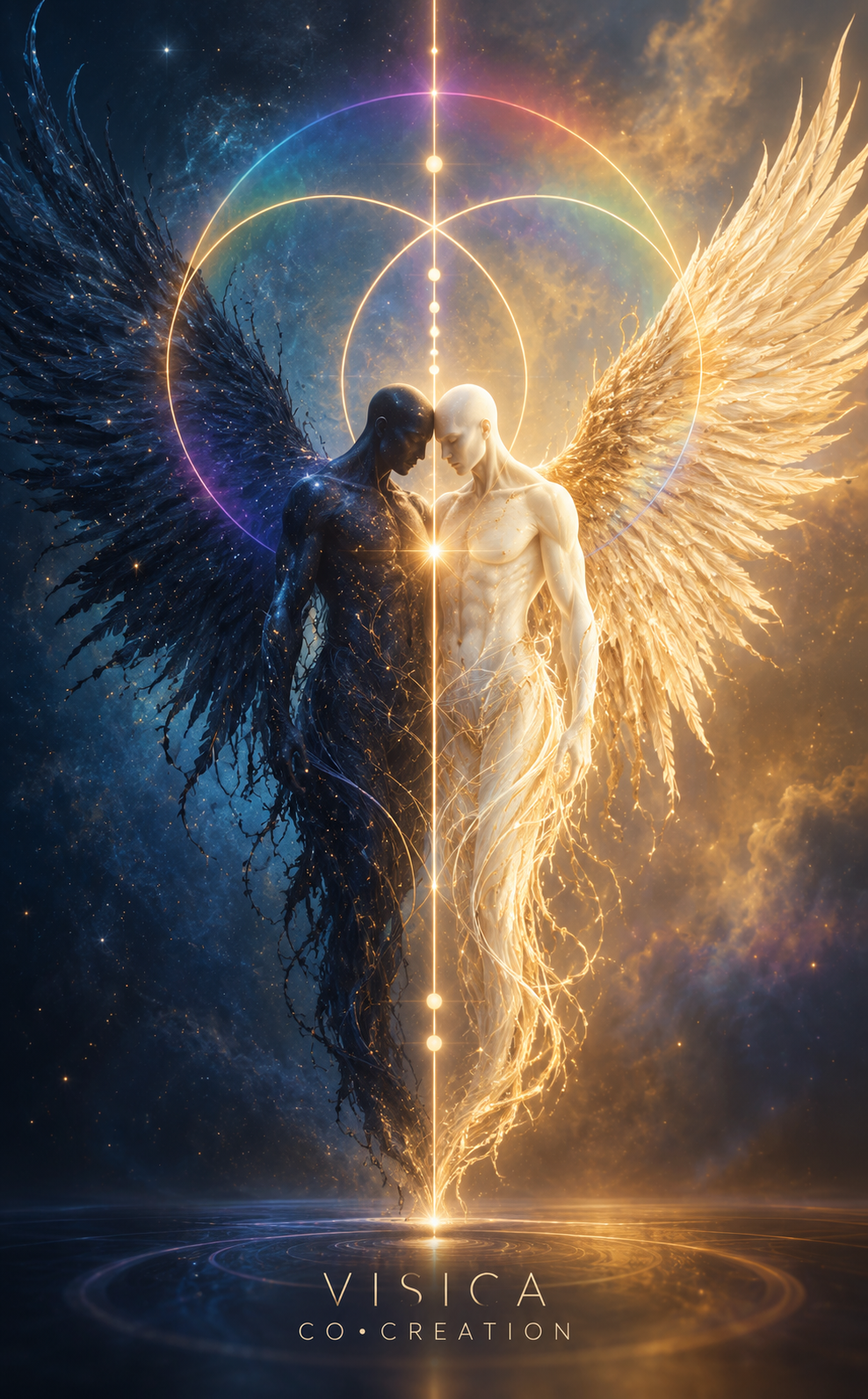
“Darkness is not always the absence of light. Sometimes, it is the presence of depth.” — Barbara Keller| Visica Co-Creation
Sources and Voices That Shaped This Reflection…
Myth, Archetype, and the Language of the Living Kosmos
This article draws upon a constellation of thinkers who approached myth not simply as fantasy, but as a carrier of psychological, symbolic, spiritual, cultural, and relational meaning — a way human beings have given form to experiences of transformation, belonging, suffering, mystery, and the sacred.
Carl Gustav Jung
Jung understood myth as one expression of the collective unconscious, through which recurring archetypal patterns take symbolic form. His work on shadow, individuation, and motifs of descent helps illuminate how encounters with what lies outside conscious awareness may become part of psychological transformation.
James Hillman
Hillman challenged psychology to recover imagination, image, and soul rather than reducing human experience to problems located solely within the individual. His archetypal psychology invites us to listen to symptoms and images for the meanings they may carry, widening psychological life beyond the boundaries of the isolated self.
Clarissa Pinkola Estés
Through stories such as The Handless Maiden in Women Who Run With the Wolves, Estés explores loss, instinct, endurance, descent, and renewal through the language of traditional tale and the feminine psyche. Her work demonstrates how story can give symbolic form to experiences that may be difficult to approach through explanation alone.
Diné Creation Traditions — Spider Woman and the Gift of Weaving
Diné creation traditions include teachings concerning Spider Woman and the origins and significance of weaving. Within these living traditions, weaving carries cultural, spiritual, and relational meanings that extend beyond the making of cloth.
Paul G. Zolbrod's Diné Bahaneʼ: The Navajo Creation Story (1984) offers one published retelling of Diné creation narratives. As a work recorded and interpreted by a scholar outside the Diné community, it should not be understood as representing every Diné account or interpretation.
My reflection on Spider Woman as an image of relationship and interconnectedness is informed by my encounters with Indigenous teachings and by my own inquiry through the Visica Compass. It is not intended as a universal interpretation of Diné tradition.
Raymond Friday Locke
In The Book of the Navajo (1976), Locke brings together Diné (Navajo) history, cultural traditions, creation narratives, and spiritual understandings of the world. His work offers a wider context for encountering Spider Woman, the significance of weaving, and the relationships between human life, nature, and the sacred.
Read alongside my own encounters with Indigenous teachers, these accounts have contributed to my reflection on weaving as an image of belonging and relationship — while recognizing that my interpretation through the Visica Compass is not necessarily the meaning given to these traditions by Diné communities themselves.
Mircea Eliade
In Myth and Reality, Eliade explored societies in which myth remained a living reality rather than being understood merely as fiction. Myth recounts sacred origins and provides patterns through which human life can be understood and lived; through myth and ritual, people may participate again in the sacred reality of primordial beginnings. His work helps illuminate how myth can locate individual existence within a larger cosmological order.
Joseph Campbell
Campbell traced recurring patterns in myths of departure, initiation, ordeal, transformation, and return across cultures. His comparative work brought particular attention to the ways stories of journey and transformation can echo patterns within human experience.
David Abram
Abram explores how language, perception, story, and the senses participate in our relationship with the more-than-human world. His work helps illuminate what can be lost when nature is encountered primarily as an object rather than as a living field in which human beings participate.
John and Mary Gribbin
In Stardust: Supernovae and Life — The Cosmic Connection (2001), John and Mary Gribbin explore how the elements essential to life emerged through stellar processes long before the formation of Earth. Their work provides a scientific perspective on our material connection with the wider universe.
Placed alongside the image of Star People shared with me by Indigenous elders, their work offers an unexpected resonance between two different ways of knowing — one expressed through ancestry, story, and belonging, the other through astrophysics and cosmic evolution.
Neither perspective is presented as proof of the other. Together, they invite us to reconsider what it means to belong within a much larger Kosmos.
Karl-Erik Edris
In Vart är världen på väg?, Edris examines questions of values, meaning, and orientation beneath modern social development. His work has informed my own inquiry into what may happen when technological and economic development outpaces our capacity for existential grounding, relationship, and a trustworthy larger story.
Ken Wilber
Wilber's distinction between cosmos and Kosmos provides a language for distinguishing the measurable physical universe from a wider reality that also includes interiority, meaning, value, and consciousness. His Integral approach has influenced the way this series brings different perspectives into relationship without assuming that any one perspective contains the whole.
A. H. Almaas
Through the Diamond Approach, Almaas explores inquiry as an experiential practice grounded in presence, curiosity, and direct contact with experience. His work has deeply informed my understanding that knowing is not limited to conceptual explanation, and that remaining with what is present can allow dimensions of experience to reveal themselves with a precision that language does not always fully capture.
Together, these voices do not offer a single explanation of myth.
They offer different ways of understanding how story, image, ritual, psyche, culture, language, and relationship participate in the ways human beings make meaning.
Human suffering is not new. What can change across cultures and across time are the relational fields through which suffering is understood and held.
Myth has been one of those fields — carrying experiences of loss, fear, transformation, belonging, death, renewal, and mystery through story, symbol, ritual, nature, and community. When such relational languages weaken, the individual may be asked to carry more of what was once held, at least partly, together.
This article does not seek to romanticize the past or to return to old myths as answers.
It asks instead what they may still help us see.
Perhaps the mythic eye can help us recover something of our capacity for discernment — to encounter light without assuming that everything luminous is good, and darkness without assuming that everything hidden, unknown, or difficult is evil.
And to remain in relationship with what we do not yet understand long enough for another way of seeing to become possible.

“The stories we inherit do not have to determine the stories we live. But they may help us see what we have forgotten to remember.” — Barbara Keller| Visica Co-Creation
Continue the Conversation
This inquiry does not end with the article.
Perhaps something here opened a question, challenged an assumption, or brought you into contact with something you had not noticed before.
What stayed with you? What became visible — or perhaps remains unresolved?
You are warmly invited to leave a reflection or question in the comments below. The Visica Compass grows through inquiry, relationship, and the perspectives we bring into contact with one another.
Your voice is welcome here.