Article 4 in the Series — Religions and Philosophies — Sacred Light and Holy Darkness
© 2025 Barbara Keller | Visica Co-Creation
This article draws from The Visica Compass — Navigating Why Light and Darkness Matter in a Time of Massive Transformation — a framework integrating inner work, systemic insight, and symbolic intelligence.
The Journey of Inquiry so Far…
Introduction — The Visica Compass: An Invitation to Inquiry
The journey opened by introducing The Visica Compass as an invitation into inquiry rather than certainty. It proposed that light and darkness are not fixed opposites but relational forces through which transformation unfolds. By exploring the relationship between cosmos and Kosmos, symbolic and scientific ways of knowing, and the practice of seeing with both eyes open, the introduction laid the foundation for a different way of perceiving — one that invites us to pause before we conclude, and to discover wholeness and relationship where modern culture often sees separation.
Prelude — The Sound of Presence: Before the Word, There Was Resonance
We began before words and forms — in the field of vibration itself, the hum of existence. Science explores the primordial vibrations and waves of the early universe; wisdom traditions have long spoken of creation through sound, vibration, or the voice of Being. Within the symbolic language of this inquiry, presence can be imagined as emerging from that resonance — the silent grammar beneath all language and light. Every act of transformation begins in this resonance, not in reaction.
Article 1 — The Language of Light and Darkness: How Words Shape What We See
We turned our attention to the subtle force shaping how we perceive and understand the world — language. We asked: What if our very understanding of light and darkness is shaped by the language we use to speak of them? We explored how reclaiming symbolic, soulful, and precise language — especially in the inner world — can help us see the sacredness of both light and darkness with new eyes.
Article 2 — The Spark in the Dark: From Conception to Cosmos
We expanded both outward and inward — from black holes to embryonic light — tracing how the universe and the human body reflect the interplay between spark and shadow. Creation itself emerges from darkness; life begins in hiddenness.
Article 3 — The Mythic Eye: Seeing Through the Stories We Inherit
We entered the living Kosmos of myth, archetype, story, and imagination, encountering light-bearers, shadow-walkers, and weavers of relationship across different cultural and spiritual traditions.
Through figures such as Prometheus, Inanna, Kali, the Bodhisattva, and Spider Woman, we explored how light and darkness can carry meanings far beyond the familiar opposition of good and evil.
We also considered how the stories we inherit shape our perception, how fear and wonder may meet at the threshold of the unknown, and how suffering has been held through ritual, community, and shared meaning.
The inquiry invited us to move from judgment toward discernment — recognizing that not everything luminous is wise, nor everything dark a threat.
And perhaps most importantly, we discovered that remaining in relationship with experience does not necessarily mean remaining in circumstances that cause harm.
Myth does not always provide an answer. Sometimes it offers another way of seeing.
I. INTRODUCTION — CANDLES IN THE CAVE OF THE SOUL
Since the dawn of time, humanity has looked up to the stars and down into the abyss, asking:
Who are we? Why are we here? What is this light that gives life — and this darkness many fear, yet to which we return?
Perhaps fear itself is the first prayer — the quiver that reminds us we stand before mystery. When we turn toward it rather than away, fear becomes not a barrier to the sacred but its doorway, the pulse that calls us deeper into the cave of the soul.
Religious traditions and philosophical systems have long served as mirrors to this inner inquiry.
They offered cosmologies to hold our awe, rituals to hold our grief, and symbols to speak where logic could not reach.
In this fourth article, we explore how the world’s great spiritual lineages have worked with the duality — and unity — of light and darkness.
We move beyond the idea that light is good and darkness is bad, listening instead to the mystics and sages who knew both as essential.
In a time when institutional religion is fading and personal spirituality is rising, what ancient wisdom still glows within these traditions?
How might they illuminate the road ahead — not only for societies in flux, but for the soul in search of home?
II. ORIENTATION — LOOKING WITH BOTH EYES OPEN
A Responsibility of Discernment
To inquire into religious and philosophical traditions is to enter a landscape shaped by centuries of human longing, wisdom, devotion, interpretation, conflict, and suffering. No single tradition speaks with one voice. No historical period contains the whole story. And no interpretation can adequately represent every person who has lived within it. I approach this exploration with curiosity, respect, and an awareness of the limits of my own knowledge. I am not a scholar of comparative religion, nor do I claim expertise in the many religious, philosophical, and mystical traditions explored here. What I bring is a lifelong inquiry into human experience, psychology, consciousness, relationship, and the ways we seek meaning in what we encounter. My intention is neither to determine which tradition holds the greater truth nor to judge its followers through the actions of particular institutions or historical periods. Rather, I wish to explore the different expressions of light and darkness at play within these traditions — the wisdom they have preserved, the human capacities they have cultivated, and the ways their teachings and interpretations may have become entangled with fear, authority, and power. This inquiry therefore asks for care: • Care in distinguishing teachings from their interpretations and practices. • Care in recognizing the historical and cultural circumstances in which particular beliefs and institutions developed. • Care in acknowledging both the wisdom these traditions have preserved and the suffering that has sometimes occurred under their authority. • Care in examining our own assumptions before drawing conclusions. Discernment does not ask us to avoid difficult truths. It asks us to approach them with sufficient precision that we do not create new misunderstandings while attempting to illuminate old ones. Which Light? Which Darkness?
Throughout this series, we have explored different expressions of light and darkness. Five forms of darkness — Cosmic, Sacred, Existential, Wounded, and Shadow Darkness — alongside six expressions of light: Physical, Perceptual, Mythic, Essential, Moral, and Creative Light. These distinctions are not fixed categories into which every experience must fit. They are invitations to look more carefully at what we mean when we speak of light and darkness. As we enter religious and philosophical traditions, this discernment becomes particularly interesting. What one tradition describes as sacred darkness may refer to contemplative mystery, while another use of darkness may describe moral wrongdoing, psychological suffering, or the unknown. Likewise, light may signify divine revelation, ethical goodness, intellectual understanding, spiritual presence, or the creative emergence of something new. Yet light may also symbolize authority, dominance, surveillance, or overexposure — an illumination that blinds rather than clarifies, exposes rather than reveals, or imposes a particular understanding as the only truth. The same light that offers guidance may, when used without discernment, become an instrument of control. The same word does not necessarily describe the same experience. Its meaning depends not only on the word itself, but also on the context in which it is used, the intention of the person using it, and how it is understood and experienced by others. What one person offers as illumination may be experienced by another as exposure or control. What one tradition calls darkness may signify mystery, suffering, ignorance, protection, or something entirely different. Intention and impact do not always coincide. Nor does the same symbol carry an identical meaning across different traditions. A symbol may invite reverence in one context, communicate authority in another, or acquire new meanings as it moves across cultures and generations. This is why discernment asks us to look beyond the words and symbols themselves — to inquire into the meanings they carry, the relationships in which they are expressed, and the consequences they may have. My intention is therefore not to determine which traditions belong to the light and which to the darkness. It is to inquire into the different meanings of light and darkness at play within them — what they reveal, what they may conceal, and what we might learn when we look with both eyes open. The Womb of Love — Inquiry Without Immediate Judgment
Within what I call the Womb of Love, inquiry invites us to remain present with what arises without immediately dividing experience into what must be accepted and what must be rejected. This does not mean that everything is equally beneficial, true, or harmless. Nor does it mean that we must remain in circumstances that cause harm. The Womb of Love does not eliminate discernment. It offers a space in which even opposing experiences can be encountered without becoming fixed in either — allowing us to recognize what is present and respond with clarity, compassion, and responsibility. The different expressions of light and darkness do not themselves become rigid. Rather, our interpretations, identifications, and ways of relating to them may become rigid. A teaching that once offered illumination may become restrictive when its interpretation is treated as unquestionable. An experience of darkness may open a space for contemplation, yet darkness may also conceal suffering, injustice, or harm that requires recognition and action. Even what we understand as sacred can become entangled with fear, identity, authority, and the need for control. Perhaps the danger is not found in light or darkness themselves, but in the moment when our interpretation of either becomes more important to defend than our willingness to discover what is actually happening. When Guidance Becomes Control
Religious and philosophical traditions have offered teachings, rituals, ethical principles, contemplative practices, and ways of understanding reality. These can support belonging, wisdom, continuity, and inquiry. Yet every tradition faces a tension between preserving what has been received and remaining open to what has not yet been understood. A teaching may provide orientation without claiming to contain the whole of reality. But what happens when an interpretation becomes unquestionable? When fear of uncertainty, the need for belonging, or the preservation of authority begins to outweigh curiosity and discernment, a living tradition may gradually become rigid. What once offered guidance may begin to demand conformity. What once invited contemplation may begin to discourage questioning. And what once sought to serve life may become increasingly concerned with preserving its own authority. This is not a danger confined to religion. Philosophical, scientific, political, and spiritual frameworks can undergo similar movements. When Authority Replaces Discernment
Throughout history, religious and philosophical traditions have offered humanity profound sources of wisdom, belonging, ethical orientation, and meaning. Yet when spiritual or institutional authority becomes dependent upon unquestioning obedience, something important may be at risk. The individual's capacity to inquire, question, and discern may gradually be replaced by the expectation to accept what has already been defined as true. When belonging becomes conditional upon agreement, questioning may feel like a threat not only to one's beliefs, but also to one's relationships, identity, and place within the community. In such circumstances, external authority can become more than a source of guidance. It can become the measure against which individuals learn to evaluate their own experience. This raises a deeper question about the relationship between inner and outer power. When people become disconnected from their own capacity for discernment and agency, might they become more dependent upon external structures to provide certainty, validation, and orientation? And when institutions rely upon that dependency to preserve their authority, what happens to the possibility of genuine spiritual freedom? The distinction is not between having authority and having none. It is between authority that cultivates human agency, responsibility, and discernment — and authority that demands their surrender. Perhaps the sacred is not diminished by our willingness to question. Perhaps our relationship with it becomes more conscious through inquiry.Different Ways of Knowing — The Responsibility of Discernment
Responsibility of Discernment
Perhaps the deeper question is not whether a tradition possesses the truth, but how it relates to what it understands and presents as true.
What experiences, observations, teachings, and interpretations have shaped that understanding?
Within which historical, cultural, philosophical, or spiritual context has it developed?
And what happens when new experiences, evidence, or perspectives challenge what has long been accepted?
Religious and philosophical traditions have developed different ways of approaching knowledge, meaning, and reality. Some emphasize revelation and sacred texts, others philosophical reasoning, contemplation, direct experience, or practices cultivated across generations.
These ways of knowing may illuminate different dimensions of human experience. Yet they do not necessarily answer the same questions, nor can one automatically validate the claims of another.
An experience may be deeply meaningful without establishing that our interpretation of its origin is correct.
A symbolic story may illuminate human experience without being a literal account of historical events.
A scientific explanation may describe measurable processes without exhausting the personal or existential meaning we find in them.
And a teaching may carry profound wisdom without every interpretation or practice associated with it being beyond question.
How, then, do we remain open to different ways of knowing without abandoning our responsibility to distinguish experience, interpretation, evidence, and belief?
Perhaps this is where the practice of looking with both eyes open becomes particularly valuable.
The inward eye invites us to notice what we experience, how we interpret it, and what meaning it carries for us.
The outward eye invites us to examine what can be observed, investigated, compared, and understood through perspectives beyond our own.
Neither eye needs to close for the other to remain open.
And neither should be expected to answer questions for which it is not suited.
Discernment does not require us to choose between openness and precision. It invites us to cultivate both.
This does not mean remaining indefinitely undecided or treating every perspective as equally valid. Sometimes evidence supports a conclusion.
Sometimes ethical responsibility requires a clear position. Sometimes experience reveals something meaningful that we cannot yet adequately explain.
And sometimes the most accurate answer remains:
I do not yet know.
Perhaps what matters is our willingness to recognize the difference — and to continue the inquiry without turning uncertainty into failure or certainty into something that can no longer be questioned.
And this returns us to a question that will accompany our exploration:
When does the light that guides us become the light that blinds us?
The Visica Compass invites us to remain curious about this threshold.
Not to abandon the wisdom we have inherited, nor to preserve it unquestioningly, but to inquire into how we relate to what we believe we know.
And to remain willing to discover that even what once guided us may need to be understood differently.
Remaining a Student of Inquiry
I do not write from a place of having mastered this inquiry. I remain a student of it myself — and perhaps I always will be. Again and again, I discover how easily my own assumptions become certainties, how quickly my mind seeks familiar explanations, and how much willingness it can take to look again. Understanding something does not necessarily mean that I can always live it. There are moments when fear, uncertainty, grief, or the need for reassurance make it difficult to remain open. Moments when my first interpretation feels much more convincing than my willingness to question it. And perhaps this, too, belongs within the inquiry. The Womb of Love must also be spacious enough to include the part of us that finds all this difficult. Otherwise, even openness, compassion, and discernment may become ideals against which we judge ourselves. I notice how easily this can happen within my own inquiry. The very qualities I wish to cultivate — openness, compassion, presence, and discernment — can quietly become expectations I feel I must live up to. What began as an invitation to explore can become another demand to get it right. And with that demand, fear may enter almost unnoticed: What if I cannot live what I am writing about? Yet when I recognize this movement, something may soften. Perhaps the Visica Compass is not something we have to live up to, but something we can return to when we notice that our own expectations, interpretations, or fears have narrowed our way of seeing. Not another doctrine. Not another standard of perfection. An invitation to look again. I am not seeking a state in which I will never judge, never fear, or never become attached to what I believe I know. What matters to me is the willingness to notice when this happens — and to inquire again. Perhaps this is what it means to remain a student of life: not to abandon what we have learned, but to remain willing to discover what we have not yet understood. With both eyes open.
III. DIFFERENT WAYS OF RELATING TO THE UNKNOWN — RELIGION VS. MYSTICISM
A. Looking Through Different Lenses — What Becomes Visible?
We do not encounter the unknown from a neutral position.
We bring our senses, memories, expectations, experiences, fears, and ways of interpreting what we perceive.
Sometimes the unfamiliar awakens curiosity and wonder.
Sometimes it evokes fear, uncertainty, or the desire for an immediate explanation.
And sometimes both movements arise together.
Perhaps the question is not simply what we encounter, but how we relate to what we do not yet understand.
Photography has long been one of my great pleasures.
I have often been fascinated by how differently I encounter the same landscape when looking through my camera rather than observing it with my unaided eyes.
Changing the lens, adjusting the focus, or altering the frame can reveal something I had not previously noticed.
A familiar shoreline reflected in water may suddenly reveal geometric forms, faces, or unexpected relationships between what appears above and below the surface.
The landscape has not necessarily changed.
What has changed is my way of looking.
Years ago, I invited a group of young people to explore one photograph and asked them to paint their relationship with what they saw.
The same image evoked remarkably different responses.
Some noticed the shoreline itself. Others became fascinated by its reflection, discovered faces, or found themselves drawn into stories and imagination.
One young woman recognized something of her own experience in the contrast between clearly defined forms and the softer, less distinct contours of the reflection.
For her, remaining vague had been a way of protecting herself from rejection. Encountering clarity and indistinctness together opened the possibility of exploring where she might dare to become clearer without immediately abandoning the caution that had once protected her.
As the participants shared their paintings, different ways of seeing became available to one another.
Not every response described what was physically present in the photograph. Some expressed imagination, emotional association, or personal meaning.
And what fascinated me was how much we could discover when these different perspectives were allowed to meet.
I had brought the photographs and the invitation. But that afternoon, I was as much a student as anyone in the room.
Perhaps something similar happens when we encounter religious and philosophical traditions.
Each offers ways of understanding human existence, meaning, suffering, and the sacred.
But what does its particular lens illuminate?
What might remain outside its frame?
And what becomes possible when we encounter another perspective without immediately dismissing it or surrendering our capacity for discernment?
A different perspective does not necessarily change what is there. It may change what becomes visible — and what we discover about our relationship with it.
B. Religion, Philosophy, and Mysticism — Different Grammars of the Unknown
B. Religion, Philosophy, and Mysticism — Different Grammars of the Unknown
Across history, religious, philosophical, and mystical traditions have developed different ways of approaching questions that cannot always be answered through ordinary observation. They have offered teachings, ethical guidance, rituals, contemplative practices, philosophical arguments, and accounts of spiritual experience.
Some emphasize revelation and sacred texts.
Others emphasize reasoning, direct experience, disciplined contemplation, or the examination of assumptions.
And within many traditions, these approaches coexist.
Religious teachings may provide continuity and moral orientation while also inviting profound questioning.
Philosophical inquiry may challenge established assumptions while developing frameworks of its own. Mystical practices may invite direct contact with experiences that resist familiar concepts, yet mystical traditions, too, can develop fixed interpretations and structures of authority. The distinction is therefore not simply between religion seeking certainty and mysticism seeking intimacy.
It concerns the different ways human beings relate to what they believe they know — and to what remains unknown.
Sometimes a teaching provides a lamp by which we find our way.
Sometimes contemplation invites us to enter the darkness beyond the lamp's reach.
And sometimes the very lamp that once guided us becomes so familiar that we forget to look beyond its illumination.
Neither clarity nor mystery is sufficient on its own.
What matters is how we relate to them, and whether our ways of knowing remain open to inquiry and discernment.
C. Avoidance, Contact, and the Courage to Inquire
The unknown does not always invite curiosity.
Sometimes it awakens fear.
We may fear losing familiar beliefs, relationships, identities, or the structures through which we have understood our lives.
Avoidance can be a necessary response to genuine danger. Boundaries can protect life, dignity, and psychological well-being.
But avoidance can also become habitual, particularly when uncertainty threatens what we believe we know about ourselves or the world.
Here, inquiry introduces another possibility.
Rather than immediately rejecting what feels unfamiliar, we may become curious about the fear itself.
What am I afraid of losing?
What do I assume will happen?
What do I actually know?
And what might become possible if I allowed myself to explore a little further?
This does not mean that encountering fear guarantees transformation.
Nor does courage require fear to disappear.
Courage may begin at the threshold where we discern that something is worth exploring and choose to take a step, even while fear remains.
Through experience, we may discover capacities, resources, or possibilities that anticipation alone could not reveal.
Yet discernment remains essential. Sometimes the appropriate response is to proceed. Sometimes it is to pause, prepare, seek support, or step away.
Perhaps transformation becomes possible not through contact alone, but through an ongoing movement of inquiry, discernment, experience, and the willingness to reconsider what we believe we know.
D. Psychological Loneliness and Mystical Solitude — Different Experiences of Aloneness
Aloneness offers another example of why our distinctions matter.
Psychological loneliness and contemplative solitude may appear similar from the outside, yet they need not be the same experience.
Psychological loneliness can involve the painful experience of unmet connection, isolation, or the absence of meaningful belonging.
It may be accompanied by grief, anxiety, shame, or a longing to be seen and understood.
Contemplative solitude, by contrast, may be deliberately entered as a space for silence, reflection, prayer, meditation, or spiritual inquiry.
Within some mystical traditions, such solitude is associated with encounters with unknowing, the loosening of familiar identity, or experiences described through the language of sacred darkness.
But these distinctions are not absolute.
Solitude may become painful.
Loneliness may arise even in the presence of others.
And experiences of psychological suffering should not automatically be interpreted as mystical transformation.
Not every night is a sacred night. Not every silence is peace. And not every experience of aloneness asks the same response of us.
Sometimes what is needed is companionship, protection, or professional support.
At other times, solitude may offer space for listening, contemplation, and discovery.
The question is not whether aloneness is good or bad. It is what kind of experience we are encountering, how we relate to it, and what it may require.
Perhaps this is where the distinction between psychological suffering and mystical unknowing becomes especially important.
One may call for healing and reconnection.
The other may invite contemplative exploration.
And sometimes the two may overlap in ways that require particular care and discernment.
E. What Our Relationship with the Unknown May Reveal
Across these different experiences, a recurring question begins to emerge. What happens when the familiar no longer provides sufficient orientation? We may seek certainty. We may withdraw. We may become curious. We may question what we have inherited. Or we may discover that our first interpretation was only one possible way of seeing. Religious, philosophical, and mystical traditions have developed many responses to this human condition.
Some offer practices for remaining with uncertainty. Others provide teachings through which uncertainty can be interpreted, contained, or resolved.
And within each tradition, the relationship between guidance, inquiry, authority, and lived experience may change across time and circumstance.
Perhaps the question is not whether we should remain in the light or enter the darkness.
It is which light, which darkness, and what kind of relationship with either allows us to see more clearly.
With this orientation, we can now explore how different traditions have understood sacred light and holy darkness — without assuming that their meanings are identical, or that any one interpretation contains the whole.
IV. SACRED LIGHT AND HOLY DARKNESS ACROSS TRADITIONS
An Invitation to Look Through Different Lenses
As we encounter these different traditions, I invite us to keep the distinctions explored earlier in mind.
Light may illuminate physically, reveal symbolically, clarify perception, express essential qualities, guide ethically, or open creative possibilities.
Darkness may refer to cosmic mystery, sacred hiddenness, existential uncertainty, psychological suffering, or what remains unrecognized or excluded.
Which light are we encountering? Which darkness?
And how might the meaning change depending on the tradition, the context, and the person interpreting it?
These are not categories through which I wish to define the traditions themselves. They are lenses that may help us notice what we are looking at — while remaining open to what those lenses might overlook.
The intention is not to fit each tradition into the Compass, but to allow the encounter to refine the Compass itself.
Across cultures and centuries, light and darkness have carried profound religious, philosophical, and symbolic meanings.
They appear in stories of creation, death, and renewal; in teachings about wisdom and ignorance; in experiences of revelation, suffering, contemplation, and mystery.
Yet their meanings are neither universal nor interchangeable.
What one tradition understands as divine illumination may differ profoundly from what another describes as awakening. And what appears as sacred darkness in one contemplative tradition may have little in common with darkness understood as moral wrongdoing elsewhere.
Perhaps the invitation is not to search for one shared explanation, but to discover what becomes visible when we encounter these different understandings with curiosity, respect, and discernment.
A. Abrahamic Traditions — Revelation, Guidance, and Mystery Christianity — Light, Wilderness, and the Unknown
Christianity — Light, Wilderness, and the Unknown
In the Gospel of John, we encounter the words:
“The light shines in the darkness, and the darkness has not overcome it.” — (John 1:5, New International Version)
Here, light is associated with divine revelation and life, while darkness carries meanings that must be understood within the theological context of the text.
Yet Christian traditions also contain accounts of wilderness, suffering, silence, and contemplative unknowing.
Jesus' time in the wilderness, the darkness surrounding the crucifixion, and later Christian mystical writings invite different reflections on temptation, suffering, faith, and the limits of human understanding.
These experiences should not be treated as interchangeable.
Still, they raise a question for our inquiry:
When does light offer orientation — and when might our understanding of that light become too narrow to recognize what remains beyond it?
Judaism — Divine Light and the Mystery of Creation
Within Jewish traditions, light carries rich meanings associated with creation, wisdom, divine presence, and revelation.
In Kabbalistic thought, Or Ein Sof refers to the infinite divine light.
Within Lurianic Kabbalah, Tzimtzum describes a divine withdrawal or contraction that makes space for finite existence. Later interpretations differ over how this withdrawal, and the apparent absence it suggests, should be understood.
Here, the language of withdrawal does not simply mean the absence of the divine.
It opens questions about presence, hiddenness, and the possibility of relationship.
Through the Visica Compass, we might ask:
Can what appears to be absence sometimes invite a different understanding of presence?
This is a symbolic and philosophical question, not a claim that every experience of absence conceals something sacred.
Islam and Sufism — Divine Guidance, Love, and Nearness
Within Islam, light is an important symbol of divine guidance.
The Qur'anic Verse of Light (24:35) offers a rich image of divine light, including the symbolism of a lamp, glass, and illumination.
Within Sufism — which encompasses diverse mystical traditions within Islam — this imagery has inspired interpretations concerning divine knowledge, love, remembrance, and spiritual understanding.
Sufi poetry and contemplative writings also explore longing, separation, and nearness to the divine.
Yet these themes do not carry identical meanings across different Sufi traditions, nor should they be understood as representing Islam as a whole.
Through the Visica Compass, we might recognize light as divine guidance and spiritual illumination, while darkness may be encountered symbolically through longing, separation, or the mystery of what remains beyond immediate understanding.
This invites another question:
Can longing itself become a way of attending to what matters — without assuming that every experience of separation must lead to union?
B. Buddhist, Hindu, and Daoist Traditions — Awareness, Transformation, and Interdependence
Buddhism — Ignorance, Insight, and Compassion
In Buddhist teachings, ignorance is not simply a lack of information. It concerns fundamental misunderstandings about the nature of experience, including impermanence, suffering, and the self.Different Buddhist traditions offer different understandings and practices concerning awakening, liberation, ethical conduct, and the cultivation of wisdom and compassion.The metaphor of light may help us reflect on insight, but Buddhist awakening should not simply be equated with divine illumination as understood within other religions.What interests me through the Visica Compass is the relationship between perception, attachment, and suffering. Perceptual Light may offer a lens for exploring insight, while what we call Shadow Darkness invites us to examine what remains unrecognized in our experience — without equating Buddhist ignorance with psychological shadow.This invites us to ask:What happens when we begin to recognize how our interpretations and attachments shape our experience?
And how might greater awareness influence our capacity for compassion?
Hindu Traditions — Creation, Dissolution, and Renewal
Hindu traditions encompass diverse philosophical schools, devotional practices, and understandings of ultimate reality.
In some traditions, Shiva is associated with creation, preservation, dissolution, and transformation.
The image of Shiva as Nataraja, Lord of the Dance, brings several of these dimensions together within a single symbolic form.
Hindu cosmological traditions also contain accounts of cyclical time, including the Yugas, although these should not be treated as identical to Shiva's symbolism.
Through the Visica Compass, Creative Light and Cosmic Darkness may offer lenses for contemplating emergence and dissolution — while recognizing that these are our interpretive distinctions, not categories belonging to Hindu traditions themselves.
This invites the question:
When does an ending represent loss, and when might it also create conditions for something new to emerge?
This does not mean that destruction is inherently beneficial, or that suffering is necessary for transformation.
Through the Visica Compass, Shiva’s symbolism invites us to reflect on what happens when something familiar comes to an end.
When old forms, patterns or ways of living no longer remain as they were, what possibilities might open for something new to emerge?
Daoism and Chinese Philosophy — Yin, Yang, and Relational Change
In Chinese philosophical traditions, yin and yang describe complementary and interdependent aspects of changing processes.
They are associated with contrasts such as dark and light, concealed and manifest, or receptive and active, but should not be reduced to fixed opposites or moral categories.
Their relationship invites attention to movement, context, and the changing conditions through which phenomena arise.
Yet these symbolic associations have also been interpreted within historical social hierarchies, including gendered arrangements.
A philosophy of interdependence does not automatically guarantee equality in the societies that interpret it.
Through the Visica Compass, Perceptual Light may help us notice changing relationships, while Sacred Darkness may invite reflection on what remains concealed or not yet understood — without equating these categories with yin and yang themselves.
This raises two questions:
What becomes visible when we stop treating difference as necessarily requiring opposition?
And when does a symbolic distinction become a justification for unequal authority or human worth?
C. Ancient Cosmologies — Cycles, Descent, and Renewal
Ancient Egypt — The Sun's Journey Through Night
In ancient Egyptian religious narratives, the sun god Ra journeys through the underworld during the night and emerges again with the dawn.
Accounts such as the Amduat describe this journey through the Duat, including encounters with forces that threaten cosmic order and the renewal of the sun's life-giving presence.
Here, darkness belongs to a particular religious cosmology concerned with danger, continuity, and renewal.
It should not simply be translated into a universal psychological metaphor.
Yet its imagery invites reflection on the relationship between continuity and change.
Through the Visica Compass, Physical Light and Mythic Light meet in the image of the sun, while Cosmic Darkness invites us to contemplate the mystery and dangers of its nightly journey.
What must be sustained, and what must be renewed, for life to continue?
Ancient Greece — Persephone, Demeter, and the Changing Seasons
In the Homeric Hymn to Demeter, Persephone is abducted by Hades with the authorization of Zeus, her father.
Her mother, Demeter, grieves and withdraws the earth's fertility, threatening the continuation of life.
Zeus eventually intervenes, sending Hermes to bring Persephone back. Yet before her departure, Hades secretly gives Persephone a pomegranate seed to eat. In the Homeric Hymn to Demeter, Persephone later recounts that Hades compelled her to eat it against her will.
The resulting arrangement requires Persephone to spend one-third of the year in the underworld and two-thirds with her mother.
The story carries powerful meanings associated with separation, grief, seasonal change, and the return of fertility.
Yet it also reveals questions of authority, consent, and whose choices determine another person's life.
Through the Visica Compass, Mythic Light invites us to explore the symbolism of seasonal renewal, while Wounded Darkness draws our attention to Demeter's grief and Persephone's separation.
Yet another dimension becomes visible when we examine the relationships of power within the story.
Zeus and Hades exercise an authority that appears established within the divine order. But Demeter's resistance reveals how profoundly that order depends upon the very power it has disregarded.
Here, the overexposure of light may become a metaphor for authority whose legitimacy is taken for granted — an illumination so dominant that other forms of power, dependence, and agency remain difficult to recognize.
When does the light of established authority become so unquestioned that it blinds us to the relationships upon which that authority itself depends?
What becomes visible when we attend not only to the symbolism of a story, but also to the experiences and voices of those whose lives it portrays?
K'iche' Maya Traditions — Creation, Maize, and Cosmic Relationship
In the Popol Wuj, a K'iche' Maya creation narrative, human beings emerge through successive acts of creation, ultimately taking form from white and yellow maize.
The narrative also recounts the journeys of the Hero Twins, whose encounters with the lords of Xibalba, underworld, belong to a larger account of cosmic order, life, death, and renewal.
Yet another part of the creation story is particularly intriguing.
The first maize humans are described as possessing extraordinary vision and understanding. They can perceive far beyond the ordinary limits of human sight.
The creators, concerned that these beings have become too similar to themselves, restrict their vision. Their sight becomes limited, as though a mirror had been clouded by breath.
Here, light and seeing acquire another dimension: the relationship between knowledge, limitation, and divine authority.
Through the Visica Compass, Mythic and Creative Light invite reflection on the emergence of life and the meanings carried through creation stories. Yet the limitation of human sight raises another question about what remains beyond our perception.
The story also invites us to consider how human life is understood in relationship with maize, ancestry, and the natural world — not merely as separate from what sustains it.
What happens when our capacity to see is limited — and how do we distinguish the humility of recognizing those limits from the authority that determines them?
And perhaps another question follows:
What changes when we experience ourselves not merely as consumers of life, but as participants within the relationships that sustain it?
Mexica Traditions — The Five Suns and Cosmic Change
In Mexica cosmology, the Five Suns describe successive cosmic eras associated with divine actions, transformations, and destruction.
These narratives belong to a wider religious understanding of time, cosmic order, and the responsibilities of human beings within that order.
They should not be reduced to a simple celebration of renewal, nor treated as interchangeable with Maya creation traditions.
They also invite questions about the relationship between sacred meaning, sacrifice, authority, and the maintenance of cosmic order.
Through the Visica Compass, Mythic Light invites us to explore the meaning of successive cosmic eras, while Cosmic Darkness evokes the uncertainty and destruction associated with their endings — alongside the moral questions raised by sacrifice and authority.
What might we learn when we examine both the meanings a tradition seeks to preserve and the practices through which those meanings are expressed?
D. What These Different Traditions Invite Us to Notice
Placed beside one another, these traditions do not reveal one universal meaning of light and darkness.
They reveal different ways human beings have sought to understand existence, suffering, wisdom, morality, creation, and the sacred.
Some emphasize illumination and revelation.
Others explore hiddenness, contemplation, cycles of dissolution and renewal, or the relationship between ignorance and understanding.
And within each tradition, different interpretations and practices have emerged across time.
Perhaps what becomes most interesting is not whether these traditions agree.
It is what their differences invite us to notice.
Which light are we encountering? Which darkness?
What does a symbol mean within its own tradition?
What does it illuminate?
What might remain unseen?
And how have its meanings been interpreted, lived, or sometimes used to exercise authority?
These questions bring us back to the Womb of Love — not as a way of avoiding difficult distinctions, but as an invitation to encounter them without immediately reducing one perspective to another.
My intention is not to make these traditions say the same thing, but to inquire into what becomes visible when their differences remain recognizable — and when we are willing to learn from them without erasing their distinct histories, meanings, or contradictions.
E. When the Sacred Becomes an Instrument of Power
Across religious and philosophical history, human beings have sought wisdom, belonging, moral orientation, and contact with what they experience as sacred.
Yet the histories of these traditions also contain exclusion, coercion, inequality, and suffering.
Women, in particular, have often lived with restrictions on their bodies, sexuality, education, authority, and freedom — sometimes justified through interpretations of religious teachings.
How could traditions that speak of love, compassion, truth, and human dignity also become associated with practices that deny those very qualities to some of the people living within them?
The question is not intended to condemn belief or dismiss the wisdom carried by religious traditions.
It invites us to examine what happens when teachings become entangled with fear, cultural assumptions, institutional authority, and the preservation of power.
And it asks another question:
When does a distinction intended to describe human experience become a hierarchy determining whose experience matters?
If qualities such as compassion, courage, wisdom, strength, receptivity, and the capacity for spiritual realization are not inherently confined to one gender, why have so many societies assigned authority, legitimacy, and opportunity differently according to gender?
Perhaps the task is not to reject the traditions we inherit, nor to accept them without question.
Perhaps it is to inquire into the relationship between their deepest aspirations and the ways they have actually been lived.
A tradition's capacity to speak of love does not, by itself, demonstrate that its institutions have acted lovingly.
And recognizing this difference may be one of the most important expressions of discernment.
F. When the Sacred Challenges Established Power
Yet the history of religious and philosophical traditions also reveals another movement.
Within traditions that have sometimes supported or accommodated social hierarchies, there have also been teachings, individuals, and communities that questioned those hierarchies and affirmed women's spiritual capacities.
Hildegard of Bingen — Christian Mysticism
A twelfth-century Benedictine abbess, visionary, composer, and writer, Hildegard exercised considerable intellectual and spiritual authority within medieval Christianity. Her life reminds us that women's religious voices were not entirely absent, even within institutions that restricted their formal authority.
Guru Nanak — Sikh Tradition
Guru Nanak challenged the devaluation of women and affirmed their dignity within his spiritual teachings. His words question why women should be regarded as inferior, offering an important example of religious teaching that challenges inherited social hierarchies.
Mahāpajāpatī Gotamī — Buddhism
Traditionally recognized as the first Buddhist nun, Mahāpajāpatī's story concerns the establishment of a community of ordained women. It also reveals tensions between recognition of women's capacity for liberation and the rules governing their institutional participation. The historical development of these accounts remains a subject of scholarly discussion.
Rābiʿa al-ʿAdawiyya — Islamic Mysticism
Remembered as an influential early Muslim mystic, Rābiʿa is associated with devotion to God motivated by love rather than fear of punishment or hope of reward. Her legacy offers another perspective on women's spiritual authority, although many accounts of her life were recorded by later generations.
These examples do not establish that the wider traditions were free from discrimination, nor that spiritual equality necessarily resulted in equal institutional authority.
They reveal something more nuanced: within religious traditions themselves, teachings and lived experiences have also provided grounds for questioning established hierarchies.
And perhaps this brings us back to the distinction between guidance and control.
When does a tradition's deepest wisdom become a resource for questioning the very structures that claim to preserve it?
And what becomes possible when spiritual capacities are recognized as human possibilities, rather than privileges determined by gender or position?
V. CONTEMPORARY VOICES — ALMAAS, WILBER, ESTÉS, IFS
Almaas and the Luminous Darkness and the Intimacy of Inquiry
Within the Diamond Approach, A. H. Almaas explores the relationship between psychological experience, spiritual realization, and the qualities of Being.
His descriptions of luminous blackness and the Luminous Night invite us to consider a darkness that is not simply the absence of physical light, psychological suffering, or moral wrongdoing.
Here, darkness may be experienced as a dimension of presence — a depth that cannot easily be captured through ordinary language or conceptual understanding.
Through my years within the Diamond Approach, I have come to experience inquiry as something more than analysis. It is an intimate encounter with what is present — without pushing myself toward an answer or pulling a possible explanation into my experience.
Instead, I allow myself to remain curious about what is actually happening, giving the experience time and space to unfold in its own way.
Sometimes something subtle becomes visible. Sometimes an unexpected understanding emerges. And occasionally, the experience brings such clarity or depth that I am left in profound awe, with an understanding that words cannot fully express.
What I have learned is that inquiry invites us to be present, without immediately needing to know, explain, or change what we encounter.
It is to remain with the open curiosity of a young child, asking again and again: What am I actually experiencing in this moment?
And to allow whatever we discover or uncover to unfold, without needing to hold on to it.
Not because analysis is without value, but because understanding does not always arrive through analysis alone.
Curiosity without demand. Presence without an agenda. Understanding without necessarily finding words. Trust without needing to hold on to what is revealed.
For even when an experience brings profound clarity, there may still be more to discover. The moment we hold on to our understanding as the final answer, curiosity may give way to certainty, and what might have revealed itself next remains unseen.
Trust allows us to appreciate what we have discovered while remaining open to what we have not yet understood.
Yet remaining in contact with our immediate experience requires a subtle kind of attention.
When our attention moves away from the immediate experience and becomes absorbed in our interpretations, memories, or expectations, our relationship with that immediate experience changes.
We may begin responding to what we think the experience means rather than remaining in contact with what is actually unfolding.
Even the attempt to capture an experience in words introduces another layer of meaning. The description may be valuable, but it is not identical to the experience being described.
This does not mean that reflection or conceptual understanding is unnecessary. Rather, it invites us to recognize the difference between experiencing something directly and interpreting what we have experienced.
And because experience continues to unfold, what seemed clear in one moment may reveal another dimension when we return to inquiry.
When we allow ourselves not to know, rather than immediately searching for an explanation, something previously unnoticed may become available.
Not necessarily a new answer.
Not necessarily a replacement for what was there before.
Sometimes simply another quality of presence, another dimension of experience, or a different relationship with what is unfolding.
Through the Visica Compass, Essential Light and Sacred Darkness offer lenses for exploring this territory — without assuming that every experience of darkness carries the same meaning.
Perhaps the challenge is not to stop interpreting, but to recognize when our interpretation has quietly taken the place of our willingness to discover.
Ken Wilber — The Spectrum of Knowing
Ken Wilber's Integral Philosophy offers a framework for exploring different dimensions of human experience, development, and consciousness.
Within his account of states of consciousness, he distinguishes:
Gross — the waking, sensory, and physical dimensions of experience.
Subtle — experiences associated with imagery, dreams, archetypal forms, and certain contemplative states.
Causal — formless awareness or emptiness, as described within particular contemplative traditions.
Nondual — realization in which the familiar separation between awareness and what is experienced is understood differently.
These distinctions belong to Wilber's philosophical framework and should not be confused with scientifically established divisions of reality.
What interests me through the Visica Compass is how different modes of experience may invite different ways of knowing.
Physical observation, symbolic meaning, contemplative experience, and conceptual understanding need not illuminate the same dimensions.
Yet the distinctions themselves can also become fixed interpretations if we forget that a map is not the territory.
Wilber's work introduces another important consideration: the way we interpret an experience may be shaped by our existing developmental perspectives, beliefs, and cultural understanding.
A profound experience does not automatically free us from the assumptions through which we understand it.
Through the Visica Compass, we might recognize resonances with Physical, Mythic, and Essential Light, or with Sacred Darkness — without assuming that our distinctions correspond directly to Wilber's states of consciousness.
What happens when we recognize that even an extraordinary experience may be interpreted through a familiar lens?
And how might keeping both eyes open help us distinguish the experience itself from the meaning we give it?
Are the ”light of reason” and the “darkness of the unknown” different faces of the same mystery — the one we might come to recognize as home?
Clarissa Pinkola Estés — Descent, Instinct, and the Recovery of Voice
In Women Who Run With the Wolves, Clarissa Pinkola Estés explores traditional stories as expressions of psychological and symbolic experience.
Through tales such as The Handless Maiden, she invites us to encounter loss, vulnerability, exile, endurance, and the possibility of recovering aspects of ourselves that have been diminished, silenced, or forgotten.
The dark forest, the unfamiliar path, and the descent into unknown territory become powerful images through which human experience may be explored.
Yet descent does not necessarily mean initiation, nor does suffering automatically lead to transformation.
Some experiences require protection, support, or a clear boundary rather than further immersion.
What interests me in Estés' work is how story can offer a language for experiences that may be difficult to recognize or express through explanation alone.
Through the Visica Compass, Mythic Light invites us to explore what symbolic images may reveal, while Wounded Darkness draws attention to experiences of loss, grief, and separation.
But neither the story nor our interpretation of it should determine what another person's experience must mean.
What becomes visible when we allow a story to accompany our inquiry without requiring our lives to follow its plot?
And might the images we encounter sometimes help us recognize a voice, an instinct, or a possibility we had not yet learned to hear?
The Enneagram and Internal Family Systems — Recognizing inner Patterns
The Enneagram and Internal Family Systems (IFS) offer different approaches to exploring the patterns through which we experience ourselves and relate to the world.
Within the Diamond Approach, A. H. Almaas draws upon the Enneagram to explore ego fixations, identifications, and the relationship between personality structures and essential qualities of Being.
The nine fixations invite inquiry into the ways our familiar identities may become organized around particular assumptions about ourselves and reality.
Internal Family Systems, developed by Richard Schwartz, approaches psychological experience through the language of inner parts.
Some parts attempt to protect us from pain, vulnerability, or perceived danger. Others, often called exiles, may carry painful experiences, emotions, and beliefs that have become difficult to approach.
IFS invites us to meet these parts with curiosity and compassion, while recognizing that protective strategies may have consequences that are no longer helpful.
Although these frameworks differ in their origins and assumptions, both can invite us to become curious about patterns we might otherwise judge or reject.
Through the Visica Compass, Shadow Darkness may offer a lens for exploring what remains unrecognized, avoided, or excluded from our conscious understanding.
Yet what we discover through inquiry need not be interpreted as a flaw to eliminate.
What changes when we become curious about the patterns through which we protect ourselves, rather than immediately trying to overcome them?
And how might discernment help us recognize both the intentions behind those patterns and their consequences?
VI. THE VISICA COMPASS — RELIGION AS MAP, NOT CAGE
Religious and philosophical traditions have long offered human beings maps through which to find orientation, meaning, belonging, and ways of relating to what they experience as sacred.
Such maps may preserve profound wisdom across generations.
Yet no map should be confused with the entirety of the territory it seeks to describe.
Within the Visica Compass, the question is not whether we should abandon the traditions we have inherited, nor whether we must accept them unquestioningly. It is how we remain in relationship with their teachings, symbols, experiences, and histories while retaining our capacity for inquiry and discernment.
When does a map help us find our way — and when does our attachment to the map prevent us from noticing that the landscape has changed?
In times of profound transformation, this distinction becomes especially important. Not to restore certainty at any cost, but to cultivate a deeper capacity for orientation amid uncertainty.
To recognize what has sustained us. To question what may have become restrictive. And to remain open to what has not yet become visible.
Within what I call the Womb of Love, even our most cherished understandings can be approached with curiosity rather than immediate defensiveness.
This does not require us to abandon ethical distinctions, deny suffering, or remain in harmful circumstances. It invites us to recognize when our interpretations have become so fixed that they prevent us from seeing what is actually happening.
Perhaps the task is not to replace one certainty with another. Perhaps it is to learn how to remain in relationship with what we believe we know — while remaining willing to discover what we have not yet understood.
The Compass does not ask us to abandon what we know. It invites us to remain willing to look again.
And perhaps this is one way of participating in the living Kosmos: not by possessing a final explanation, but by remaining in relationship with the unfolding mystery of existence.
With both eyes open.
“In the womb of love, even opposing experiences may be held long enough for meanings we had not yet recognized to become visible.” — Barbara Keller | Visica Co-Creation
Contemporary thinkers such as Karl-Erik Edris invite us to reconsider how we understand the direction of our civilization.
In Vart är världen på väg?, Edris examines the limitations of a worldview built primarily around rationality, scientific progress, and economic growth. He explores the possibility that today's crises may also be accompanied by a profound shift in human values, consciousness, and our understanding of what constitutes a meaningful future.
His work invites me to consider another question through the Visica Compass:
Could what we experience as civilizational darkness also become a threshold for reconsidering the assumptions through which we have understood progress, meaning, and our relationship with life?
Not because crisis necessarily produces transformation, but because it may reveal what our existing ways of seeing have left unexamined.
VII. CONCLUDING REFLECTION — FROM SACRED LIGHT TO SYSTEMIC SHADOW
Religious and philosophical traditions across time have offered humanity more than doctrines and explanations.
They have provided languages through which human beings have sought orientation, belonging, wisdom, and relationship with what they experience as sacred.
Within these traditions, light and darkness have carried many meanings — revelation and mystery, knowledge and ignorance, guidance and uncertainty, suffering and renewal.
Yet they have not always been understood in the same way.
And perhaps this is one of the most important discoveries of our inquiry.
What we call light does not necessarily illuminate everything. And what we call darkness does not necessarily signify absence.
Sometimes what appears hidden invites deeper attention.
Sometimes what appears luminous conceals assumptions we have not yet questioned.
And sometimes what we encounter requires not contemplation, but recognition, protection, or action.
Through the Visica Compass, I have come to appreciate how easily our interpretations may become more familiar to us than the experiences they were intended to illuminate.
We may begin defending what we believe we know, rather than remaining curious about what is actually happening.
Yet this, too, belongs within the inquiry.
The Womb of Love does not ask us to abandon our capacity for judgment, nor to accept everything we encounter.
It invites us to remain open enough to discern what is present without becoming imprisoned by our first interpretation.
Perhaps awakening is not a final state of knowing, but an ongoing willingness to discover what our familiar ways of seeing have left unnoticed.
A Reflective Question
Where in your own spiritual or philosophical journey have you encountered something you initially understood as darkness, absence, or uncertainty — only to discover that your understanding of the experience could change?
And where might discernment have asked you not to remain, but to establish a boundary or take action?
From Sacred Light to Systemic Shadow
The questions explored in this article do not end with religion, philosophy, or personal spiritual experience. They extend into the structures through which we organize our collective lives.
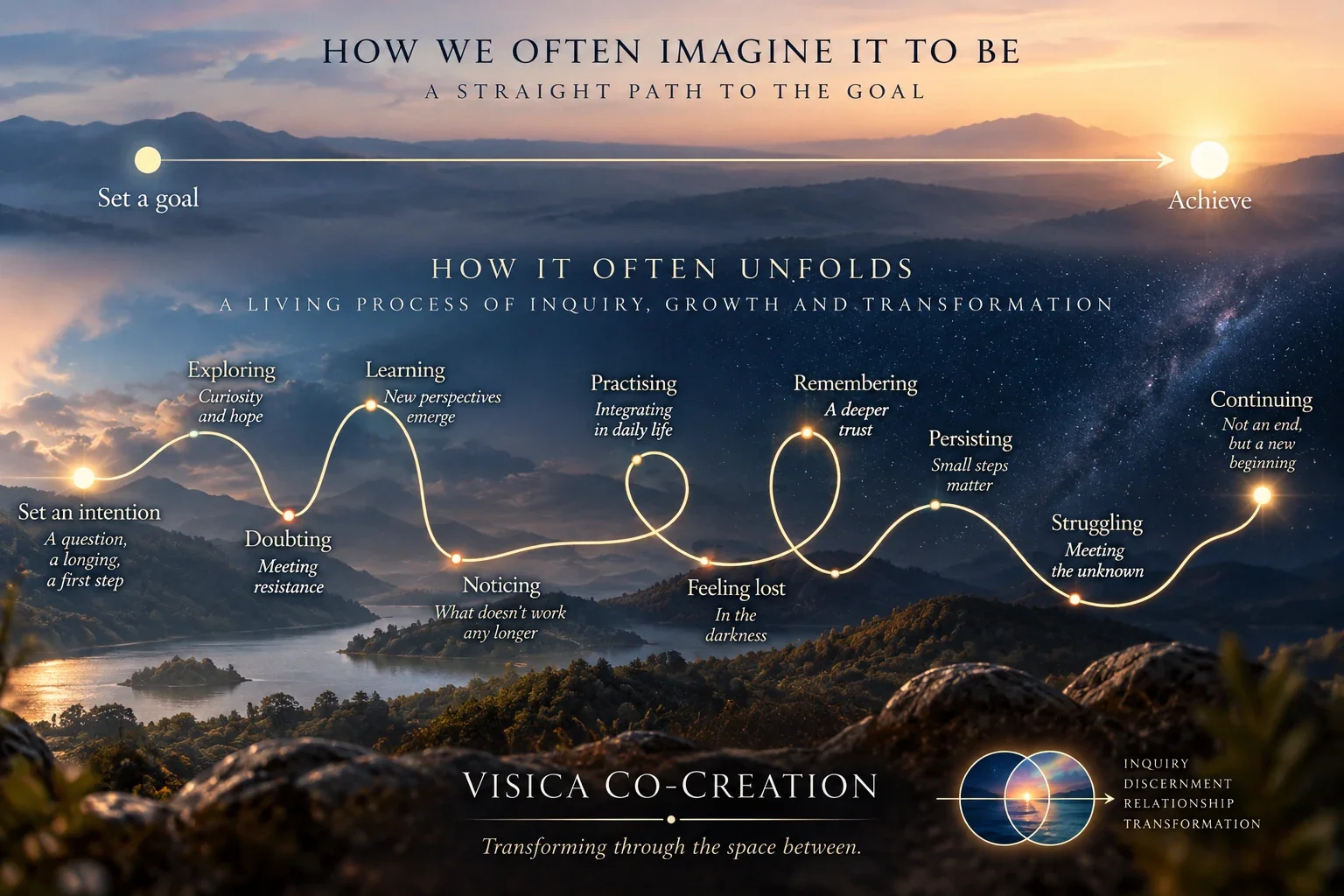
Our societies, economies, institutions, and technologies are shaped by histories, values, assumptions, relationships, and decisions — some visible, others less easily recognized.
These structures can support cooperation, dignity, creativity, and belonging.
They can also preserve inequalities, conceal dependencies, or continue operating according to assumptions that are rarely questioned.
Just as an individual may become identified with a familiar interpretation, institutions may become attached to established ways of understanding and organizing reality.
What once provided guidance may become restrictive.
What once served a meaningful purpose may continue long after the circumstances that gave rise to it have changed.
And what appears to be an independent structure may depend upon relationships that remain largely invisible.
Here, our inquiry into light and darkness takes another turn.
What becomes visible when we begin to examine not only the beliefs we hold, but the structures through which those beliefs are expressed and sustained?
The question is no longer only how we pray, but how we build.
How do our values become embedded in the systems we create?
Whose needs are recognized?
Whose contributions remain unseen?
And what happens when the light of established authority becomes so familiar that we no longer question the relationships upon which it depends?
Perhaps the task is not simply to create better structures, but to remain capable of inquiring into the assumptions through which we design, maintain, and transform them.
Can our systems become spaces that support life, relationship, dignity, and the possibility of renewal — rather than merely preserving their own continuation?
And can the discernment we cultivate within ourselves contribute to greater responsibility in how we organize, govern, and create together? T
hese questions open the doorway to Article 5 — Shadows of the System.
We move from exploring the light and darkness within our interpretations toward examining how those interpretations may become embedded in collective structures.
Not from an inner world separate from an outer one, but toward a deeper inquiry into the relationships between them.
With both eyes open.
“What remains unexamined within us, may find expressions in the structures we create around us.” — Barbara Keller | Visica Co-Creation
Next in the Series…
Article 5 — Shadows of the System: Light and Darkness in Societal Structures
We trace how the same archetypal dance of light and shadow moves through our collective designs — from institutions to economies — and how rediscovering the Kosmos within our systems may be the most sacred work of our time.
Continue Your Personal Inquiry
What Lights Up Your Understanding?
A Personal Guided Inquiry into Belief, Knowing, and Discernment
Accompanying Article 4 — Religions and Philosophies: Sacred Light and Holy Darkness
Throughout this article, we have explored how religious, philosophical, and contemplative traditions offer different ways of understanding light, darkness, and the unknown.
Now the invitation becomes personal.
What has shaped your understanding of life? Which beliefs, experiences, or teachings have offered you guidance?
And might some of the very things that illuminate your understanding also influence what remains unseen?
This Personal Guided Inquiry invites you to explore your own ways of knowing — with curiosity, presence, and discernment.
Not to question everything you believe, but to discover how you relate to what you believe you know.
What might become visible when you allow yourself to look again?
“May the light of understanding and the darkness of mystery walk beside you until they are known as one.” — Barbara Keller | Visica Co-Creation
Sources & Voices That Shaped This Reflection…
Different Traditions, Different Ways of Knowing
This article draws upon religious and philosophical traditions, ancient narratives, contemplative teachings, and contemporary thinkers who have explored human experience, consciousness, suffering, meaning, and the sacred.
Their understandings of light and darkness are neither identical nor necessarily compatible.
Some explore divine revelation and spiritual realization. Others examine psychological experience, symbolic meaning, ethical responsibility, or the limits of human knowledge.
Together, they have informed my continuing inquiry into how we perceive, interpret, and relate to what we encounter — particularly when familiar understandings no longer provide sufficient orientation.
My intention is not to bring these voices into agreement, but to allow their different perspectives to illuminate, question, and sometimes challenge one another.
The Visica Compass does not seek to contain these traditions. It remains open to being refined by what they reveal — and by what they may leave unexplained.
Religious, Philosophical, and Historical Sources
Christian Scriptures — The Gospel of John and the Synoptic Gospels
The Gospel of John (1:5) offers the image of light shining in darkness. Accounts of Jesus' wilderness experience and crucifixion provide different contexts for exploring testing, suffering, faith, and revelation.
These texts inform our inquiry without suggesting that Christianity assigns one meaning to darkness.
Sources: Gospel of John 1:5; Matthew 4:1–11; Mark 1:12–13; Luke 4:1–13; and the Gospel accounts of the crucifixion.
Jewish Mysticism — Isaac Luria and Lurianic Kabbalah
The sixteenth-century Kabbalistic tradition associated with Isaac Luria introduces Tzimtzum, a concept of divine contraction or withdrawal in relation to creation.
Interpretations of this teaching differ, particularly concerning divine presence and apparent absence.
Lawrence Fine's scholarship provides historical and theological context for these ideas.
Source: Lawrence Fine, Tikkun in Lurianic Kabbalah, My Jewish Learning.
Islamic and Sufi Traditions — The Qur'an and Mystical Interpretation
The Qur'anic Verse of Light (24:35) offers imagery of divine illumination, including a lamp, glass, and an olive tree.
Sufi contemplative and poetic traditions have developed varied interpretations concerning divine knowledge, love, remembrance, longing, and nearness to the divine.
These interpretations are diverse and should not be taken as representative of Islam in its entirety.
Primary source: The Qur'an, Surah An-Nur (The Light), 24:35.
Buddhist Teachings — Ignorance, Insight, and Compassion
Buddhist philosophical and contemplative traditions contribute perspectives on suffering, impermanence, ignorance, attachment, wisdom, and compassion.
They invite inquiry into how perception, attachment, and interpretation shape experience, without equating Buddhist awakening with divine revelation in other traditions.
Background reference: Stanford Encyclopedia of Philosophy — Buddha.
Hindu Traditions — Shiva, Nataraja, and Cyclical Time
The symbolism of Shiva as Nataraja, Lord of the Dance, brings together creation, preservation, dissolution, and renewal.
Hindu cosmological accounts of cyclical time provide further perspectives on change and the continuity of existence, although these teachings belong to different contexts within the wider Hindu traditions.
Their inclusion invites reflection on transformation without assuming that destruction is inherently beneficial or necessary.
Reference: The Metropolitan Museum of Art, Shiva as Lord of Dance (Nataraja).
Chinese Philosophy — Yin and Yang
Yin–yang thought explores complementary, interdependent, and changing relationships within Chinese philosophical traditions.
Its historical development provides an important example of how symbolic distinctions acquire meaning through context and interpretation.
These ideas also invite inquiry into the relationship between philosophical understandings of complementarity and the social hierarchies within which they have sometimes been interpreted.
Background reference: Stanford Encyclopedia of Philosophy, Metaphysics in Chinese Philosophy.
Ancient Egyptian Cosmology — The Amduat
The Amduat, meaning What Is in the Netherworld, describes the sun god's nightly journey through the Duat.
Its imagery offers a particular ancient Egyptian religious understanding of danger, cosmic order, continuity, and renewal.
It should not be reduced to a universal account of psychological transformation.
Reference: The Metropolitan Museum of Art, Amduat papyrus inscribed for Gautsoshen, Third Intermediate Period, approximately 1000–945 BCE.
Ancient Greek Mythology — The Homeric Hymn to Demeter
The Homeric Hymn to Demeterprovides the principal ancient textual account used here for Persephone's abduction, Demeter's resistance, the pomegranate seed, and the arrangement governing Persephone's return.
The narrative also invites our own questions about authority, consent, grief, agency, and the relationships upon which established power depends.
These questions belong to the Visica Compass interpretation rather than being presented as conclusions of the ancient text itself.
Primary source: Homeric Hymn to Demeter, translated by Gregory Nagy, Center for Hellenic Studies, Harvard University.
K'iche' Maya Traditions — The Popol Wuj
The Popol Wujpreserves K'iche' Maya narratives of creation, the emergence of human beings from maize, and the Hero Twins' encounters with the underworld.
Its account of the first humans' extraordinary vision and the subsequent limitation of their sight informs our inquiry into perception, knowledge, and authority.
The questions raised through the Visica Compass remain our interpretive reflections, not meanings automatically attributed to the original storytellers.
Source: Allen J. Christenson, translator, Popol Vuh: The Sacred Book of the Maya, University of Oklahoma Press, 2007.
Mexica Traditions — The Five Suns
Mexica accounts of successive cosmic eras offer perspectives on time, divine action, destruction, renewal, and the maintenance of cosmic order.
These narratives are considered separately from K'iche' Maya traditions, preserving their distinct historical and cultural contexts.
Reference: Instituto Nacional de Antropología e Historia (INAH), Piedra del Sol, and its representation of the Five Suns.
_ _Historical Voices — Spiritual Authority and the Questioning of Hierarchy
Hildegard of Bingen — Christian Mysticism
Hildegard of Bingen (1098–1179), Benedictine abbess, composer, visionary, and writer, exercised significant intellectual and spiritual authority within medieval Christianity. Her life and writings illustrate the possibilities and limitations of women's religious leadership within the institutions of her time.
Reference: Barbara Newman, Sister of Wisdom: St. Hildegard's Theology of the Feminine.
Guru Nanak — Sikh Tradition
Guru Nanak (1469–1539), founder of the Sikh tradition, challenged inherited social hierarchies and affirmed the dignity of women. His teachings provide an example of spiritual perspectives that question gender-based devaluation.
Primary source: Guru Granth Sahib, Ang 473, Asa Ki Var.
Mahāpajāpatī Gotamī — Buddhism
Traditionally recognized as the first Buddhist nun, Mahāpajāpatī Gotamī occupies an important place in Buddhist accounts of women's ordination. The narratives also reveal tensions surrounding women's institutional participation, and their historical development remains a subject of scholarly discussion.
Primary source: Vinaya Piṭaka, Cullavagga X (Bhikkhunī Khandhaka).
Rābiʿa al-ʿAdawiyya — Islamic Mysticism
Rābiʿa al-ʿAdawiyya, remembered as an influential early Muslim mystic, is associated with devotion motivated by divine love rather than fear of punishment or expectation of reward. Many accounts of her life and teachings were preserved by later writers, making historical caution important.
Reference: Margaret Smith, Rābiʿa the Mystic and Her Fellow-Saints in Islām.
Contemporary Voices — Psychology, Consciousness, and Inquiry
A. H. Almaas — The Diamond Approach
Through his exploration of inquiry, Being, essential qualities, and spiritual realization, Almaas has profoundly influenced my understanding of presence and direct contact with experience.
His descriptions of luminous blackness and the Luminous Night have informed my inquiry into sacred darkness, while his work on the Enneagram and ego structures contributes another perspective on identification, knowing, and transformation.
Relevant works: The Inner Journey Home; Facets of Unity: The Enneagram of Holy Ideas; Spacecruiser Inquiry.
Ken Wilber — Integral Philosophy
Wilber's distinction between cosmosand Kosmosoffers a language for approaching reality through physical, interior, cultural, and other dimensions.
His Integral approach also distinguishes gross, subtle, causal, and nondual states of consciousness.
His work has influenced how I bring different perspectives into relationship without assuming that any single perspective contains the whole.
Relevant works: Sex, Ecology, Spirituality; Integral Spirituality.
Clarissa Pinkola Estés — Women Who Run With the Wolves
Estés explores traditional stories as symbolic expressions of psychological experience.
Through tales such as The Handless Maiden, she examines loss, instinct, vulnerability, endurance, and the recovery of capacities that may have been silenced or forgotten.
Her work informs this article's exploration of descent as a possible symbolic language of transformation, without suggesting that suffering necessarily leads to renewal.
Source: Clarissa Pinkola Estés, Women Who Run With the Wolves: Myths and Stories of the Wild Woman Archetype.
Richard C. Schwartz — Internal Family Systems (IFS)
Schwartz developed Internal Family Systems as a psychological approach to understanding inner parts, protective strategies, and painful experiences.
IFS contributes to our inquiry into the difference between judging a psychological pattern and becoming curious about the fears, intentions, and experiences associated with it.
Relevant works: Internal Family Systems Therapy; No Bad Parts.
The Enneagram — Personality, Identification, and Essential Qualities
The Enneagram, particularly as explored within the Diamond Approach, contributes perspectives on recurring personality patterns, ego fixations, and the relationship between identification and essential qualities.
It is included as an interpretive framework rather than a scientifically established classification of personality.
Relevant source: A. H. Almaas, Facets of Unity: The Enneagram of Holy Ideas.
Karl-Erik Edris — Vart är världen på väg?
Edris explores contemporary civilization, its underlying assumptions, and the possibility of profound changes in values, mentality, and our understanding of progress.
His work informs my inquiry into how periods of collective uncertainty may invite reconsideration of inherited ideas about development, meaning, and responsibility.
This is not a claim that crisis necessarily produces transformation, but an invitation to examine what our existing perspectives may have left unrecognized.
Source: Karl-Erik Edris, Vart är världen på väg?, Edris Idé AB.
Closing Reflection — Sources & Voices
These voices do not offer a single explanation of light and darkness.
What they offer are different ways of approaching experience, meaning, knowledge, suffering, and mystery.
Some perspectives may resonate. Others may challenge one another or reveal assumptions we had not previously recognized.
Perhaps this, too, is part of looking with both eyes open.
Not to find one interpretation that explains everything, but to remain willing to discover what becomes visible when different ways of knowing enter into relationship.
Continue the Inquiry — A Conversation Still Unfolding
Perhaps something in this article has awakened a memory, challenged a familiar belief, or invited you to look again at an experience you thought you understood. Perhaps you discovered a perspective that resonates with your own — or one that raises new questions.
What became visible for you?
Was there a particular understanding of light or darkness that surprised you?
Or a moment when you recognized how your own beliefs, experiences, or interpretations shape what you see?
I warmly invite you to share your reflections, questions, or different perspectives in the comments below.
Not to determine who holds the final truth, nor to require agreement, but to continue learning through inquiry, dialogue, and discernment.
For the Visica Compass is not a destination we reach, but an inquiry we continue — together, with both eyes open.
Stay in contact. Remain curious. Allow the conversation to unfold →
— Visica Co-Creation