Article 2 — The Spark in the Dark —Light and Darkness from Conception to Cosmos
© By Barbara Keller | Visica Co-Creation
This article draws from The Visica Compass — Navigating Why Light and Darkness Matter in a Time of Massive Transformation — a framework integrating inner work, systemic insight, and symbolic intelligence.
The Journey of Inquiry So Far…
Introduction, The Visica Compass — An Invitation to Inquiry
The journey opened by introducing The Visica Compass as an invitation into inquiry rather than certainty. It proposed that light and darkness are not fixed opposites but relational forces through which transformation unfolds. By exploring the relationship between cosmos and Kosmos, symbolic and scientific ways of knowing, and the practice of seeing with both eyes open, the introduction laid the foundation for a different way of perceiving — one that invites us to pause before we conclude, and to discover wholeness and relationship where modern culture often sees separation.
Prelude, The Sound of Presence — Before the Word, There Was Resonance
We began before words and forms — in the field of vibration itself — the hum of existence. Science explores the primordial vibrations and waves of the early universe; wisdom traditions have long spoken of creation through sound, vibration, or the voice of Being.
Within the symbolic language of this inquiry, presence can be imagined as emerging from that resonance — the silent grammar beneath all language and light. Every act of transformation begins in this resonance, not in reaction.
Article 1, The Language of Light and Darkness — How Words Shape What We See
We turned our attention to the subtle force shaping how we perceive and understand the world — language. We looked at the question: “What if our very understanding of light and darkness is shaped by the language we use to speak of them?” We explored how reclaiming symbolic, soulful, and precise language — especially in the inner world — can help us see the sacredness of both light and darkness with new eyes.
Before we continue, a brief reminder:
Words like light and darkness carry many meanings. In this article, we step into the first of the darknesses named earlier — cosmic darkness, approached here not as a single scientific phenomenon, but as a symbolic expression of primordial mystery — the fertile field within which physical light, energy, matter, life, and sparks of creation arise.
This darkness is not shadow or wound; it is origin, depth, and possibility — darkness as womb rather than danger or absence.
A brief note on light:
In this article, “light” refers primarily to physical light — photons and the radiance of stars — alongside observable phenomena associated with the emergence of life, such as the zinc spark at fertilization.
Later in the series, we will explore perceptual light, mythic light, and essential light — but here we stay with observable phenomena and allow their symbolic meaning to unfold alongside them.
Here, light does not arrive to expose or judge the dark, but to reveal what has been quietly forming within it.
How Creation, Consciousness, and the Universe Illuminate Our Journey Through Transformation
In a time of massive transformation — technological, ecological, spiritual — we find ourselves called to revisit the timeless metaphors of light and darkness.
Not as opposites to be judged or ranked, but as relational forces through which we can inquire into a larger intelligence — inviting discernment rather than division, and what we might describe, drawing on A.H. Almaas’s work, as a movement from judgment toward seeing through the heart.
Cosmos
“What if the sparks we encounter — in the emergence of life, in stars igniting across the universe, and in moments of insight in our own minds — reveal something about the mystery of becoming?”
Across these different realms, we find a sacred enclosure — the womb of love — where opposites meet and new form is conceived. Darkness here is not emptiness, but a tender holding. It is love’s atmosphere — spacious enough to cradle the spark before it becomes visible.
We tend to think of light as the beginning, the arrival, the breakthrough. But light always emerges from the darkness. In the realms of biology, cosmology, and consciousness, we see a repeating pattern: the spark in the dark.
This pattern is not only symbolic. It draws our attention to real, observable processes in biology and cosmology — and invites us to explore their deeper resonance in a time of massive transformation.
What if these different sparks — biological, cosmic, and within our own awareness — invite us to inquire into something deeper: the universe remembering itself? Could this be another way of approaching what A.H. Almaas describes as Nous — essential intelligent light?
1. The First Light: Conception and the Zinc Spark
At the beginning of mammalian development, something remarkable occurs. As the egg is activated, it releases zinc in a series of rapid bursts known as zinc sparks. Scientists have made these normally invisible events visible through fluorescent probes, allowing us to witness what appears under the microscope as a burst of light.The phenomenon is biological; the image it evokes is almost archetypal.
The egg holds extraordinary potential. The sperm brings movement, and their meeting initiates a cascade of transformation. Together, they enter a process through which something entirely new can begin to form.
Here science gives us an image that invites a larger inquiry:
“Darkness is not absence. It is preparation.”
And even here, science offers another intriguing image. Three-dimensional microscopy has revealed that human sperm move through a combination of asymmetric flagellar beating and rolling. Seen in two dimensions, this complex movement can create the appearance of symmetry.
As an image, this invites us to consider how life, from its very beginning, can move through creative asymmetry. What seems off-balance from one angle may reveal, from another, a remarkably coordinated movement.
Perhaps transformation, too, asks us to look again at what we too quickly name as imbalance.
The image of the spiral offers another way of exploring this. A spiral returns, yet it does not return to exactly the same place. There is repetition, but also movement. Something familiar is encountered again from another position.
Our planet, too, participates in more than one movement at once: Earth orbits the Sun while the Sun itself moves through the Milky Way. The path depends upon the perspective from which we observe it. What appears as return from one frame of reference is also movement within a larger journey.
Perhaps consciousness can move in a similar way. We may return to the same questions, patterns, losses, relationships, or thresholds — but we do not necessarily meet them from the same place.
Neuroscience gives us another piece of the inquiry. Attention shapes what we perceive, and repeated experience can contribute to changes in patterns of neural activity and connection.
What we attend to matters.
When awareness loosens its hold on judgment and opens toward discernment, possibilities that were previously obscured may become visible.
From conception to cosmos, we encounter movement, asymmetry, cycles, and return — always moving, never quite the same.
Perhaps the deeper principle is not perfect symmetry or static balance, but relationship within movement. Judgment tends to fix what we see; discernment remains curious about what is actually unfolding.
To see through the heart, then, may not mean escaping the movement, but participating in it — returning, seeing again, and discovering what has changed.
Reflective Question
Can you recall a moment in your life that felt like a “spark” of new beginning? What preceded it?
The zinc spark marks not an end; it is a threshold — part of the extraordinary cascade through which a new organism begins to develop.
Seen symbolically, the threshold invites another question: What begins to take form before it can yet be seen?
In the symbolic language of this inquiry, we might say: matter remembers its source.
As we explored in Article 1, language itself can reveal very different relationships with reality. In some Indigenous languages and worldviews, a river may be encountered not merely as an object or resource, but as a living presence — a relation within a larger web of life. What modern language may separate into subject and object, other ways of knowing may hold in relationship.
This offers another way of approaching the distinction between cosmos and Kosmos.
Ken Wilber uses the older word Kosmos to point toward a reality larger than the measurable cosmos of matter and motion — one that includes not only physical existence, but consciousness, meaning, culture, and value.
What happens to our relationship with a river when our language does not first reduce it to an object?
Seen through this symbolic lens, the zinc spark becomes more than a biological event: an image of the Kosmos whispering itself into form — spirit touching matter, love taking shape as life.
2. The Light Within: Neurons, Awareness, and the Inner Cosmos
Inside the human brain, billions of neurons communicate through intricate patterns of electrical and chemical activity. We do not see this activity as light, yet the image of illumination has long accompanied our experience of understanding: something dawns on us; we see the light; suddenly, something becomes clear.Moments of remembering, deciding, or sudden insight can therefore become the symbolic equivalent of a spark in the dark.
Some transformations also unfold away from the brightness of deliberate thought — during sleep, meditation, grief, silence, or periods of not-knowing. In the symbolic language of this inquiry, these too can be experienced as forms of darkness: places in which something may be reorganising before it becomes conscious or clear.
At times, such spaces can loosen the grip of our usual judgments and explanations. What the analytical mind could not resolve may then be encountered differently — through presence, intuition, feeling, or what we have been calling the deeper intelligence of love.
Neuroscience has begun to trace what happens during moments of sudden insight — the “Aha!” experience in which something that was not consciously available becomes suddenly clear.
Through the symbolic language of the Visica Compass, we might call this another kind of spark in the dark.
Reflective Question
When have you experienced a sudden insight “out of nowhere”? What kind of inner state were you in?
What was happening before you knew?
These inner illuminations echo ancient traditions that understood light as an expression of the divine, and darkness as sacred space.
3. The Cosmic Mirror: Star Birth and the Gravity of Darkness
In space, stars are born in immense clouds of gas and dust. Some regions become so dense that dust obscures what is happening within them at visible wavelengths.
To the human eye, they may appear dark. Yet the darkness is far from empty. Within these clouds, gravity draws matter together. A protostar begins to form, gathering mass and growing hotter until conditions eventually allow nuclear fusion to begin.
This threshold — when fusion begins and a star enters a new phase of its existence — gives us the cosmic image at the heart of this article: the spark in the dark.
Long before that threshold is reached, however, a process of becoming is already underway.
What appears dark from one way of seeing may therefore already hold movement, relationship, and transformation that our present way of seeing cannot yet reveal.
At another extreme of the cosmic landscape are black holes, whose event horizons mark a boundary beyond which not even light can escape.
What happens beyond that boundary remains inaccessible to direct observation, while the behaviour of matter, light, space, and time around black holes continues to challenge and deepen our understanding.
From a human perspective, such immensities can look like emptiness — even a kind of cosmic loneliness. Yet what appears isolated is profoundly relational: gravity shapes the movement of matter and light, while space and time themselves are affected by the presence of mass.
What appears empty, then, may not be empty at all. It may simply lie beyond what our present way of seeing can reveal.
Seen through the symbolic eye of the Visica Compass, another image emerges:
“Light and darkness are not enemies; they are lovers in eternal exchange.”
In science, darkness does not carry a single meaning. It may describe what is not visible at particular wavelengths, regions obscured by matter, or boundaries beyond which light cannot reach us.
Through a symbolic and spiritual lens, however, darkness can carry another meaning: the hidden, the unmanifest, the not-yet-visible — the fertile space from which form may emerge.
“The dark holds the memory of form before it becomes visible.”
Through the wider lens of Kosmos introduced earlier, we can ask whether the measurable cosmos — stars, galaxies, gravity, matter — belongs within a larger reality that also includes consciousness, meaning, and relationship.
Within that inquiry, darkness becomes the fertile gravity of love — drawing what is not yet visible toward form.
Reflective Questions
What area of your life is currently in a phase of contraction, uncertainty, or not-knowing?
Where in your inner universe might something be forming silently, not yet visible or ready to be named?
What changes when you allow yourself not to know what — if anything — is emerging?
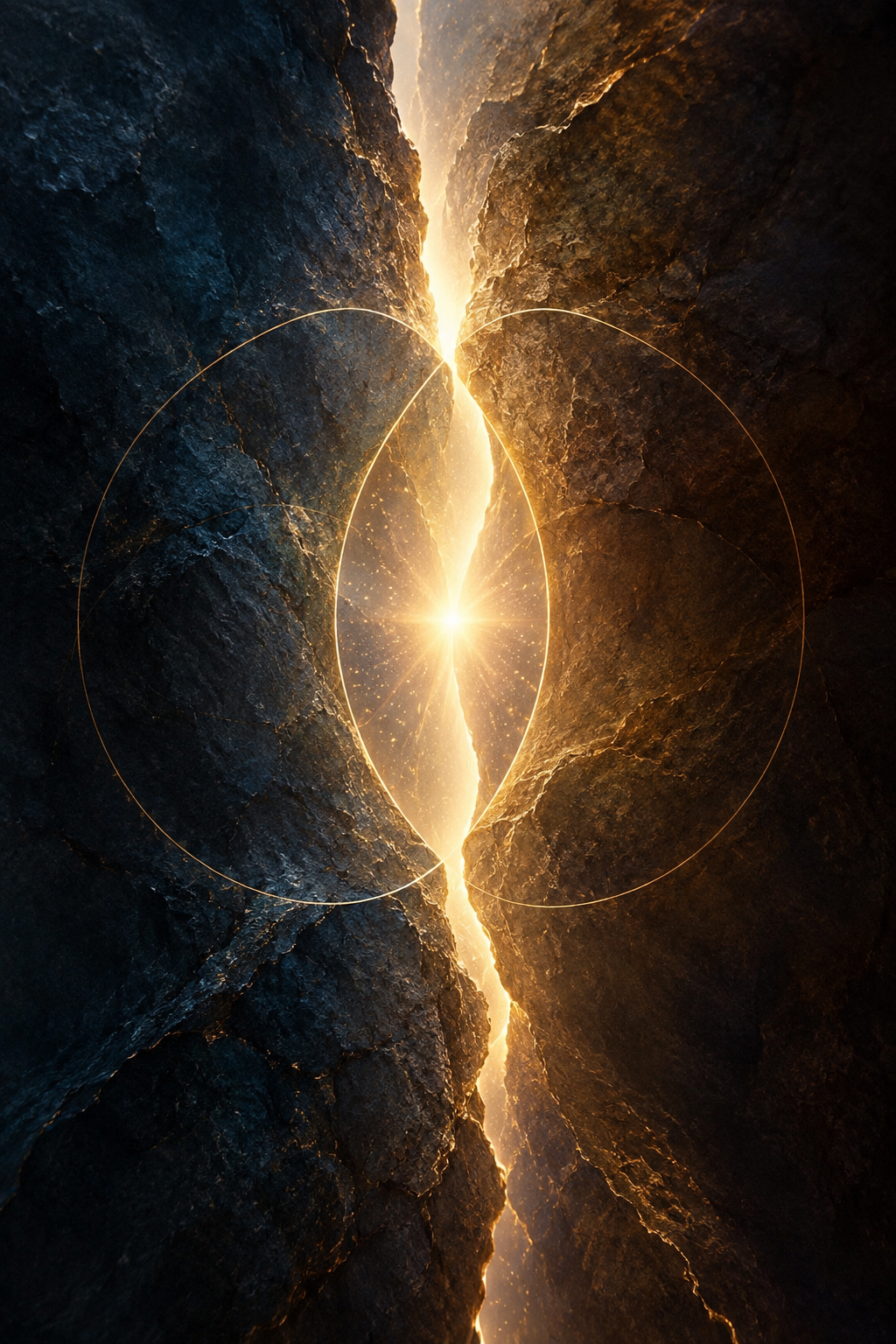
As above, so below — not as identical processes, but as resonant images of gathering, transformation, and emergence.
© Barbara Keller | Visica Co-Creation
“Darkness cannot drive out darkness: only light can do that. Hate cannot drive out hate: only love can do that.”
— Martin Luther King Jr.
4. What This Means in a Time of Massive Transformation
Seen through the Visica Compass, contraction need not immediately be understood as failure. It can become an invitation to pause, enter presence and discernment, and inquire into what is happening — and what, if anything, may be trying to emerge.Across our planet, societies, institutions, and individual lives, we encounter periods of contraction, disruption, and uncertainty. We are, in many ways, in the dark.
Through the symbolic lens of this inquiry, darkness can also be approached as a womb — a holding space in which what comes next may not yet be visible.
This is the womb of love — vast enough to hold our fear, judgment, fragmentation, and not-knowing without demanding that they immediately become something else. In that sense, love holds because it can remain in presence and contact, even when it does not know what happens next.
Across living systems and human experience, we encounter rhythms of opening and closing, activity and rest, expansion and contraction. Transformation does not always proceed in a straight line.
Contraction is not necessarily collapse. Nor does contraction guarantee emergence. It asks us first to attend to what is actually happening.
Ecological disruption may sometimes be followed by regeneration — and sometimes by irreversible loss.
Institutional breakdown may create conditions for wiser systems — but it can also deepen fragmentation.
Personal confusion may open into deeper insight — or may simply need time, support, and care.
The movement is not predetermined.
Perhaps this is where the image of the spark in the dark becomes most relevant. The spark is not something we need to manufacture, nor something we can assume will appear. We can learn instead to remain present to what is here, discern what is actually unfolding, and create enough space for what is not yet known.
Reflective Question
Where in your life are you being drawn inward — and can you remain present there without deciding too quickly what it means or what must emerge?The spark in the dark thus becomes less a promise of what will come next than an invitation into relationship with what is not yet visible.
Closing Thought
From egg to neuron, from star to soul, we have followed a recurring image: something becoming visible where, at first, we could not yet see what was taking form.
Again and again, darkness has invited us not to assume absence simply because something remains beyond our present way of seeing.
In moments of contraction, when certainty falls away, we may not yet know whether we are encountering an ending, a beginning, or something for which we have no name. Presence does not require us to know.
Perhaps it asks something quieter: to remain in relationship with what is here long enough to discern what, if anything, is beginning to become visible.
Here darkness is not the enemy of light. Through the symbolic eye of the Visica Compass, it can become its cradle.
Long before I knew of zinc sparks or star-forming clouds, I encountered something of this mystery in snow — sunlight scattering through frozen water, revealing colours that appear only through the meeting of light and matter.
My father, a brilliant linguist and creative thinker, loved to play with the hidden possibilities within words. He once invited me to hear the word human differently: Hu as breath or light, and man as our earthly nature.
It was not a lesson in literal etymology. It was the kind of linguistic doorway he loved to open.
And yet the historical roots offer their own beautiful resonance. The word human belongs to an ancient family of words associated with earth and the earthly being — related to the same deep linguistic root from which humus, soil, also emerges.
Perhaps to be human is precisely to inhabit this meeting place: light and matter, meaning and earth, mystery and form.
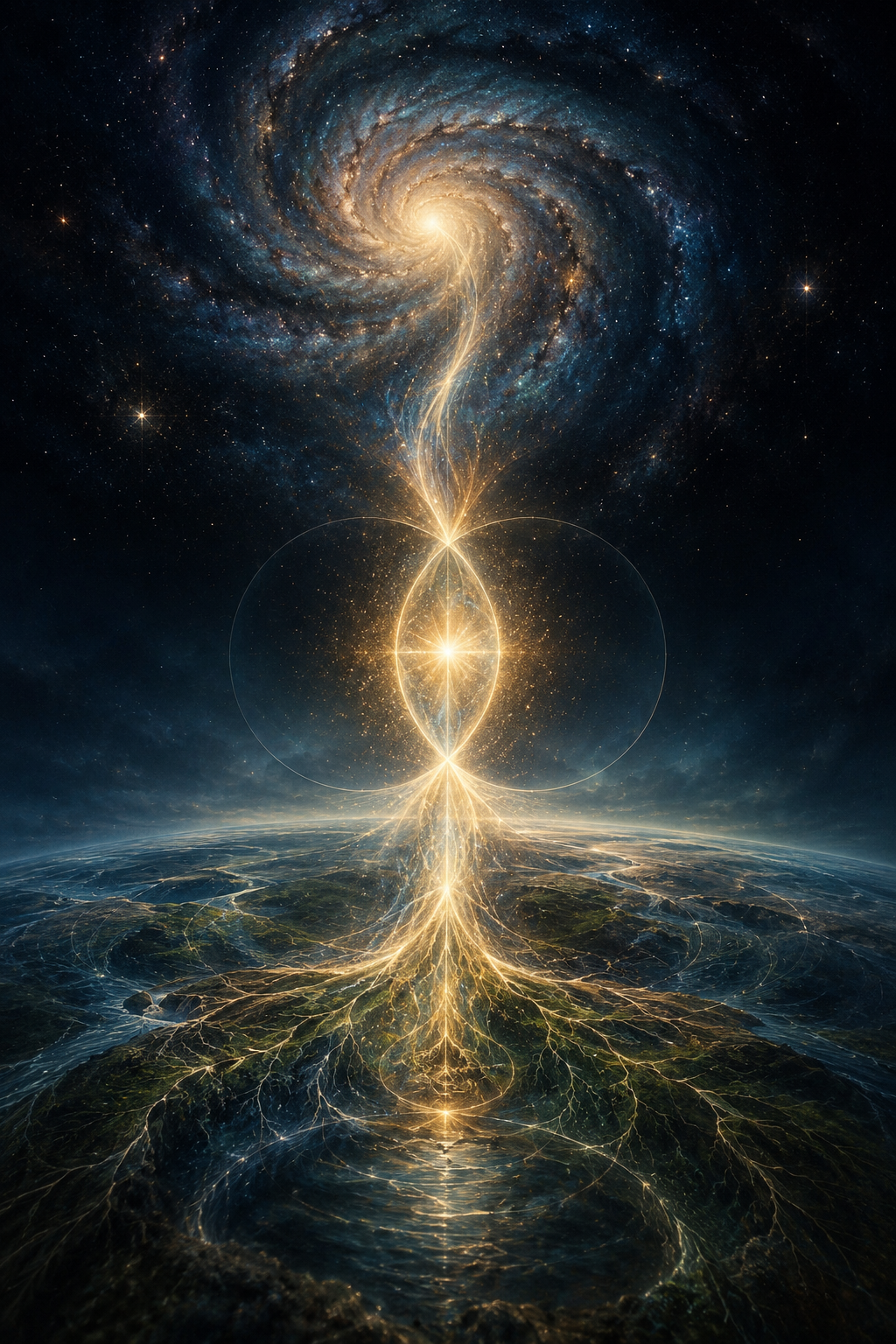
To witness light bending through matter — and to feel love awaken in the space between.
© Barbara Keller | Visica Co-Creation
“We are not separate from light and darkness; we are their meeting place.”
— Barbara Keller | Visica Co-Creation
Continue the Inquiry
The Spark Before You Know
Personal Guided Inquiry for Article 2 — The Spark in the Dark
Would you like to explore where this inquiry meets your own life?
Turn the other eye inward.
A short personal inquiry into uncertainty, contraction, discernment, and what may — or may not yet — be becoming visible.
Explore The Spark Before You Know →
Next in the series is…
Article 3: The Mythic Eye — Myths of Light-Bearers and Shadow-Walkers
With Article 2, we explored the image of the spark in the dark through biology, consciousness, and the cosmos.
Now we enter the second circle of the Visica Compass: the realm of story and symbolic intelligence.
In Article 3, we turn to myths, archetypes, and ancient stories through which cultures across time have explored light and darkness — long before modern science gave us the language of photons, neural activity, or star formation.
Here, the inner and outer worlds begin to overlap.

© Barbara Keller | Visica Co-Creation
“The universe is not a collection of objects, but a communion of subjects.”
— Thomas Berry
Sources & Voices That Shaped This Reflection…
This article draws from a constellation of thinkers who explore creation, consciousness, transformation, and meaning across science, psychology, philosophy, spirituality, and cosmology.
Their perspectives do not speak with one voice; they offer different lenses through which the relationship between light, darkness, emergence, and transformation can be explored.
Brian Swimme & Thomas Berry, in The Universe Story, present cosmic evolution as an unfolding story of emergence and relationship rather than solely as a mechanical account. Their work offers a cosmological perspective that resonates with this article’s inquiry into creation, transformation, and our participation in a larger unfolding universe.
Carl Gustav Jung, particularly in Psychology and Alchemy, explores psychological transformation through the symbolism of alchemy. His work offers a psychological lens through which images of darkness, illumination, dissolution, and emergence can be approached as dimensions of inner transformation.
A.H. Almaas, particularly in The Inner Journey Home, informs the inner dimension of this inquiry through his exploration of essence, presence, knowing, and the multidimensional nature of human experience. His work offers one of the contemplative lenses through which this article approaches essential light, darkness, and not-knowing.
Matthew Fox, through Original Blessing, explores darkness, silence, suffering, letting go, and letting be through what he calls the Via Negativa — one of the four paths of Creation Spirituality. His work offers a spiritual lens through which mystery and not-knowing can be approached not simply as absence or failure, but as dimensions of a larger movement of creation and transformation.
Marija Gimbutas, in The Language of the Goddess, explores symbolic imagery associated with birth, death, regeneration, earth, and the feminine in prehistoric European cultures. Her interpretations offer one lens through which the article’s imagery of darkness, womb, and emergence can be considered.
Fritjof Capra, especially in The Tao of Physics, explores parallels between concepts in modern physics and insights from Eastern philosophical and contemplative traditions. His work offers a useful reference point for this article’s movement between scientific description and symbolic or relational ways of understanding reality.
James Lovelock, through the Gaia hypothesis, proposed that living organisms and their inorganic environment interact as a complex, self-regulating system. His work contributes a planetary and systemic perspective to the article’s exploration of relationship, interdependence, and life.
Helena Blavatsky, in The Secret Doctrine, represents an esoteric cosmological tradition in which light and darkness appear as primordial dimensions of manifestation. While her cosmology is not science in the modern empirical sense, it offers one historical example of humanity’s attempts to understand emergence across visible and invisible realms.
Ken Wilber, particularly in Sex, Ecology, Spirituality, deliberately uses Kosmos to refer to a reality encompassing more than the physical cosmos — including life, mind, culture, meaning, and spiritual dimensions. His integral framing provides one way of holding these domains within a larger field without reducing one to another.
Together, these voices do not offer a single explanation. They form a field of perspectives through which this inquiry moves — scientific, psychological, philosophical, spiritual, and symbolic.
The spark in the dark is the image that brings them into conversation: not as identical processes, but as different ways of exploring what may be happening before something becomes visible, known, or able to take form.
Next in the series is…
Article 3: The Mythic Eye — Myths of Light-Bearers and Shadow-Walkers
With Article 2, we explored the image of the spark in the dark through biology, consciousness, and the cosmos.
Now we enter the second circle of the Visica Compass: the realm of story and symbolic intelligence.
In Article 3, we turn to myths, archetypes, and ancient stories through which cultures across time have explored light and darkness — long before modern science gave us the language of photons, neural activity, or star formation.
Here, the inner and outer worlds begin to overlap.
Continue the Conversation
This inquiry does not end with the article.
Perhaps something here opened a question, challenged an assumption, or brought you into contact with something you had not noticed before.
What stayed with you? What became visible — or perhaps remains unresolved?
You are warmly invited to leave a reflection or question in the comments below. The Visica Compass grows through inquiry, relationship, and the perspectives we bring into contact with one another.
Your voice is welcome here. Stay Connected →