Article 1 in the series: The Language of Light and Darkness — How Words Shape What We See. From scientific Metaphor to Mythic Meaning: The Grammar of Transformation.
© By Barbara Keller | Visica Co-Creation
This article draws from “The Visica Compass – Navigating Why Light and Darkness Matter in a Time of Massive Transformation,” a framework integrating inner work, systemic insight, and symbolic intelligence.
The Journey of Inquiry so Far…
Introduction, The Visica Compass — An Invitation to Inquiry
The journey then opened by introducing The Visica Compass as a framework for transformation in which inquiry becomes a way of seeing more clearly what is present, including what may not yet be visible. It proposed that light and darkness are not fixed opposites but relational forces through which transformation unfolds.
By exploring the relationship between cosmos and Kosmos, symbolic and scientific ways of knowing, and the practice of seeing with both eyes open, the introduction laid the foundation for a different way of perceiving—one that invites us to pause before we conclude, and to discover wholeness and relationship where modern culture often sees separation.
Prelude, The Sound of Presence — Before the Word, There Was Resonance
We began before words and forms—in the field of vibration itself, the hum of existence. Science speaks of primordial waves; wisdom traditions speak of the voice of Being. From that first resonance, presence emerged—the silent grammar beneath language and light. Every act of transformation begins not in reaction, but in resonance.
And every inquiry begins somewhere. It begins with the words through which we perceive the world.
The Spiral Begins — Why Light and Darkness Matter
What if our understanding of light and darkness is not just a matter of insight — but of syntax, metaphor, and cultural inheritance?
We often think of language as a tool to describe reality. But what if language also builds it — shaping what we can perceive, feel, or even imagine? The words we choose form the lenses through which we see the world; they reveal what our culture allows to be illuminated and what it insists must remain unseen.
Language can therefore reveal — but it can also conceal. Within the Visica Compass, inquiry invites us to listen beneath the familiar meanings of words and to become curious about what may have disappeared from view. Hidden assumptions, inherited beliefs, forgotten knowledge, expectations and teachings from the past may reveal relationships — including our relationship with ourselves, others and our environment we live in — that have slipped from awareness, yet still carry information necessary for transformation.
Some of what we need in order to move forward may therefore reside precisely where we have learned not to look — in what has been placed in the dark. Bringing this information into the light does not mean leaving the darkness, or the past, behind. It allows us to discern what needs to be remembered, what needs to be questioned, and what can be integrated into what is still becoming.
This article invites a reflection on how language creates worlds — from scientific terms to Indigenous grammars, from inner thought to collective myth. The language we use is never neutral. In a time of massive transformation, reclaiming the symbolic power of language may be one of our most urgent tasks.
And perhaps language itself is wider than we have learned to imagine.
Human words are only one way in which information passes between living beings. Whales communicate through intricate patterns of sound. Animals call, signal, warn, court, and orient through frequencies and forms of communication very different from our own. Plants and trees, once regarded as largely silent, are now known to emit acoustic signals — including frequencies beyond the range of human hearing — and to respond to sound and vibration. Science is only beginning to explore what these signals mean and what role they may play within the relationships of living systems.
Long before I knew of this research, I had experiences in forests in which I seemed to sense which tree a particular high-pitched sound or vibration was coming from. The Indigenous people I was with playfully called me the “tree whisperer.” When I approached the tree that I sensed the sound was coming from, its frequency changed, and the sound in my ears stopped. I did not know what this meant then, and I do not claim to know now. But the experience stayed with me.
Perhaps part of inquiry is learning not to reduce language too quickly to human words — but to remain curious about the many ways information, signal, resonance, and relationship move through the living world.
Language can be understood as emerging from relationship — from the human impulse to give expression to what is experienced within us and between ourselves, each other, and the world. At its deepest, language can become a bridge: a way of making contact across difference and giving form to what might otherwise remain unseen.
When language loses contact with relationship, it can harden into judgment and separation. When relationship is remembered, language can become a way of restoring contact.
“Even the elements seem to listen. The tone of our words leaves patterns in the fabric of matter — a quiet reminder that symbolically, language is never without consequences.”
This sensitivity to sound, vibration, signal, and meaning prepares us for the inquiry ahead — how words not only reflect but refract the light they carry. And few words bend meaning as powerfully as “light” and “darkness.”
A First Glimpse: The Many Darknesses We Will Meet
Before we go further, it may help to notice that even the word darkness carries many meanings.
Throughout this inquiry, we will encounter darkness in different forms and contexts, each with its own tone and meaning:
Cosmic darkness — the primordial mystery before the first light, the unmanifest field out of which the universe emerges.
Sacred darkness — the fertile, gestational depth, the womb of transformation where new qualities of being are born.
Existential darkness — the loneliness and aloneness that arise with self-awareness, the felt gap between “me” and the world.
Wounded darkness — the unprocessed pain, fear, and fragmentation we carry when experience overwhelms us.
Shadow darkness — aspects of ourselves and our cultures that have been repressed, rejected, excluded, or left unseen. What enters the shadow is not necessarily harmful or unwanted; it may also contain qualities, knowledge, capacities, and ways of relating that could not find a place within what was accepted or understood at the time. Inquiry allows us to meet what has been placed there and discern what it may still have to teach us.
Language often flattens these very different experiences into a single word: dark.
Part of our journey will be learning to listen more precisely — to sense which darkness we are encountering, what information it may hold, and what it asks of us.
A First Glimpse: The Many Lights We Will Meet
Just as the word darkness carries many meanings, so does light.
Throughout this series, light will appear in different registers — physical, perceptual, psychological, symbolic, and spiritual. Each reveals a different way of seeing:
Physical light — the photons of science, the measurable radiance of the cosmos.
Perceptual light — the clarity that arises through attention, awareness, and the brain’s creation of contrast.
Mythic light — the light of revelation, insight, and the archetypal light-bringers of story.
Essential light — the inner luminosity described by mystics and by A.H. Almaas, the radiant qualities of essence such as Brilliancy, Strength, and Compassion.
Moral or ethical light — the light we confuse with “goodness,” often weaponized through judgment or purity narratives.
Creative light — the generative spark at the heart of the Visica, where light bends into colour and new forms emerge.
Language often collapses these different meanings into a single idea — light as clarity, goodness, or truth.
But each kind of light has its own grammar. Part of our inquiry will be learning to discern which light we are encountering, what it reveals — and what it may obscure.
In the articles ahead, we will return to these different lights and darknesses as they unfold through cosmos and Kosmos, psyche, nature, myth, relationship and society.
1. The Grammar of Judgment — From Condemnation to Discernment
When power believes itself pure, judgment can become its instrument. Across history, religious, scientific, political, and cultural authorities have at times claimed the light while placing what they feared, rejected, or did not understand in the dark. We inherit traces of these histories whenever we instinctively equate light with good and darkness with evil.
There is an important distinction between judgment and discernment.
The first — egoic judgment — is the language of validation and condemnation. It measures, compares, and divides, often seeking safety through certainty or superiority. In psychological terms, we can recognize something of the voice of the superego, described by A.H. Almaas¹ as an internalized authority that judges what is acceptable or unacceptable in ourselves. It can secure its view of reality by declaring one side right and the other wrong.
Discernment, by contrast, is the capacity to distinguish without necessarily dividing. Almaas describes the Diamond Guidance¹ as an inner guidance for inquiry; Ken Wilber² distinguishes differentiation from dissociation; and Carl Jung³ explored the importance of holding the tension of opposites.
Discernment, as we use it here, begins as a perceptual capacity — a willingness to see more clearly before deciding what something means. Simone Weil⁴ captured something of this quality in her understanding of attention: “Attention, taken to its highest degree, is the same thing as prayer.” Discernment asks for precisely this kind of attention — presence capable of perceiving nuance without immediately reducing what it encounters to what is already known.
When language hardens around egoic judgment, it can become “sinical” — half cynical, half sanctified. It may appear to protect us from darkness while preventing us from inquiring into what the darkness contains. What is prematurely labelled dangerous, wrong, inferior, or unacceptable can be pushed out of sight before we have understood it.
The meanings and judgments carried by language do not remain within the individual. They move through relationships, families, institutions, and cultures, shaping what can be spoken about, questioned, accepted — and sometimes even seen. When these meanings become accepted as certainty, we may stop asking where they came from, whose experience they reflect, or what they leave outside the frame.
And this is precisely where children can surprise us.
They have not yet inherited all the meanings, judgments, and assumptions adults attach to words. They ask why. They question what we have learned to take for granted. And when an answer does not really answer the question, they may simply ask again.
Research into children's questioning suggests that this persistence is not merely conversational. Children actively use questions to seek missing information, responding differently when adults offer genuine explanations than when they do not. Their curiosity can therefore expose something adults no longer notice: the assumptions hidden inside the language we use.
Perhaps this is one of the gifts children offer us — an invitation back into discernment. A seemingly simple question can interrupt certainty long enough for us to hear our own words again:
What do I actually mean when I say that?
Why do I call this good and that bad?
Where did I learn that?
Is it true?
And perhaps equally important: What happens when a child's question is not met?
Inquiry needs relationship. Curiosity can be encouraged, but it can also be silenced. When a question is dismissed, ridiculed, or repeatedly left unanswered, something more than information may be lost: the willingness to keep asking.
Perhaps children also remind us of something we may need to re-member: the capacity to remain with not-knowing, to question what does not make sense, and to keep asking before we learn which questions are acceptable to ask.
“Discernment restores the courage to stay with the unknown — to see before we decide.”
When language opens into discernment, it invites inquiry rather than immediate conclusion. We can stay with what we encounter, listen rather than label, and sense what lives there without either glorifying or condemning it. Presence allows us to inquire into our fear, assumptions, expectations and judgments — and into the relationships they may reveal.
To speak differently is already to see differently.
This is where the inquiry deepens. Throughout this series, we will explore how the movement from judgment toward discernment changes what becomes visible — from science to story, from psyche to society. Illumination, then, need not mean the conquest of darkness. It may arise through remaining in contact long enough for what was hidden, overlooked, or not yet understood to become visible.
Reflective question:
What happens in your own perception when you notice the impulse to judge and become curious about what the judgment itself might reveal?
2. Love as the Womb of Seeing
True discernment arises only where Love holds the field.
Love, as we use it here, is not sentiment but a capacity to hold what is present — to stay with our experience without immediately judging, rejecting, explaining, or trying to change it. Holding asks us to remain grounded, present, and in contact long enough to notice what is here and what may want to emerge.
This is the womb of transformation: not a place where differences disappear into one another, but where difference can remain in contact without becoming separation. In the Visica Compass, the overlapping circles symbolize this space-between — a field of contact and relationship in which inquiry becomes possible and something new may emerge.
Love does not take sides; it reveals relationship. Where judgment seeks certainty or purity, Love allows us to remain with complexity. Through this holding field, discernment can deepen: we may begin to recognize intelligence within shadow, limits within brilliance, and possibilities that could not become visible while one side had to defeat the other.
3. Kosmos vs Cosmos — The Depth Dimension of Language
In A Theory of Everything, Ken Wilber refers to the beautiful Greek word Kosmos, noting that it encompasses the patterned whole of all existence — including the physical, emotional, mental and spiritual realms. He uses Kosmos to point toward a meaning of “everything” broader than the material cosmos alone.
Scientific language has given us extraordinary precision in describing and investigating the physical cosmos. Yet not every dimension of human experience can be expressed through the same grammar. Our inner lives also speak through sensation, emotion, image, metaphor, relationship, symbol, and meaning.
The difficulty begins not when we use one of these languages, but when one language becomes the measure of everything else.
To reclaim a fuller grammar of seeing, we need not choose between cosmos and Kosmos. We can learn to hold different ways of knowing in contact: the measurable and the experienced, precision and meaning, the clarity of what can be illuminated and the mystery of what remains unknown.
Wilber's distinction restores depth to the word everything. It also raises a question central to this inquiry:
What becomes visible — and what disappears from view — when one way of speaking about reality becomes the only language through which we are willing to know it?
In the Visica Compass, transformation does not ask us to move from cosmos to Kosmos, but to widen the field in which both can remain in relationship.
Perhaps the deeper grammar of transformation lies not in choosing between them, but in what becomes possible when different ways of knowing remain in contact.
“In the Visica Compass, the movement from judgment to discernment, from separation toward relationship, traces the same curve of light bending through love — the hidden geometry of transformation.”
4. The Metaphors We Live By — and Cannot See
If language shapes what becomes visible, metaphor may be one of its most powerful — and least noticed — instruments.
In Metaphors We Live By, Lakoff and Johnson show how metaphors are not merely decorative expressions. They help structure how we think, perceive, and make sense of experience.
We speak of enlightenment, a bright idea, a dark past, shed light on a problem, or being left in the dark. Repeated often enough, these metaphors can become perceptual grooves we no longer notice. Light quietly becomes associated with knowledge, clarity, safety and goodness; darkness with ignorance, uncertainty, danger, and what should remain hidden.
But what happens when metaphor becomes so familiar that we forget it is a metaphor?
Inquiry allows us to pause inside language itself. Rather than immediately accepting the meanings carried by a word, we can ask:
What relationship does this metaphor create? What does it illuminate? What does it place in shadow? And what might become visible if we loosen its hold for a moment?
Poetic and symbolic language can help us do precisely this. Clarissa Pinkola Estés, Carl Jung, and A.H. Almaas, in different ways, invite attention to forms of language that do not merely define experience but open it — allowing image, symbol, felt experience, and meanings not yet fully formed to enter awareness.
To name something can bring it into view. But naming can also fix it too quickly.
Someone says “I am anxious.” The word can be useful — it gives something a name. But if we stop there, “anxiety” can become the conclusion instead of the beginning of inquiry.
What does anxiety mean in this person, this body, this moment, this relationship? Fear? Excitement? Grief? Anger? A boundary? An expectation? Something remembered? Something anticipated?
Suddenly language becomes a doorway rather than a label.
Perhaps symbolic fluency asks for both: the capacity to name what we encounter and the willingness to remain curious about what our naming may still leave unseen.
5. Chomsky’s Deep Structures — The Unseen Grammar of Meaning
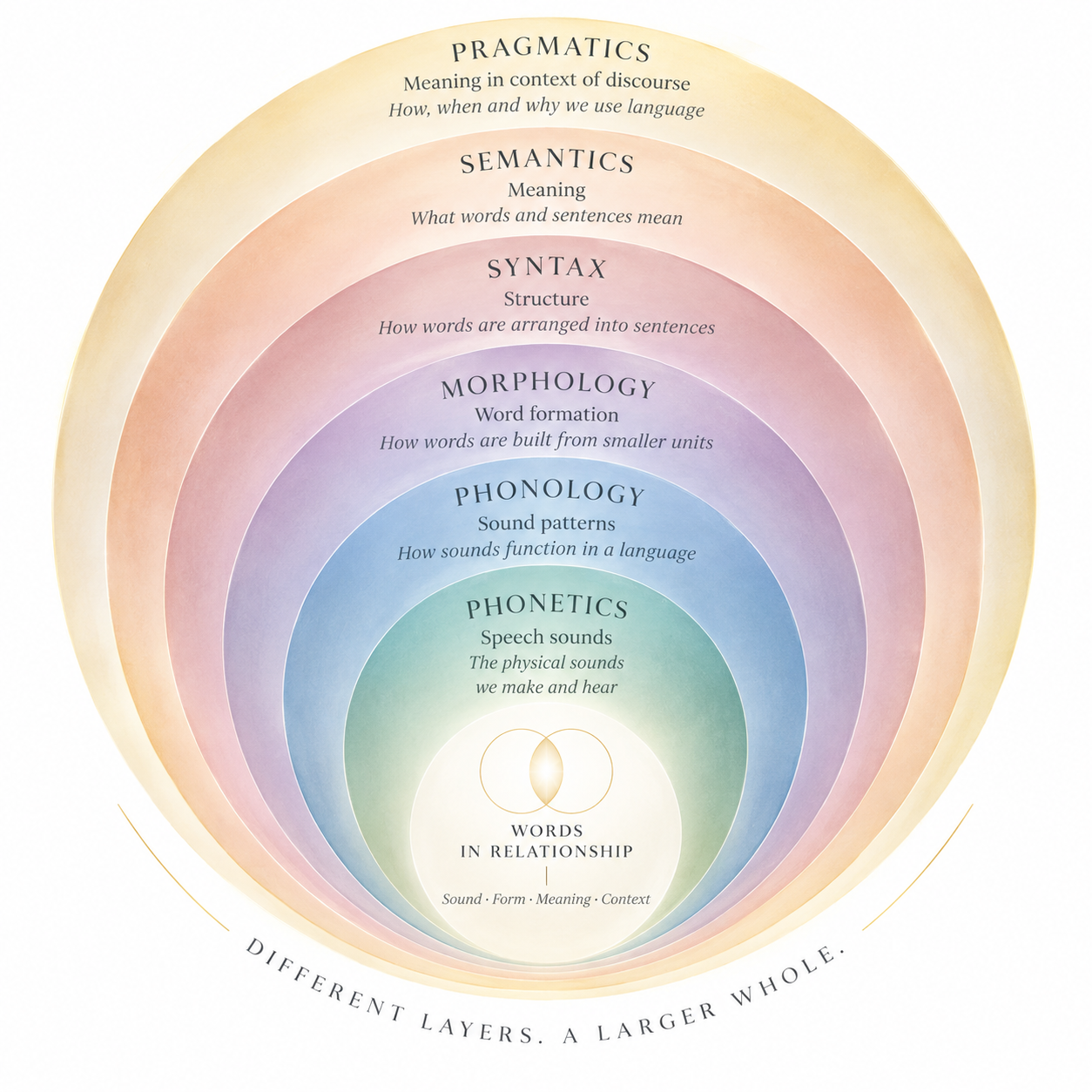
Lakoff and Johnson helped us see how metaphor can quietly structure the way we conceptualize experience. Chomsky takes us into a different layer of language: not the metaphors through which we understand experience, but the underlying structures that make language itself possible.
These are different theories addressing different questions. Yet brought into contact, they reveal something important for our inquiry: much of what shapes language — and what language, in turn, makes available to perception — operates without our conscious attention.
Linguist and philosopher Noam Chomsky challenged the idea that language is acquired simply by imitation. His work proposed that human beings possess an innate capacity for language — an underlying biological endowment that enables children to acquire extraordinarily complex linguistic structures from the language they encounter around them.
In his earlier work on transformational grammar, Chomsky distinguished between surface structure — the form a sentence takes when expressed — and deep structure, an underlying grammatical organization from which different surface forms could be generated.
The linguistic concept should not be confused with a hidden psychological “true meaning” beneath our words. Yet it offers an interesting analogy for inquiry.
Lakoff and Johnson invite us to notice the conceptual frames carried by our metaphors. Chomsky reminds us that language itself has underlying structures that normally remain outside awareness. The Visica Compass takes neither theory beyond what it claims, but allows the relationship between them to open another question:
What might be organizing meaning, beneath the words we consciously choose?
Take a seemingly simple sentence: “I need to be strong.”
At first, its meaning may appear obvious. But inquiry can open the words. What does strong mean here? Not showing emotion? Managing alone? Protecting others? Not asking for help? Enduring without complaint? And where did those meanings come from?
A single word may carry personal experience, family expectations, cultural values, and ways of relating to ourselves and others that have never been consciously examined.
And beneath these meanings, we may begin to notice a pattern:
strength can be seen as self-sufficiency;
vulnerability can be interpreted as weakness;
needing another can feel like a personal failure;
my value might depend on how much of a burden I believe I should be able to carry.
This is what we might call, metaphorically, an unseen grammar of meaning — not Chomsky’s linguistic deep structure, but the often-unnoticed patterns through which words, assumptions, experiences, and relationships become organized within us.
Here the two perspectives meet without becoming the same. Metaphor can reveal the frames through which we interpret experience; structure reminds us that not everything organizing language is visible at the surface. Inquiry then asks us to notice what these patterns are doing in our own perception and relationships.
Reclaiming symbolic fluency does not require us to abandon structure or precision. It asks us to become curious about the relationship between the words we speak and the meanings, experiences, assumptions, and patterns they may carry.
Inquiry does not ask us to discard the word strong. It allows us to hear more of what the word is carrying — and to discover whether the grammar beneath it still describes the relationship we want to have with ourselves, with others, and with the world.
This resonates with A.H. Almaas’ approach to inquiry: naming an experience can give us a place to begin, but the name itself is not the experience. Inquiry asks us to remain with what is actually present, allowing familiar interpretations to loosen so that something not yet seen may reveal itself.
6. Meta-Perspective — Learning to See Our Layered Communication
“To communicate well is not just to speak clearly, but to see clearly — the frames we speak from, the patterns we inhabit, and the stories we transmit.”
Lakoff and Johnson helped us notice the metaphors that frame experience. Chomsky drew attention to structures of language that operate beneath its surface. But what happens when we bring this awareness into communication itself?
The Meta-Perspective model, taught by Charlotte Alexandersson and Håkan Persson, Huvudleden AB offers a practical framework for becoming more conscious of how we organize experience while speaking, listening, and relating.
At its foundation, the model works with 10 basic sortings — fundamental distinctions through which we organize experience in communication, such as inner and outer, conscious and unconscious, and past, present, and future. These sortings influence what we notice and emphasize, but also what may remain outside our immediate attention.
When a sorting becomes weighted toward one side, the model introduces 10 balancing patterns that help widen the field of perception. The intention is not to replace one perspective with its opposite, but to recognize what may be missing and restore greater balance.
From there, the 4 meta-perspectives invite us to step back another level and notice the perspective from which we are communicating. We become able to observe not only what we are saying, but something of how we are organizing, interpreting, listening, and responding.
Together, these three layers — 10 basic sortings, 10 balancing patterns, and 4 meta-perspectives — offer a practical way of developing more conscious communication.
Consider two people discussing a difficult organizational change. One asks:
What is the target? What needs to be done? When will it be completed?
The other asks:
How are people experiencing this? What are we not noticing? What might happen if we move too quickly?
Neither perspective is necessarily wrong. They may simply be attending to different dimensions of the same situation. Yet without awareness of these differences, each may begin to interpret the other through judgment: controlling, vague, resistant, insensitive, unrealistic.
What began as difference can become separation.
Meta-perspective offers another possibility. We can begin to notice not only what is being said, but the sorting and perspective through which experience is being organized:
What am I attending to?
What might I be leaving outside the frame?
From what perspective am I speaking?
From what perspective am I listening?
What becomes visible when another perspective is allowed to remain in contact with mine?
This is where the Meta-Perspective model connects deeply with the Visica Compass. Becoming conscious of our basic sortings and patterns does not require us to abandon our own perspective. The model helps us to frame from what place, experience we speak and listen. It helps us to guide and frame our intentions and messages in our communication. It allows us to recognize our message as a perspective rather than the whole.
Within the Visica Compass, this becomes part of the movement of inquiry: noticing the frames and patterns through which we perceive and communicate, holding different perspectives in contact, and allowing information that might otherwise remain outside our awareness to become visible.
Meta-perspective therefore becomes more than a communication technique. It becomes a practice of layered seeing — learning to notice not only the stories we tell, but the position from which we tell them, and how that position shapes our relationship with ourselves, with others, and with what is unfolding.
From my own experience, investing in this training and practice can be invaluable for individuals, teams, and organizations navigating transition. It offers practical ways of becoming more conscious of how we communicate, how we interpret one another, and how easily difference can become separation.
I want to express my deep gratitude to Charlotte Alexandersson and Håkan Persson for their teaching of the Meta-Perspective model, and for the wisdom, trust, humour, and generosity with which they have shared their work. Their teaching and support have enriched not only my understanding of communication, but also my capacity to notice the perspectives from which we meet ourselves, each other, and the world.
7. Scientific Language — Precision or Reduction?
Scientific language gives us photons, wavelengths, wave-particle duality — and an extraordinary ability to describe, measure, test, and predict the behaviour of light.
This precision allows dimensions of reality to become visible that human perception alone could never reveal. Scientific language does not diminish light by describing it through measurement; it asks particular questions and develops particular methods through which those questions can be explored.
But every language also has a frame.
The language of physics can tell us about wavelength, frequency, energy, and interaction. It does not necessarily tell us what light means when someone speaks of seeing the light, experiences a moment of illumination, encounters light as sacred, or uses it as a symbol of hope.
These are not competing descriptions of the same thing. They are different questions asked from different perspectives.
Fritjof Capra has spent much of his work exploring relationships between scientific and other ways of understanding reality. In The Tao of Physics, he placed insights from modern physics in dialogue with Eastern philosophical and mystical traditions. Later, in The Web of Life, his attention expanded toward living systems, networks, and patterns of relationship.
Carlo Rovelli, from within physics itself, also challenges the image of reality as simply a collection of independently existing objects. In his relational interpretation of quantum mechanics, physical properties are understood in relation to interactions between systems rather than as properties existing independently of every interaction.
Different disciplines are speaking here, and they should not be collapsed into one another. Yet each, in its own way, can challenge the assumption that understanding reality means understanding isolated things.
James Gleick, in The Information, traces the extraordinary rise of information as a scientific and technological concept — from messages and codes to computation, genetics, and physics. Information gives us another powerful language through which patterns in reality can become visible.
And yet the Visica Compass invites another question:
What becomes visible through a particular language of knowing — and what remains outside its frame?
A photon does not become less scientifically real because human beings also use light symbolically. Nor does symbolic meaning alter the measurable properties of a photon. The two belong to different dimensions of inquiry.
The danger lies not in precision, measurement, metaphor, or meaning themselves, but in allowing any one language to claim the whole.
Scientific language can sharpen our capacity to see. Symbolic, psychological, relational, and poetic languages can reveal other dimensions of experience. Holding them in contact does not require us to blur their differences. It asks us to discern what each can reveal, what each cannot answer alone, and what may become visible in the relationship between them.
Perhaps the question, then, is not precision or meaning, but:
What kind of question am I asking — and which language allows me to see it most clearly?
8. Poetic, Indigenous, and Animistic Grammars
If scientific language allows particular dimensions of reality to become visible through precision and measurement, what becomes visible through languages in which relationship itself is embedded in the way the world is named?
Robin Wall Kimmerer, botanist, writer, and citizen of the Citizen Potawatomi Nation, offers a striking example through what she calls the grammar of animacy.
In learning Potawatomi, Kimmerer encountered a linguistic world different from the one carried by English. Plants and animals are animate, but so too can be rocks, mountains, water, fire, places, medicines, songs, drums, and stories. The distinction is not simply between what Western biology classifies as living and non-living. The grammar itself carries relationship.
In Potawatomi, even what English might name simply as an object — a rock, a tree, water — can be spoken of through a grammar that acknowledges animacy and relationship.
Something subtle but profound happens here. Grammar does not merely describe a worldview after the fact. Through speaking, relationship is repeatedly remembered.
This shift can influence how we meet the world. When elements of the living world are spoken of not simply as objects but as beings, relatives, elders, or participants in relationship, language can invite ways of relating that include reverence, responsibility, reciprocity, and care.
Tyson Yunkaporta, writing from an Indigenous Australian perspective, similarly explores ways of knowing grounded in relationship, pattern, place, story, and responsibility. Knowledge is not simply something possessed by an isolated individual; it emerges within relationships — between people, land, experience, story, and the patterns connecting them.
David Abram approaches related questions through philosophy, ecology, and perception. In The Spell of the Sensuous, he explores language as arising from our embodied participation in a more-than-human world. Perception, in this view, is not simply a detached observer looking outward at passive objects. We are already participants in what we perceive.
In such ways of knowing, language does not merely describe relationship. It can participate in relationship.
Indigenous ways of knowing should therefore not be understood as merely poetic or symbolic alternatives to science. Many are grounded in generations of careful observation, pattern recognition, lived experience, and accumulated knowledge of particular lands, waters, plants, animals, seasons, and ecological relationships.
Contemporary science is increasingly revealing complex relationships and interdependencies within living systems that Indigenous peoples have observed and lived in relationship with across generations. This does not make the knowledge systems identical, nor does one need to validate the other. Their methods, languages, histories, and understandings of what it means to know may differ.
What becomes particularly interesting for this inquiry is that relationship itself can be a source of information.
A language that remembers relationships between human beings, plants, animals, water, land, seasons, and place may carry observations that disappear when those relationships are divided into isolated objects of study. Scientific methods, in turn, can reveal relationships at scales and dimensions unavailable to ordinary human perception.
Consider something as familiar as water.
When water is named as a resource, particular questions become visible: How much is available? How clean is it? How should it be distributed or managed?
When water is encountered as relative, living presence, ecosystem, sacred element, or participant in life, other questions may arise: What is our relationship with this water? What depends upon it? What responsibilities follow from belonging to the same living system?
Neither language needs to erase the other. Each brings something into view.
There is growing recognition of the importance of bringing Indigenous Knowledge into respectful relationship with scientific knowledge in how we understand and care for our planet — without requiring either to surrender its distinct ways of knowing.
This is also where the Visica Compass becomes relevant. The invitation is not to collapse different knowledge systems into one, nor to decide prematurely which possesses the fuller truth. It is to allow difference to remain in contact long enough for relationships, patterns, and information that might otherwise remain unseen to become visible.
Integration does not have to mean assimilation. Difference does not have to mean separation.
Perhaps the deeper question is not simply What do we know? but:
What becomes possible when different ways of knowing can remain in respectful relationship with one another?
Reflective questions
When does your language turn something into an object — and when does it allow relationship to remain visible?
What changes when you become curious about the relationship carried inside the words you use?
When does your language seek control, and when does it seek connection?
When have your words healed a divide — and when have they deepened one?
What changed when Love entered your language?
9. Language That Binds or Liberates
We have explored how different languages and ways of knowing bring different dimensions of reality into view. But there is another question beneath them all:
What does language itself do to our experience?
Words help us name, distinguish, communicate, remember, and make meaning. Yet the same capacity that allows us to give form to experience can also fix that experience into categories that begin to feel like reality itself.
Someone says, “I am anxious.”
The sentence names something real. But notice what happens grammatically: anxiety and I become joined. An experience may begin to sound like an identity.
What changes when we say instead:
“I notice anxiety in me.”
Or:
“Something in me feels anxious.”
The anxiety has not been denied, softened, or made less real. But a little space has appeared between the person and the experience. And within that space, relationship becomes possible.
What is this anxiety responding to? What does it fear? What might it be protecting? What information does it carry?
Language that binds can turn experience into identity, interpretation into fact, and difference into separation.
Language that liberates does not necessarily give us better answers. It can give us enough space to ask another question. And that is where inquiry begins again — returning us, perhaps, to our youngest teachers — our children — who remind us through their persistent why? how to remain curious when an answer begins to feel like certainty.
Jung's work with dreams, images, and symbols reminds us that not everything within human experience arrives in literal language. An image or symbol can carry layers of meaning that resist being reduced to a single definition. Here again, naming can open a doorway — but closing the meaning too quickly may close the inquiry with it.
This is also central to A.H. Almaas' approach to inquiry. Naming what we experience can help us make contact with what is present, but the name is not the experience itself. Inquiry continues beneath our habitual interpretations, allowing us to stay with the felt experience and discover what our familiar language may have concealed.
Richard Rorty approaches language from a very different philosophical direction. He challenges the idea that language simply mirrors a reality already waiting to be described. Our vocabularies are also tools: they influence what we are able to describe, distinguish, imagine, and communicate.
Put these perspectives into contact and an intriguing possibility appears:
Changing language does not necessarily change reality — but it can change our relationship to what we experience, and therefore what becomes possible to see, ask, imagine, and do.
This is why language can bind and liberate.
A label can close a question.
A symbol can open one.
A familiar description can keep an old relationship in place.
A new way of speaking can create enough space for another relationship to become possible.
The task is not to find perfect words. It is to remain aware that our words are participating in the way we meet ourselves, one another, and the world.
And when language begins to harden into certainty, perhaps we can borrow that small but persistent question from our youngest teachers once more:
Why?
10. When Language Becomes Loss — and the Return of Symbolic Fluency
If language can open experience, what happens when some forms of language gradually disappear from the ways we understand ourselves and the world?
When symbolic, poetic, and mythic language loses its place, we may also lose ways of approaching experiences that cannot easily be explained, diagnosed, measured, or solved. Darkness can then become something to fix, fear, or remove rather than something we might also stay with, listen to, and inquire into.
Martin Shaw and Robert Bly, voices within the mythopoetic tradition, invite a return to story and metaphor — not as an escape from reality, but as ways of approaching dimensions of human experience that literal language may not fully contain.
Symbolic fluency does not require us to interpret every image or turn everything into a sign. It asks for the capacity to remain available to meanings that are not yet fully formed.
David Whyte describes poetry as a “language against which we have no defenses.” Poetry can reach us differently from explanation. A poem does not necessarily tell us what something means. It can create a space in which something is felt, recognized, remembered, or seen anew.
Perhaps this is why poetry, story, image, and metaphor have accompanied human beings for so long. They allow us to approach grief, love, death, beauty, mystery, and transformation without requiring that we reduce them immediately to conclusions.
In a world rich in information but sometimes poor in symbolic fluency, we may need to recover the capacity to move between different forms of language — analytical when analysis is needed, precise when precision matters, and poetic when experience asks for a language spacious enough to hold what cannot yet be fully named.
We do not need symbolic language to solve the dark. We may need it to remain in relationship with what the dark has not yet revealed.
11. The Vibration of Words — Water as Inquiry and Metaphor
Few images have captured the imagination around words and intention as strongly as the photographs associated with Masaru Emoto.
Emoto became known for experiments in which water was exposed to words, music, prayer, or intention and then frozen and photographed. He reported that water associated with words such as love or gratitude produced more aesthetically harmonious crystals than water associated with words such as hate or anger.
His work became enormously influential — and scientifically controversial.
Later blinded studies co-authored by Emoto and other researchers reported differences in aesthetic ratings between crystals formed from water exposed to distant positive intention and control samples. These findings remain contested, and they do not establish that the meanings of particular words physically reorganize water.
For the purposes of this inquiry, perhaps we do not need to make them do so.
The image itself raises another question.
What happens when we imagine our words as entering something as receptive and essential to life as water?
Not because we know that water understands the meaning of love or hate, but because human beings do.
Words enter bodies, relationships, families, organizations, and cultures. They can soothe or alarm, include or exclude, dignify or humiliate, open inquiry or close it down. Their consequences are psychological, relational, social — and sometimes physiological through the ways human beings respond to one another.
Water can therefore remain here as a metaphor rather than as proof.
If our words were water flowing through the relationships of which we are part, what would we want them to carry?
To speak with care does not require us to believe that matter understands our vocabulary. It asks us to remember that those with whom we are in relationship may be changed by the language through which we meet them.
Speak beauty. Speak truth. Speak with care.
Reflective Questions
What words do you instinctively associate with light and darkness? What meanings, assumptions, or judgments might they carry?
Can you recall a time when changing the way you named an experience changed your relationship to it?
What words or expressions did you inherit from your family, culture, education, or profession? What relationships and ways of seeing might be carried within them?
When you encounter a perspective different from your own, what helps you remain curious long enough to discover what it might reveal?
Where in your own language might an answer have become a certainty — and what happens if you ask why? again?
If your words were water flowing through your relationships, what would you want them to carry?
This is Article 1, The Language of Light and Darkness — How Words Shape What We See.
What we Explored
In this first article, we explored how language shapes not only what we say, but what becomes available for us to perceive.
We moved from metaphor and the hidden patterns carried within familiar words to the ways language can organize experience, shape relationship, and influence what remains inside or outside our frame of attention.
Through scientific language, symbolic language, Indigenous and relational grammars, and different approaches to communication, we encountered not one correct way of speaking about reality, but different languages of knowing — each capable of revealing something, each carrying assumptions, and each leaving something outside its frame.
Inquiry invites us to notice these frames without immediately replacing one with another.
It asks us to remain curious about what our language illuminates, what it places in shadow, what relationships it creates, and what information may become visible when different ways of knowing remain in contact.
Closing Reflection
In times of profound transformation, language matters.
The words through which we name ourselves, one another, and the world do not simply describe what is already there. They participate in how we perceive, relate, remember, question, and imagine what might become possible.
When language hardens into judgment, perception can narrow. When a name becomes an identity, an interpretation becomes a fact, or one perspective becomes the whole, inquiry can close.
But language can also create space.
A word can become a doorway rather than a label. A question can interrupt certainty. A metaphor can reveal a relationship we had stopped seeing. Another way of knowing can illuminate what our own language left outside the frame.
Transformation does not require us to abandon the languages we already know. It asks us to become more conscious of how we use them — and curious about what may still remain unseen.
Perhaps this is one of the deepest invitations of language:
to name what we see without assuming that what we have named is all there is to see.
“The capacity for language is the essence of human freedom.”
— Noam Chomsky
Next in the Inquiry Series…
Article 2: The Spark in the Dark — Light and Darkness from Conception to Cosmos
In Article 2, the inquiry moves from the language through which we perceive light and darkness to the phenomena themselves — from the first flashes associated with conception to the birth and death of stars.
We follow the spark from biology into cosmos and ask what becomes visible when light and darkness are encountered not only as metaphor, but as processes woven through matter, life, and transformation.
© Barbara Keller | Visica Co-Creation
Sources & Voices That Shaped This Reflection…
This article has emerged in conversation with a diverse field of linguists, psychologists, philosophers, scientists, poets, storytellers, Indigenous thinkers, and teachers. Their perspectives are not presented as saying the same thing. Rather, each offers a different lens through which to inquire into how language shapes what we perceive, what we leave unseen, and how we enter into relationship with ourselves, one another, and the world.
George Lakoff & Mark Johnson — Metaphors We Live By (University of Chicago Press, 1980). Their work on conceptual metaphor shows how metaphor is not merely decorative language but participates in structuring how we conceptualize and make sense of experience.
Noam Chomsky — his work on generative grammar, Universal Grammar, and the distinction between surface and deep structure opened fundamental questions about the underlying structures of human language. In this article, Chomsky's linguistic concepts are distinguished from — but also used as an analogy for — our inquiry into the often-unnoticed patterns carried beneath the language we consciously use.
A.H. Almaas — particularly Spacecruiser Inquiry (Shambhala, 2002), The Unfolding Now (Shambhala, 2008), Facets of Unity (Shambhala, 1998), and The Inner Journey Home (Shambhala, 2004). His understanding of inquiry, presence, the superego, Diamond Guidance, and direct experience has deeply informed the movement in this article from judgment toward discernment and from naming toward open-ended inquiry.
Ken Wilber — A Theory of Everything (Shambhala, 2000), The Eye of Spirit (Shambhala, 1997), and Integral Psychology (Shambhala, 2000). His use of the Greek term Kosmos helps distinguish the physical cosmos from a wider conception that includes interior, cultural, psychological, and spiritual dimensions of existence.
C.G. Jung — particularly his work on symbol, shadow, archetype, and the tension of opposites. Jung's work contributes to the inquiry into how images and symbols can carry dimensions of psychological experience that literal language may not exhaust.
Simone Weil — Waiting for God (1951). Her writings on attention offer an important resonance with discernment as the capacity to remain present before reaching too quickly for conclusion.
Richard Rorty — Philosophy and the Mirror of Nature (Princeton University Press, 1979) and related writings on language and vocabulary. His critique of language as simply mirroring an independently given reality, and his understanding of vocabularies as tools, contributes to the question of how different descriptions make different possibilities of thought and action available.
Fritjof Capra — The Tao of Physics (1975) and The Web of Life (1996). His work brings modern physics, systems thinking, ecology, and patterns of relationship into dialogue, contributing to the inquiry into what becomes visible when reality is approached relationally rather than solely through isolated parts.
Carlo Rovelli — his work on Relational Quantum Mechanics offers, from within physics, an interpretation in which physical properties are understood relationally — as arising in interactions between physical systems rather than as wholly observer-independent properties of isolated systems.
Robin Wall Kimmerer — Braiding Sweetgrass: Indigenous Wisdom, Scientific Knowledge and the Teachings of Plants (Milkweed Editions, 2013), including her reflections on the grammar of animacy. As a botanist and Indigenous scientist, Kimmerer brings scientific knowledge into relationship with Indigenous ways of knowing, reciprocity, kinship, language, and the teachings of the living world.
Tyson Yunkaporta — Sand Talk: How Indigenous Thinking Can Save the World (Text Publishing, 2019). His work explores Indigenous ways of knowing grounded in pattern, relationship, story, place, responsibility, and interconnected systems.
David Abram — The Spell of the Sensuous (Vintage, 1996). His exploration of embodied perception, oral language, and the more-than-human world contributes to the understanding of language and perception as participatory rather than simply descriptive.
Charlotte Alexandersson & Håkan Persson — through their teaching of the Meta-Perspective model, with its 10 basic sortings, 10 balancing patterns, and 4 meta-perspectives, they offer a practical way of becoming more conscious of how we organize experience while speaking, listening, and relating. Their teaching, wisdom, humour, and support have profoundly enriched my own understanding and practice of conscious communication.
Clarissa Pinkola Estés — Women Who Run With the Wolves (Ballantine, 1992). Her work with story, myth, image, and symbolic language contributes to the inquiry into how forms of knowing that are not reducible to literal explanation can carry psychological and cultural meaning.
Martin Shaw & Robert Bly — through their work in the mythopoetic tradition, they invite renewed attention to story, poetry, metaphor, and myth as ways of approaching dimensions of human experience that literal or analytical language may not fully contain.
David Whyte — poet and writer whose work explores the relationship between language, inner experience, work, relationship, and the unknown. His description of poetry as a “language against which we have no defenses” speaks to the capacity of poetic language to reach experience differently from explanation.
Masaru Emoto — The Hidden Messages in Water (2001). His widely known experiments and images exploring water, words, music, and intention have been influential culturally but remain scientifically contested. They are included here not as established evidence that words physically imprint their meanings upon water, but as a provocative symbolic doorway into questions about language, intention, relationship, and consequence.
Together, these voices do not form a single theory.
They form a field of difference.
Held in contact, they invite us to inquire into language from multiple perspectives — linguistic, psychological, philosophical, scientific, relational, Indigenous, symbolic, and poetic — without requiring one to replace the others.
Perhaps symbolic fluency begins here: not in knowing which language contains the whole, but in learning to discern what each allows us to see — and remaining curious about what still lies outside the frame.
© We Still Live Here — Âs Nutayuneân (2010/2011)