By Barbara Keller | Visica Co-Creation
This article draws from The Visica Compass — Navigating Why Light and Darkness matter in a Time of Massive Transformation — a framework integrating inner work, systemic insight, symbolic intelligence, and creative response.
The Journey of Inquiry so far…
Introduction — The Visica Compass: An Invitation to Inquiry
The journey opened by introducing The Visica Compass as an invitation into inquiry rather than certainty. It proposed that light and darkness are not fixed opposites but relational forces through which transformation unfolds. By exploring the relationship between cosmos and Kosmos, symbolic and scientific ways of knowing, and the practice of seeing with both eyes open, the introduction laid the foundation for a different way of perceiving — one that invites us to pause before we conclude, and to discover wholeness and relationship where modern culture often sees separation.
Prelude — The Sound of Presence: Before the Word, There Was Resonance
We began before words and forms — in the field of vibration itself, the hum of existence. Science explores the primordial vibrations and waves of the early universe; wisdom traditions have long spoken of creation through sound, vibration, or the voice of Being.
Within the symbolic language of this inquiry, presence can be imagined as emerging from that resonance — the silent grammar beneath all language and light. Perhaps transformation begins not only in reaction to what happens, but also in the quality of presence with which we meet it.
Article 1 — The Language of Light and Darkness: How Words Shape What We See
We turned our attention to the subtle force shaping how we perceive and understand the world — language. We asked: What if our very understanding of light and darkness is shaped by the language we use to speak of them? We explored how reclaiming symbolic, soulful, and precise language — especially in the inner world — can help us see the sacredness of both light and darkness with new eyes.
Article 2 — The Spark in the Dark: From Conception to Cosmos
We expanded both outward and inward — from black holes to embryonic light — tracing how the universe and the human body reflect the interplay between spark and shadow. Creation itself emerges from darkness; life begins in hiddenness.
Article 3 — The Mythic Eye: Seeing Through the Stories We Inherit
We entered the living Kosmos of myth, archetype, story, and imagination, encountering light-bearers, shadow-walkers, and weavers of relationship across different cultural and spiritual traditions. Through figures such as Prometheus, Inanna, Kali, the Bodhisattva, and Spider Woman, we explored how light and darkness can carry meanings far beyond the familiar opposition of good and evil. We also considered how the stories we inherit shape our perception, how fear and wonder may meet at the threshold of the unknown, and how suffering has been held through ritual, community, and shared meaning. The inquiry invited us to move from judgment toward discernment — recognizing that not everything luminous is wise, nor everything dark a threat. And perhaps most importantly, we discovered that remaining in relationship with experience does not necessarily mean remaining in circumstances that cause harm. Myth does not always provide an answer. Sometimes it offers another way of seeing.
Article 4 — Religions and Philosophies — Sacred Light and Holy Darkness
We turned toward religious and philosophical traditions to explore how light and darkness have shaped humanity's understanding of the sacred. Through mysticism, philosophy, and symbolic teachings, we encountered darkness not only as something feared, but also as a dimension of mystery, depth, and transformation. Yet we also examined what happens when spiritual teachings become instruments of judgment, hierarchy, and control — when the search for illumination loses contact with compassion and discernment.
Article 5 — Shadow of the System: Light and Darkness in Societal Structures
We turned our attention toward the structures shaping our collective lives — institutions, economies, systems of governance, and the often-invisible assumptions beneath them. We explored how systems can become collective myths, how the promise of progress may conceal loneliness and disconnection, and how our identification with roles can shape the ways we think, feel, and relate. Through systems thinking, Theory U, and the distinction between judgment and discernment, we asked how the shadows of our systems might also live within us — and what becomes possible when we begin to recognize them.
Article 6 — The Wisdom of the Wild — Light, Darkness, and the Cycles of Regeneration
We turned toward the living world to explore regeneration not simply as an ecological process, but as a relationship of participation, reciprocity, and responsibility. From soil and forests to the living waters of Earth, we examined how cycles of growth, decay, adaptation, and renewal sustain life. We also explored regenerative initiatives and the tensions between technological progress and the ecological conditions upon which it depends. Nature became both a living reality and a source of metaphor — inviting us to reconsider what it means to belong to, rather than stand apart from, the web of life.
Perhaps transformation begins not only with what we do, but with how we have learned to see.
“Having explored the stories, structures, and living systems that shape our world, we now turn toward the inner landscape — where separation, protection, longing, and the possibility of reconnection become deeply personal.”
Preface — From Systems to Souls
At the close of the previous chapter, The Wisdom of the Wild, we explored how the living Earth regenerates through cycles of growth, decay, stillness, and renewal — through the interplay of light and darkness.
Now, the spiral turns inward.
If our outer systems both reflect and shape our collective ways of thinking, perceiving, and relating, might we recognize similar patterns within our psychological lives — and discover how our inner and outer worlds continually influence one another?
An exhausted forest may remind us of a weary nervous system. A polluted river may evoke the experience of thoughts and emotions that no longer seem to flow freely.
These are not identical processes, but perhaps they invite us to recognize something about the relationships between our inner and outer worlds.
This article invites us to explore the threshold between change and transformation.
Change may involve modifying behaviours, circumstances, or existing structures. Transformation may reach deeper, reshaping the very assumptions, identifications, and patterns through which we perceive ourselves and the world.
It is the difference between pruning the branches and attending to the soil from which the tree grows — between addressing what is visible and becoming curious about what has remained unseen.
Psychology, in this inquiry, belongs not only to the realm of the cosmos — where human experience can be studied through observation, mechanisms, and measurement — but also to what Ken Wilber calls the Kosmos: a broader understanding that includes lived experience, meaning, relationship, and dimensions of Being that cannot be reduced to measurement alone.
To enter this inner landscape is to explore the movement from judgment toward discernment.
Not simply asking what is wrong with us, but becoming curious about what our experiences may be revealing.
Here, the womb of love becomes a guiding image — a receptive space in which we may encounter fear, longing, protection, and vulnerability without immediately attempting to change or eliminate them.
And perhaps it is within this space that re-membering becomes possible.
Not merely remembering something forgotten, but re-membering — allowing what has been separated, obscured, or excluded from our awareness to enter into relationship again.
Yet re-membering may also involve encountering experiences for which our familiar understanding has no ready explanation.
Experiences that challenge the boundaries of what we have learned to perceive, believe, or consider possible.
Sometimes such encounters do not simply add something new to our understanding. They invite us to question the framework through which we have understood ourselves and the world.
The living world offers a powerful reminder: its processes are not confined by the conceptual frameworks through which we attempt to describe them.
Perhaps our own experience, too, invites us to remain curious about what lies beyond our established interpretations.
Not by abandoning scientific inquiry, psychological understanding, or discernment, but by recognizing that our knowledge is always developing — and that the unknown need not immediately become something to fear or dismiss.
This is not simply self-improvement. It is re-membering — and perhaps also the emergence of possibilities we have not yet learned to recognize.
“What we heal within mirrors what the Earth remembers without.”
— A symbolic reflection from The Visica Compass
The Splintered Self in a Splintered World

Within the history of psychology, certain approaches have understood human experience primarily through the individual — examining thoughts, emotions, behaviours, and psychological difficulties as though they could be understood largely within the boundaries of a separate self.
Yet psychology has also developed relational, systemic, humanistic, embodied, and ecological perspectives that challenge this separation.
What happens when we widen our understanding of psychological suffering beyond the individual, without losing sight of each person's unique experience?
Anxiety, exhaustion, burnout, and difficulties with identity or belonging cannot always be understood apart from the relationships, environments, expectations, and social structures within which people live.
They are not necessarily signs of individual failure, nor can they simply be reduced to collective dysfunction.
Perhaps they invite us to explore the space between personal experience and the conditions that shape it.
In cultures that place considerable emphasis on productivity, visibility, achievement, and constant availability, we may find ourselves living in what could be described as a permanent summer — expected to remain active, capable, and outwardly successful.
But what happens when winter comes?
When the body needs rest, when grief asks for attention, or when our familiar sense of identity no longer provides the orientation it once did?
The living world reminds us that growth does not continue without interruption. Periods of rest, withdrawal, and renewal are also part of life's rhythms.
Perhaps our psychological lives deserve a similar understanding.
We live within another paradox: technologies allow us to communicate across enormous distances, yet the availability of connection does not necessarily create the experience of belonging.
We may be surrounded by people and still feel profoundly alone.
And we may find moments of connection in solitude, in nature, or through an experience of presence that does not depend upon another person being physically nearby.
Loneliness — The Silent Fracture Beneath Modern Life
Loneliness is not simply the absence of people. It is the absence of contact. It is what happens when nothing inside us touches anything outside us, and the world becomes mute.
This is not necessarily an absence of relationship itself, but an absence of the felt experience of relationship — of being touched, met, and connected.
From a relational and depth-psychological perspective, loneliness may also involve a sense of inner fragmentation — a disconnection from parts of us that once knew belonging. In a culture of increasing individualism, distraction, and digital overstimulation, loneliness has become a silent epidemic, shaping how we see ourselves and others.
It is one of the deepest expressions of the split between inner and outer light, a wound of separation that longs not for company, but for connection — for a felt sense of being met.
Understanding loneliness as a relational and systemic phenomenon prepares us to explore what reconnection truly means.
Judgment and Discernment in the Inner World
The split between light and darkness runs through our metaphors, cosmologies, and systems. When entering the psychological dimension, these metaphors become lived realities inside the human psyche. It is here that the collective is most intimately personal.
Just as our institutions cling to control, our inner lives are ruled by judgment — the subtle tyranny of the inner critic. Judgment fragments: it divides us from our own experience.
Discernment, as cultivated through inquiry, listens. It pauses in the womb of not-knowing, allowing a deeper or perhaps entirely new understanding to unfold.
There is no need to effort toward understanding, to search for an answer, or to direct experience toward a particular outcome.
One experience may arise, unfold, change, or give way to another. We remain in intimate contact with what presents itself, without immediately judging, comparing, interpreting, or attempting to clarify it.
In this openness, experience may reveal dimensions of itself that were not previously apparent. Sometimes this happens gradually; sometimes clarity arises in an instant.
We do not need to determine in advance what we are looking for, or even whether there is something to find.
Inquiry becomes an intimate relationship with experience itself.
And sometimes, in that direct contact, there is knowing — not knowledge constructed through analysis, but knowing within the experience.
Nothing less. Nothing more. Just experiencing what is, AS IT IS.
Inquiry is not the mind trying to uncover experience. It is the willingness to be with experience as it unfolds and reveals itself.
Psychological healing, then, is not about silencing judgment but transforming it into discernment — learning to listen within as we would listen to a forest: patiently, reverently, without haste.
Our time confuses change with transformation. We multiply techniques for self-optimization yet rarely pause to listen to what the soul asks. Change modifies behaviour; transformation renews being. The former arises from will; the latter from surrender — from descending into the dark, living Kosmos where we can sense the pulse of the earth, the rhythm of the season.
Here darkness offers a different kind of connection — one that holds our inner space and opens the possibility of healing.
“We are human only in contact, and conviviality, with what is not human.”
— David Abram, Alliance for Wild Ethics.
Ben Lazare Mijuskovic — Loneliness as the First Darkness
Philosopher Ben Lazare Mijuskovic offers a profound lens into the psychological and spiritual terrain we now enter. Loneliness, in his philosophical understanding, is not merely an emotional state — it is rooted in the fundamental condition of individual self-awareness. To be conscious is to be separate. To reflect is to be divided. In this view, the first descent into darkness is not trauma, but solitude.
Mijuskovic argues that our deepest fear is not pain or confusion, but the unbearable experience of existential aloneness. This is not the loneliness that comes from missing someone — but the loneliness of being a separate self in a vast universe. And yet, he suggests, it is precisely this ontological solitude that drives our longing for love, belonging, and transcendence.
Many psychological defences — perfectionism, performance, addiction to connection — may, in this light, become attempts to resist this darkness and its solitude. We fear the silence because it reflects our separateness.
But does this mean that separateness is the fundamental nature of consciousness? Or might loneliness also reveal the limitations of the way we have learned to experience ourselves?
Here, the philosophical perspective of Mijuskovic meets another understanding of human experience.
Within the Diamond Approach, A. H. Almaas explores how the structures of ego identity shape our experience of ourselves as separate individuals. Yet in the deeper dimensions of Being, the familiar boundaries between self and world may dissolve. What we ordinarily experience as separation is no longer present in the same way.
From this perspective, loneliness may not be an inherent quality of Being, but an experience arising through our identification with a separate self.
In my own experience, from childhood through my near-death experience and in moments of simply Being, I have encountered something profoundly different from existential aloneness. There is no separation to overcome, no distance to bridge, and no loneliness to resolve. There is simply Being.
This invites us to distinguish between the experience of an individual ego and the deeper dimensions of Being. Individuality does not necessarily imply separation, just as solitude does not necessarily imply loneliness.
Perhaps, then, reconnection is not always about restoring something that has been lost. Perhaps it is also about recognizing what was never separate in the first place.
And perhaps our attempts to escape the experience of loneliness can prevent us from discovering what lies beneath it. When we cease resisting this darkness and allow ourselves to meet it with curiosity, compassion, and presence — within the womb of love — the ache of separateness may ripen into the seed of presence: an intimate contact with what is, and perhaps, ultimately, with a deeper sense of belonging.
If we follow Mijuskovic down this philosophical corridor, we find ourselves face to face with a possibility illuminated by Almaas' teachings: the light of essence may emerge through our willingness to encounter the darkness of experienced separation.
Not around it, not "in spite of it" — but through it.
Perhaps re-membering is not only bringing fragmented parts of ourselves back into relationship, but also recognizing that, in Being, wholeness is never lost.
Clarifying the Three Darknesses
Before entering the psychological and spiritual traditions that guide this Article, it is essential to clarify that not all darkness is the same.
Sacred darkness is the womb of transformation — the still, fertile depth where insight gestates and new life is conceived.
Wounded darkness is the realm of unprocessed pain — trauma, shame, and abandonment that have never been met with compassion.
Disowned shadow is what we exile — impulses, needs, and capacities that do not fit our ideal self-image, and thus are pushed into the unconscious.
Our invitation is not to erase darkness, but to discern which darkness we are meeting: the sacred womb, the wounded child, or the rejected shadow.
These dimensions may overlap, yet they are not interchangeable. Sacred darkness is not the same as psychological suffering, and trauma does not automatically become transformative simply because we encounter it.
Nor does meeting darkness mean remaining in circumstances that harm us. Sometimes discernment asks us to establish boundaries, seek support, or leave.
The question is not whether darkness is good or bad, but what kind of darkness we are encountering — and what relationship with it becomes possible.
As Brené Brown explores in her work on vulnerability, shame, and courage, what we fear or conceal may lose some of its power when approached with empathy and compassionate awareness.
Perhaps darkness itself is not always the danger. Sometimes it is our fear of what we might encounter there that prevents us from discovering what it holds.
“The dark does not destroy the light; it defines it. It’s our fear of the dark that casts our joy into the shadows.”
— Brené Brown (2010). The Gifts of Imperfection: Let Go of Who You Think You’re Supposed to Be and Embrace Who You Are.
A.H. Almaas, Richard Schwartz: Reclaiming the Inner Light
A.H. Almaas’ Diamond Approach teaches that our essence — our true inner light — becomes obscured by layers of egoic structure formed through early wounding, adaptation, and identity. This light isn’t merely metaphorical; it corresponds to essential qualities of being such as Brilliancy, Strength, Compassion, Peace.
For these qualities to become consciously accessible, the darkness must first be welcomed — not denied or overcome. Through inquiry, we may discover what is present beneath our familiar identifications.
It is through being with our experience — confusion, fear, loneliness, vulnerability, and even the absence of what we long for — that previously obscured dimensions of Being may reveal themselves.
This descent is not simply a movement into psychological shadow. It may also become an opening into the deeper dimensions of the Kosmos — the fertile mystery in which our familiar sense of self is no longer the only way of experiencing existence.
Richard Schwartz’s Internal Family Systems (IFS)
IFS approaches inner fragmentation from another perspective.
IFS understands the psyche not as a unified psychological entity. The psyche is understood as a living ecology of “parts” — natural aspects of mind that carry essential qualities from birth. In their original state, these parts are expressions of innocence, creativity, intuition, courage, play, and sensitivity. They are not pathological — they are the architecture of a naturally multiple mind.
When trauma, shame, or attachment injuries occur, parts can become burdened — and take on protective roles:
A once-playful part may take on fear.
A sensitive part may carry feelings of worthlessness.
A vigilant part may become hyper-controlling.
Some parts polarize into inner conflict; others form alliances or protective systems. Within IFS, Managers try to prevent pain. Firefighters react when overwhelming feelings break through, and Exiles carry vulnerable experiences, often including grief, shame, fear and longing.
Healing becomes possible when the Self — characterized in IFS by qualities such as compassion, clarity, calmness, curiosity and courage — becomes present. When parts feel seen and welcomed without judgment, their burdens soften. They step out of their extreme roles and return to their original luminosity.
In this, IFS resonates with an important dimension of Almaas’ teachings: what has been rejected, defended against, or obscured may reveal something valuable when met through presence rather than control.
Yet there is also an important distinction.
In IFS, the emphasis is on restoring relationships among inner parts through Self-leadership and unburdening.

In the Diamond Approach, psychological inquiry may also open into the direct realization of essential qualities and dimensions of Being that are not simply another personality structure, psychological role, or self-image.
For Almaas, essential qualities such as Strength, Compassion, and Brilliancy are not merely improved personality characteristics. They are directly experienced qualities of Being.
One perspective explores the healing of inner relationships; the other also inquires into the nature of the self that experiences them.
These approaches need not be identical to illuminate one another.
Ken Wilber's Integral Framework — From Fragmentation to Participation
Ken Wilber's Integral Framework offers another perspective on this movement toward wholeness.
His approach invites us to consider human experience through multiple dimensions — subjective and objective, individual and collective — rather than reducing psychological life to any single explanation.
Body, emotion, mind, relationships, culture, and spiritual experience each contribute to our understanding of human development.
Fragmentation may arise when one dimension is privileged at the expense of others: when analysis eclipses lived experience, when control suppresses receptivity, or when individual suffering is understood without considering the systems and relationships in which it unfolds.
Wilber's distinction between cosmos and Kosmos invites us to widen our understanding beyond a merely physical or mechanistic description of existence.
Within The Visica Compass, this becomes a movement from separation toward participation — from seeing ourselves as isolated entities toward recognizing the relationships through which life continually unfolds.
Wilber's understanding of development also introduces an important distinction between transcending and including. Transformation does not necessarily mean abandoning what came before, but integrating earlier dimensions of development within a wider field of awareness.
Yet integration does not mean that every experience of transcendence automatically resolves our psychological wounds. Spiritual realization and psychological development may unfold differently, even as they influence one another.
This invites us to consider whether reconnection involves not only healing our inner fragmentation, but also widening the field through which we understand ourselves and our relationship with the world.
Re-membering — From Separation Toward Wholeness
Together, Almaas, Schwartz, and Wilber offer three different yet complementary invitations:
To encounter what has been obscured and discover the essential qualities of Being.
To restore relationship with the parts of ourselves that have been rejected, burdened, or exiled.
To widen our understanding of the whole to which we belong — including the individual, relational, cultural, and systemic dimensions of our existence.
Together, these perspectives invite us to reconsider what transformation means — and deepen our exploration of loneliness.
If loneliness arises through identification with a separate ego, might the compassionate recognition of our inner parts help soften that identification?
And might the direct experience of Being reveal a wholeness that was never fundamentally divided?
Here, re-membering takes on two complementary meanings: restoring contact among aspects of ourselves that have become fragmented, and recognizing a deeper wholeness that may never have been lost.
But does transformation mean changing the structures through which we experience ourselves, or discovering what lies beyond those structures?
Perhaps both movements have their place.
Not every descent leads automatically to renewal. Yet when darkness can be approached with presence, discernment, and appropriate support, what once appeared only as fragmentation may become an opening toward deeper understanding.
Just as the living world transforms fallen leaves into fertile soil, perhaps our psychological lives, too, hold possibilities for regeneration.
Not by forcing darkness to become light.
But by discovering what becomes possible when we no longer need to reject what is present.
And perhaps this is where the distinction between change and transformation becomes most apparent.
Change may reorganize the familiar structures of our psychological lives. Transformation may reveal something that cannot be reached simply by rearranging those structures.
What if reconnection is not only about healing the experience of separation, but also about discovering that, in Being, separation was never the whole story?
A Crisis of Belonging, Not Just of Being
As Mijuskovic suggests, the crisis of disconnection may begin not only in culture, but in our experience of consciousness itself. From his philosophical perspective, we become aware of ourselves as separate individuals and spend our lives seeking reunion — not only with others, but perhaps also with a forgotten sense of wholeness within.
Yet, as we explored through Almaas, Schwartz, and Wilber, this experience of separateness need not be the final word on the nature of Being.
Perhaps the crisis of belonging emerges not simply because we are separate, but because we have come to identify so completely with the experience of separation.
And perhaps our cultures, institutions, and psychological frameworks both reflect and reinforce this identification.

ity?
We do not need to determine in advance what the pressure means.
We allow the experience to reveal itself.
In this way, inquiry becomes an intimate dialogue with what is present — not an attempt to force understanding, but a willingness to discover.
This orientation resonates with Hillman's attention to the images of the psyche, Almaas' exploration of immediate experience, and Schwartz's compassionate relationship with inner parts.
Each offers a different doorway into a similar question:
What becomes possible when we stop treating our experience as an object to control and begin meeting it as something with which we can enter into relationship?
Over-Exposure — The Modern Fear of Darkness
As explored in Article 1, the language we use to describe light and darkness shapes our perception of them.
Masaru Emoto's controversial experiments with water crystals proposed that words, intentions, and emotional qualities could influence the forms of ice crystals.
His interpretations have not been established through sufficiently rigorous and reproducible scientific evidence. Yet the imagery raises a symbolic question worth exploring:
If water can become a metaphor for receptivity and relationship, what might our inner waters reveal about the language through which we experience ourselves?
The psyche, like water in this metaphor, responds to its environment. Language, tone, relationships, and the meanings we attach to experience can influence how we feel, perceive, and relate.
When we live within environments characterized by fragmented communication, hostility, or a narrow emphasis on rational control, these conditions may also shape our inner lives.
As we explored in earlier articles, the fragmentation of societal structures may be reflected in the fragmentation of meaning and belonging.
Perhaps healing also involves reconnecting with a language that allows room for the living world — where word, rhythm, silence, metaphor, and relationship once again carry meaning.
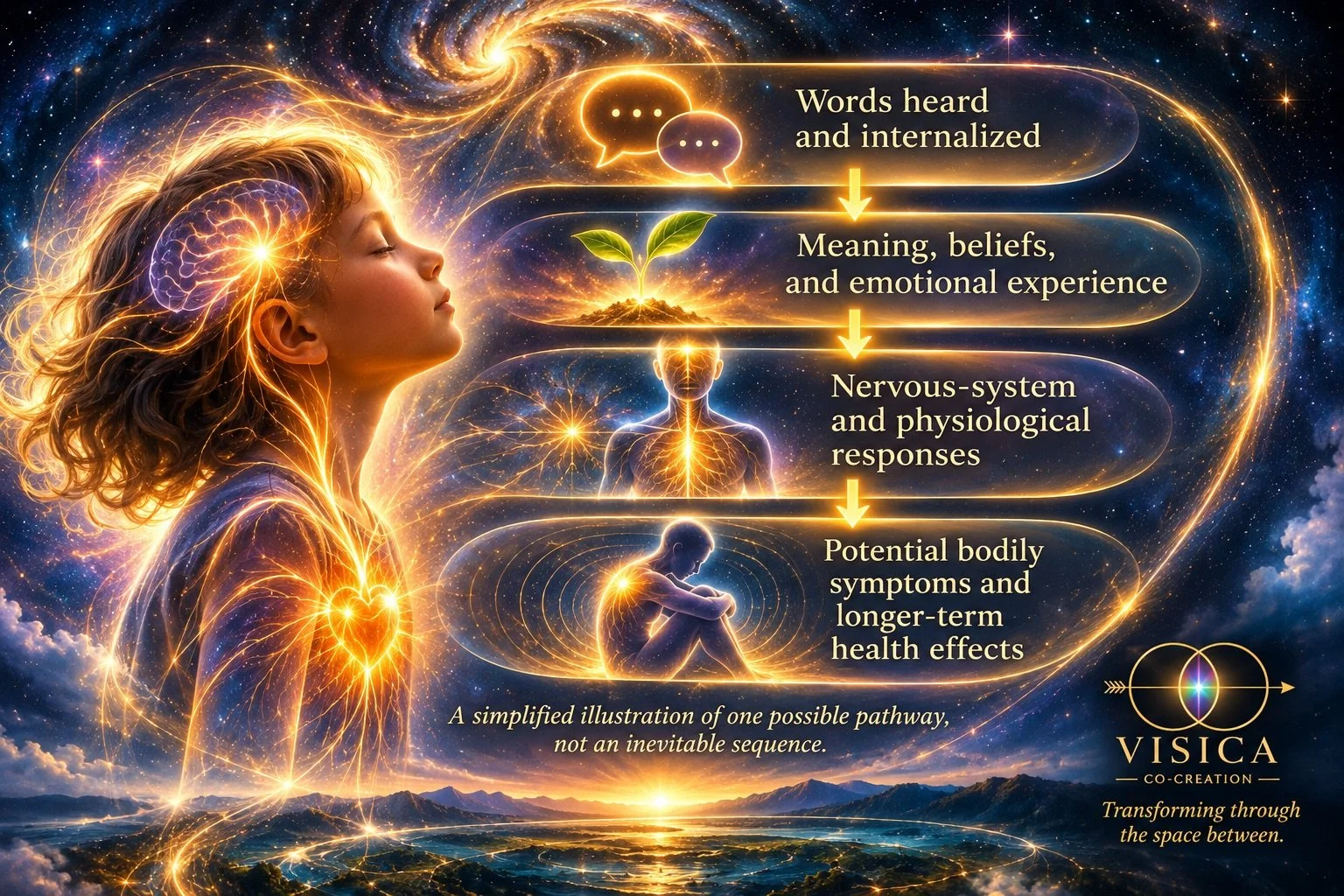
Words do not merely describe reality. They participate in shaping the reality we experience — psychologically, relationally, and physiologically.
Consider a child who repeatedly hears words of rejection, criticism, or worthlessness. These words may become internalized, shaping the child's sense of identity, safety, and belonging. The feelings they evoke are not confined to the mind. Fear, shame, and prolonged emotional distress can influence the nervous system, muscular tension, hormonal responses, and the body's regulation of stress and pain.
Over time, these processes may contribute to physical symptoms, even when no identifiable structural pathology explains the experience.
In this sense, language does not simply influence what we think. Through the meanings and emotions it evokes, it may also influence what we feel in our bodies.
Words become meanings. Meanings become experiences. And experiences may become embodied patterns.
Yet these patterns need not define us permanently. Through awareness, compassionate relationship, and inquiry, what has become familiar may reveal possibilities we had not previously recognized.
Ken Wilber's integral understanding of development offers another perspective. His principle of transcend and include invites us to recognize that expanding awareness need not require rejecting earlier ways of knowing.
Analytical precision and symbolic intelligence need not become enemies.
Rather than abandoning scientific understanding, we may ask how it can enter into dialogue with embodied experience, intuition, imagination, and relational awareness.
This is not a regression into mysticism, but an invitation to embrace complexity — including the intuitive and relational, the linguistic and luminous.
Some influential approaches in contemporary psychology mirror society's preference for what we might symbolically call light: cognition, performance, clarity, and measurable outcomes.
Yet psychology also contains longstanding traditions that explore the unconscious, imagination, embodiment, meaning, and the mysterious dimensions of human experience.
The difficulty arises when the measurable becomes the only reality we consider meaningful.
This can have a cost:
We over-identify with doing and knowing.
We may come to fear not-knowing, grief, and stillness.
We risk reducing pain to a diagnosis without sufficiently listening to the experience and circumstances of the person who suffers.
Here, the distinctions from Article 6 become psychological:
Light as visibility becomes the capacity to see and be seen with care.
Light as exposure becomes over-examination, constant self-display, and surveillance of the soul.
Darkness as absence may appear as numbness, disconnection, or dissociation.
Darkness as depth and contact becomes the inwardness where we feel, rest, and reconnect.
Measurement is necessary in science and can be valuable in psychological care.
But measurement alone cannot restore belonging.
Healing does not come through exposure alone, but also through the quality of relationship in which experience is encountered.
“We do not measure our way home — we re-member our way home.”
— Barbara Keller | Visica Co-Creation
A Simple Example — Anxiety as Light, Darkness, and Field
Imagine someone feeling anxious.
At first, anxiety is treated as a problem inside the person.
The focus is on exposure:
What’s wrong with me? How do I stop this feeling? How do I manage or fix it?
This is light as exposure — attention turned into pressure.
Now the perspective widens.
The person pauses and asks instead:
What am I responding to? What feels unsafe, overwhelming, or disconnected right now?
Anxiety may become a signal, to explore rather than merely a flaw to eliminate.
This is darkness as depth — a space of listening rather than immediate control.
At a deeper level still, anxiety may no longer be understood as exclusively personal.
We begin to explore the wider field: pace, expectations, relationships, isolation, uncertainty, and possible losses of contact — with the body, others, nature, or meaning.
The person's experience is not separated from the conditions in which it arises.
This does not mean that anxiety is always a response to external circumstances, nor that psychological treatment or symptom management is unnecessary.
Sometimes therapeutic techniques, including carefully guided exposure, are essential. Yet these interventions need not exclude compassionate inquiry into the wider meaning and context of the experience.
Healing may involve both alleviating suffering and restoring relationship.
From an integral perspective (higher-order synthesis) inspired by Wilber, we need not choose between inner work and outer conditions.
We can explore how subjective experience, bodily processes, relationships, culture, and social systems continually influence one another.
Perhaps transformation begins when we no longer ask only how to eliminate what troubles us, but also what our experience may be inviting us to understand.
The Ecology of the Psyche
The psyche is not a machine but a living ecosystem. Thoughts are winds, feelings are rivers, imagination is soil.
Ecopsychology reminds us: we are not merely on the Earth; we are of the Earth.
Yet another spiritual understanding invites us to recognize that we are in the world, but not of it.
Are these perspectives contradictory?
Perhaps not.
The first reminds us of our embodied participation in the living Earth. The second invites us to inquire into dimensions of Being that cannot be reduced to our physical existence or the identities through which we ordinarily experience ourselves.
We belong to the living world, yet perhaps the nature of Being is not confined to the forms through which it expresses itself.
What if we are both profoundly of the Earth and, in Being, more than our familiar understanding of earthly existence?
But recognizing our belonging raises another question: How do we live in relationship with the world to which we belong?
Belonging is not merely a feeling or an understanding. It is also expressed through how we participate, how we care, and how we respond to the living world around us.
Here, Robin Wall Kimmerer's work offers another dimension to our inquiry. Through her weaving of Indigenous wisdom and botanical science, she explores reciprocity as a living relationship between human beings and the more-than-human world.
We do not simply receive from the Earth. We participate in relationships that invite responsibility, gratitude, and care.
And perhaps this is where our inner and outer ecologies meet.
When our sense of belonging becomes obscured, what happens to our relationship with ourselves, with one another, and with the living world?
The land itself is wounded. And so are we.
Fritjof Capra and Gregory Bateson invite us to deepen this understanding of relationship.
Both challenged the tendency to understand life through isolated components. Their work directs our attention toward the patterns, connections, and processes through which living systems organize themselves.
Bateson explored mind as inseparable from the wider circuits of relationship and communication in which it participates. Capra, drawing upon systems thinking and the sciences of life, emphasizes the interconnected networks through which living processes emerge and sustain themselves.
From this perspective, mind is not simply an isolated entity enclosed within the individual, but participates in patterns within patterns — relationships embedded in wider relationships.
When we forget the greater whole — the Kosmos — we risk losing our orientation.
And perhaps this is where systems thinking meets the wisdom of many Indigenous and land-based traditions.
Across diverse indigenous cultures, relationships among land, language, ancestry, dreams, and the living world have long shaped understandings of human existence. Although these traditions differ profoundly, many recognize dimensions of belonging that extend beyond the isolated individual.
Within some of these worldviews, darkness is not simply evil or absence, but also gestational — a place of receiving, mystery, and renewal rather than erasure.
In recent years, ecopsychology and nature-based therapeutic approaches have increasingly explored what many Indigenous and land-based cultures have long recognized: our experience of belonging is not only social, but may also be ecological.
Perhaps the healing of loneliness involves more than finding human company. It may also involve restoring our felt relationship with the living world.
Research into contact with nature suggests that practices such as forest bathing, spending time in natural environments, and nature-based therapeutic activities can contribute to reduced stress, improved mood, and greater psychological well-being. Some studies also suggest benefits for attention and emotional regulation.
Yet the significance of these encounters may extend beyond measurable outcomes.
For people experiencing psychological distress, meaningful contact with nature and community may offer experiences of grounding, safety, and belonging alongside appropriate psychological and medical care.
Sitting beneath a tree, feeling the soil, listening to birdsong, or being welcomed through communal rituals may become more than activities.
They may become experiences of relationship.
These are not merely metaphors. They are lived encounters through which body, psyche, and environment meet.
And perhaps they remind us that reconnection is not always something we must create.
Sometimes it begins when we recognize the relationships in which we are already participating.
Light, in the natural world, is not constant. It comes in arcs, rhythms, and angles.
So too does our awareness.
Darkness, far from being inherently pathological, is where seeds root and dreams return.
Nature reminds us: we are not meant to glow all the time.
Perhaps healing also involves remembering this rhythm.
rhythm offer one doorway through which these different dimensions of experience can enter into relationship?
In future chapters, we will explore how the brain responds to rhythm and contrast, not only visually but also auditorily.
And when we turn toward questions of power, we will examine how the silencing of certain voices may be as consequential as constant exposure to noise.
Healing is not just about what we hear — but also about what we are allowed to express, receive, and resonate with.
We cannot bloom in endless summer.
The refusal of darkness may also become a refusal of integration.
Many of our inner parts keep us in "summer mode." They fear stopping, losing control, or encountering what has remained unattended.
But the psyche needs rest.
It needs compost.
Within IFS, we might ask: Which parts of me are afraid of stopping? What are they protecting me from?
Within the Diamond Approach, we might inquire into what becomes possible when we remain present with stillness, uncertainty, and the luminous darkness of Being.
Neither approach requires us to force an outcome.
Sometimes the most meaningful movement begins when we cease trying to become something else.
Perhaps inner composting is not about turning what we consider undesirable into something more acceptable.
Perhaps it is about allowing experience to unfold, decompose, and reveal possibilities that could never emerge through control alone.
Reflective Questions
What parts of you have never been allowed to rest?
Where have you turned away from grief that wanted to guide you home?
If your psyche were a body of water, how would the words you speak — to yourself or others — change its clarity?
From Light as Exposure to Light as Awareness
Let us reclaim light not as exposure or control, but as presence.
A steady awareness that can hold darkness without fleeing.
This is the light of consciousness that integrates, not obliterates.
This is the luminous darkness of the mystics. The regenerative pause in the cycle. The inner cave where soul is remembered.
What if mental health is not the absence of darkness, but the presence of depth?
Closing Reflection: A Soul Craft for Our Times
"In light" of all we have explored in Article 7 — from the philosophical questions of existential loneliness to the symbolic wisdom of darkness, from the systems that shape our psychological lives to the rhythms of the living world — one possibility becomes increasingly apparent:
The restoration of the psyche may also involve the restoration of meaningful connection.
Ken Wilber’s integral model invites us to embrace a full-spectrum awareness — one that reintegrates body, mind, soul, and Spirit.
Healing, from this perspective, is not simply a linear process of fixing what is broken. It may involve recognizing dimensions of experience that have been fragmented, neglected, or excluded from our understanding.
And yet, as we explored through Almaas, perhaps there is also a dimension of Being in which wholeness was never lost.
Throughout this series, we have returned to language as something more than expression.
Words carry meaning, rhythm, emotional significance, and relationship. They can shape the way we perceive ourselves, how our bodies respond, and how we participate in the world.
How do we speak to the parts of ourselves in pain?
What tone, meaning, and intention do we bring to our own inner exiles?
Might a more relational language — rooted in silence, metaphor, nature, and story — offer a doorway back to belonging?
And what becomes possible when we stop analysing our experience from the outside and begin entering into an intimate relationship with what is present?
Perhaps inquiry itself becomes an act of reconnection.
Not by demanding that experience explain itself.
But by allowing it to reveal itself.
Here, the distinction between loneliness and aloneness returns.
What we experience as separation through ego identity may, in moments of Being, reveal something profoundly different.
Alone — all-one.
Not as an etymological explanation, but as a symbolic invitation to recognize an intimacy with existence that our familiar identifications may obscure.
Perhaps reconnection is not always about overcoming separation.
Perhaps it is also about discovering that separation was never the whole story.
Let us move from the therapy of performance to the ecology of presence.
Let us remember that darkness is not the opposite of light. It is its partner.
The planet burns as our nervous systems do.
Soil erodes as our attention does.
Rain cycles shift like the rhythms of our breath.
These are not identical processes, yet they invite us to recognize how our inner and outer ecologies may mirror one another.
Healing the psyche means healing the split within, and between ourselves and the world.
Article 7 has invited us to reclaim light not as exposure, but as presence — the steady awareness that can hold the unknown.
We have explored how the overexposure of the psyche to performative light — productivity, visibility, measurement — can push darkness toward pathology.
Yet, as nature teaches, regeneration often begins underground.
Healing may involve the restoration of rhythm — the composting of grief, the silence beneath the words, the resonance of sound.
Sometimes it begins with recognizing a part of ourselves that has waited years to be heard.
Sometimes with discovering how deeply words have shaped our embodied experience.
Sometimes with a moment of stillness in which our familiar sense of separation gives way to something we had not previously recognized.
And sometimes, in the intimacy of inquiry, there is simply Being.
Not a problem to solve.
Not an identity to improve.
But an experience to meet.
Transforming through the space between.

Continuing the Inquiry
Throughout this article, we have explored how our inner and outer worlds continually shape one another — and how the experience of separation may obscure our sense of belonging.
We have encountered loneliness not only as a longing for connection with others, but also as an invitation to inquire into the nature of the self that experiences separation.
We have also questioned how psychology understands human suffering.
What happens when psychological difficulties are approached primarily as symptoms to diagnose, manage, or eliminate? And what becomes possible when we widen our perspective to include the relationships, experiences, environments, and systems in which suffering arises?
Through different psychological and philosophical approaches, we have explored the possibility of a more relational understanding of healing — one that does not abandon scientific knowledge or therapeutic methods, but recognizes that human experience cannot always be understood through measurement and symptom reduction alone.
Within this perspective, inquiry becomes something more than analysis.
It becomes an intimate encounter with experience itself.
We may begin to recognize how words become embodied patterns, how our inner parts carry protective intentions, how loneliness may reflect identification with separateness, and how the living world participates in our sense of belonging.
Perhaps psychological transformation is not always about changing what we experience, but also about transforming our relationship with experience.
And perhaps re-membering involves both restoring contact with what has become fragmented and recognizing a wholeness that, in Being, may never have been lost.
The Visica Compass invites us to continue exploring these questions — not as an exercise in self-improvement, but as an opportunity to deepen our relationship with ourselves, one another, and the living world.
What becomes possible when we move from judgment toward discernment?
When we begin listening to our experience rather than immediately attempting to change it?
When psychological healing becomes not only a process of alleviating suffering, but also an exploration of relationship, meaning, and Being?
If these reflections resonate with you, you are warmly invited to continue the journey through The Visica Compass and its Personal Guided Inquiries — spaces for gentle exploration, curiosity, and discovery.


Visica Co-Creation — Transforming through the space between
Next in the Series…
Article 8 — Perceiving Light, Embracing Shadow: A Neuroscientific View on Contrast, Transformation, and Consciousness
Having explored the psychological experience of light and darkness, we now turn toward the extraordinary processes through which the brain and nervous system participate in shaping our perception of ourselves and the world.
How do we perceive light through contrast? How do rhythm, sound, memory, emotion, and expectation influence what we experience?
And how do the words we hear, the meanings we create, and the experiences we internalize become part of our embodied reality?
Neuroscience offers fascinating insights into how our brains construct, interpret, and continually revise our experience of the world.
Yet another question remains:
If our perception of reality is shaped by the way our nervous system organizes experience, what becomes possible when those familiar patterns begin to change?
In Article 8, we will explore the neuroscience of perception, contrast, and consciousness — continuing our inquiry into the relationship between what we can measure, what we experience, and what may still lie beyond our present understanding.
Sources & Voices That Shaped This Reflection…
This reflection stands on the shoulders of thinkers and practitioners who invite us to understand psychology not merely as the repair of an isolated self, but as an exploration of reconnection — with body, soul, Earth, and the living field of relationship.
Their perspectives do not always agree. Yet each contributes a different dimension to our inquiry into light, darkness, loneliness, transformation, and the nature of Being.
Psychology, Consciousness & the Nature of Being
Ben Lazare Mijuskovic
Through his philosophical investigations of loneliness, Mijuskovic explores existential aloneness as a fundamental dimension of individual consciousness. His work invites us to examine the relationship between self-awareness, separateness, and the human longing for love and belonging. Within The Visica Compass, his perspective also becomes a doorway into questioning whether separateness belongs to consciousness itself or to our identification with a separate self.
A. H. Almaas
Through the Diamond Approach, Almaas explores how essential qualities of Being may become obscured through ego structures, identifications, and defensive patterns. His work illuminates inquiry as an intimate relationship with immediate experience, through which psychological understanding and the realization of Being may unfold.
Richard C. Schwartz
The founder of Internal Family Systems (IFS) understands the psyche as a naturally multiple system of inner parts. His approach emphasizes compassionate Self-leadership, the recognition of protective intentions, and the possibility of releasing burdens carried by wounded or polarized parts.
Carl Gustav Jung
Jung's analytical psychology explores the unconscious, archetypes, shadow, and the process of individuation. His work reminds us that psychological development involves encountering aspects of ourselves that have remained outside conscious awareness, rather than identifying exclusively with an idealized self-image.
James Hillman
Hillman's archetypal psychology reframes psychological life through soul-making, imagination, mythology, and the significance of descent. His work challenges the reduction of psychological suffering to symptoms requiring elimination and invites us to remain in relationship with the images and meanings through which psyche expresses itself.
Ken Wilber
Wilber's integral framework offers a multidimensional understanding of human development, encompassing subjective and objective, individual and collective perspectives. His distinction between cosmos and Kosmos invites inquiry into dimensions of existence that cannot be understood through physical mechanisms alone.
Brené Brown
Through her research and writing on shame, vulnerability, courage, and belonging, Brown explores how fear of rejection and the need for acceptance shape our relationships with ourselves and others. Her work contributes to our understanding of how compassion and vulnerability can support meaningful connection.
Embodiment, Perception & Psychological Healing
Peter A. Levine
Levine's Somatic Experiencing approach emphasizes bodily awareness and the physiological dimensions of trauma. His work invites attention to the relationship between nervous-system responses, embodied experience, and psychological healing.
David Abram
Through The Spell of the Sensuous and Becoming Animal, Abram explores perception as participatory — an ongoing relationship between body, senses, language, and the more-than-human world. His work challenges the assumption that human consciousness exists independently of the living environment.
Clarissa Pinkola Estés
Through myth, storytelling, and depth psychology, Estés explores instinctual life, psychological descent, grief, and renewal. Her work offers a symbolic understanding of the psyche in which darkness may become a place of encounter, transformation, and the recovery of neglected dimensions of the self.
Living Systems, Ecology & Belonging
Gregory Bateson
Bateson's work explores mind, communication, ecology, and the patterns connecting living systems. His understanding of relational processes challenges the separation of individual consciousness from the wider networks in which it participates.
Fritjof Capra
Through systems thinking and his explorations of the sciences of life, Capra emphasizes interdependence, networks, and the relational organization of living systems. His work contributes to our understanding of psychological and ecological life as interconnected rather than isolated.
Robin Wall Kimmerer
Through Braiding Sweetgrass, Kimmerer brings Indigenous ecological knowledge into dialogue with botanical science. Her work explores reciprocity, gratitude, responsibility, and belonging within the living community of Earth.
Bill Plotkin
Plotkin's depth ecopsychology explores the relationship between psychological development, soul, initiation, and ecological belonging. His work invites us to consider human maturation in relationship with the wider Earth community.
Sound, Resonance & the Boundaries of Inquiry
Albert Einstein
Einstein's relationship with music and his appreciation of mathematical beauty offer inspiration for exploring the connections between scientific imagination, harmony, and the physical universe. His scientific contributions and personal reflections on music invite dialogue between analytical understanding and creative intuition.
Masaru Emoto
Emoto's investigations into water-crystal formation proposed relationships among intention, language, and physical form. His interpretations remain scientifically disputed, but the questions raised by his work invite reflection on how we investigate the relationships among meaning, intention, perception, and matter.
A Continuing Conversation
Together, these voices offer different, sometimes contrasting, perspectives on human experience.
Some explore the psychological structures through which we experience ourselves. Others inquire into the nature of Being, the living systems to which we belong, or the relationship between perception, language, and embodied experience.
Their contributions invite us to recognize that psychological suffering cannot always be understood solely within the boundaries of an isolated individual.
It may also be shaped by relationships, language, culture, ecology, and the ways we have learned to perceive ourselves and the world.
And perhaps the deepest invitation is not to adopt one explanation, but to remain curious about what becomes possible when different ways of knowing enter into dialogue.
From judgment toward discernment. From separation toward reconnection. From changing what is toward discovering what may become possible through intimate inquiry.
The Visica Compass — Transforming through the space between