© By Barbara Keller | Visica Co-Creation
This article draws from The Visica Compass — Navigating Why Light and Darkness Matter in a Time of Massive Transformation — a framework integrating inner work, systemic insight, and symbolic intelligence.
The Journey of Inquiry So Far…
Introduction — The Visica Compass: An Invitation to Inquiry
The journey opened by introducing The Visica Compass as an invitation into inquiry rather than certainty. It proposed that light and darkness are not fixed opposites but relational forces through which transformation unfolds.
By exploring the relationship between cosmos and Kosmos, symbolic and scientific ways of knowing, and the practice of seeing with both eyes open, the introduction laid the foundation for a different way of perceiving — one that invites us to pause before we conclude, and to discover wholeness and relationship where modern culture often sees separation.
Prelude — The Sound of Presence: Before the Word, There Was Resonance
We began before words and forms — in the field of vibration itself, the hum of existence.
Science explores the primordial vibrations and waves of the early universe; wisdom traditions have long spoken of creation through sound, vibration, or the voice of Being.
Within the symbolic language of this inquiry, presence can be imagined as emerging from that resonance — the silent grammar beneath all language and light. Every act of transformation begins in this resonance, not in reaction.
Article 1 — The Language of Light and Darkness: How Words Shape What We See
We turned our attention to the subtle force shaping how we perceive and understand the world — language.
We asked: What if our very understanding of light and darkness is shaped by the language we use to speak of them?
We explored how reclaiming symbolic, soulful, and precise language — especially in the inner world — can help us see the sacredness of both light and darkness with new eyes.
Article 2 — The Spark in the Dark: From Conception to Cosmos
We expanded both outward and inward — from black holes to embryonic light — tracing how the universe and the human body reflect the interplay between spark and shadow.
Creation itself emerges from darkness; life begins in hiddenness.
Article 3 — The Mythic Eye: Seeing Through the Stories We Inherit
We entered the living Kosmos of myth, archetype, story, and imagination, encountering light-bearers, shadow-walkers, and weavers of relationship across different cultural and spiritual traditions.
Through figures such as Prometheus, Inanna, Kali, the Bodhisattva, and Spider Woman, we explored how light and darkness can carry meanings far beyond the familiar opposition of good and evil.
We also considered how the stories we inherit shape our perception, how fear and wonder may meet at the threshold of the unknown, and how suffering has been held through ritual, community, and shared meaning. The inquiry invited us to move from judgment toward discernment — recognizing that not everything luminous is wise, nor everything dark a threat.
And perhaps most importantly, we discovered that remaining in relationship with experience does not necessarily mean remaining in circumstances that cause harm.
Myth does not always provide an answer. Sometimes it offers another way of seeing.
Article 4 — Religions and Philosophies — Sacred Light and Holy Darkness
We turned toward religious and philosophical traditions to explore how light and darkness have shaped humanity's understanding of the sacred. Through mysticism, philosophy, and symbolic teachings, we encountered darkness not only as something feared, but also as a dimension of mystery, depth, and transformation. Yet we also examined what happens when spiritual teachings become instruments of judgment, hierarchy, and control — when the search for illumination loses contact with compassion and discernment.
Article 5 — Shadow of the System: Light and Darkness in Societal Structures
We turned our attention toward the structures shaping our collective lives — institutions, economies, systems of governance, and the often-invisible assumptions beneath them. We explored how systems created to serve life can gradually become disconnected from the very people and purposes they were intended to support. We examined how fear, control, and the pursuit of certainty may produce blind spots, while the pressure to maintain existing structures can prevent us from recognizing what is no longer sustainable.
Yet we also encountered the possibility of another response: one grounded in presence, discernment, relationship, and the willingness to question the assumptions underlying our systems.
This brought us to a deeper question:
What happens when the systems we have created lose contact with the living world upon which they depend?
And so, in Article 6, we turn toward nature — not simply as something to protect or manage, but as a living world from which we may learn about relationship, limits, regeneration, and belonging.
1. Prelude — From the Shadows of the System
In Article 5, we explored how systems created to serve life may gradually lose contact with the very relationships that sustain them.
When uncertainty threatens what we have built, our response is often to tighten control — to resist what we cannot predict, measure, or fully understand.
Yet the living world reveals another possibility.
In nature, darkness is not merely absence. Beneath the soil, within the forest's shadow, and through the quiet processes of decomposition and rest, conditions for renewal may emerge.
What appears to be an ending may also become nourishment for something not yet visible.
This does not mean that every collapse leads to regeneration, nor that destruction is inherently transformative. Renewal depends on the relationships, conditions, and living processes that make it possible.
And perhaps this is where our inquiry must now turn.
From systems to soil.
From the structures we have created to the living world upon which they depend.
From our attempts to control uncertainty toward a deeper understanding of the rhythms, limits, and relationships through which life regenerates.
The wild world invites us to listen differently — not because nature holds simple answers to human problems, but because it may reveal dimensions of relationship and renewal that our systems have forgotten.
2. Introduction — Why We Turn to the Wild
We are living not merely in an era of change, but in a change of era.
Our technologies accelerate, our economies expand, and yet our spirits and soils grow thin.
The more we illuminate, the less we seem to see.
Between our obsession with control and the humility of transformation lies a widening gap.
It is also a gap between different ways of understanding light and darkness:
Light as visibility — and light as illumination.
Darkness as absence — and darkness as depth.
Modern culture often privileges visibility, measurement, and certainty, while overlooking the less visible processes through which life sustains and renews itself.
Yet nature invites us to look differently.
Beneath the visible landscape, roots extend, microorganisms transform organic matter, and countless relationships sustain the conditions for life.
What remains unseen is not necessarily absent.
And what appears to be stillness may conceal extraordinary activity.
Perhaps part of our difficulty lies in interpreting uncertainty as failure rather than recognizing it as information — something that invites attention, inquiry, and discernment.
This resonates with the work of Peter Senge and Otto Scharmer, whose approaches to systems thinking and transformation invite us to look beyond visible events toward the deeper patterns, relationships, and assumptions that shape them.
The difference is not simply between changing what we see and preserving what remains hidden, but between rearranging existing structures and transforming the conditions from which they arise.
Loneliness and the Loss of Contact
There is another dimension to this inquiry.
We often understand loneliness as a psychological experience — the painful absence of meaningful human connection.
But what happens when we widen our understanding of relationship to include the living world?
What happens when we lose contact with the soil beneath our feet, the changing seasons, the rhythms of day and night, and the more-than-human life with which we share this planet?
Perhaps ecological disconnection can deepen our experience of isolation, even when we are surrounded by people.
In this wider sense, loneliness may sometimes reflect not merely the absence of others, but a loss of meaningful contact.
And as contact diminishes, so may our sense of response-ability — our capacity to recognize what is happening around us and respond with care, discernment, and responsibility.
When we treat the living world primarily as a collection of resources to be measured, managed, or consumed, we risk overlooking the relationships upon which our own existence depends.
We may become extraordinarily skilled at observing life while gradually losing our felt participation in it.
Visibility without relationship can become exposure rather than illumination.
And knowledge without contact may leave us informed, yet disconnected.
Learning from the Rhythms of Life
Nature does not offer a world without struggle.
Forests experience drought, disease, competition, and fire. Rivers flood and change course. Species adapt, migrate, flourish, and sometimes disappear.
Not every disturbance leads to renewal.
Not every contraction prepares the way for expansion.
And not every ecosystem recovers from the pressures placed upon it.
Yet within these complex processes, we encounter remarkable patterns of interdependence, adaptation, and regeneration.
Fallen trees become habitats. Decomposing matter returns nutrients to the soil. Seasonal changes alter the relationships between organisms and their environments.
Life unfolds through interactions that are neither entirely harmonious nor simply destructive.
The wisdom of the wild is not that nature is always gentle, but that life exists through relationship.
Nature does not ask us to romanticize destruction or surrender our responsibility.
Instead, it invites us to recognize that regeneration depends upon conditions — conditions that can be supported, disrupted, or destroyed.
And perhaps this is where our understanding of transformation must deepen.
Floods, fires, changing migration patterns, and declining biodiversity are not punishments. They are ecological realities that may reveal profound changes in the relationships sustaining life.
They invite us to listen — not for a message imposed upon nature, but for what careful observation, scientific understanding, embodied experience, and attentive relationship may reveal.
The Invitation
Throughout this article, we will explore what the living world can teach us about cycles, limits, regeneration, and belonging.
We will encounter the meeting of scientific knowledge and symbolic understanding — not as competing explanations, but as different ways of approaching our relationship with life.
We will ask what sustainability might mean when it becomes more than a technical objective.
And we will explore whether the restoration of ecological relationships may also invite a transformation in how we understand ourselves.
For perhaps the deepest question is not simply how we can sustain the world as we know it.
It is how we might learn to participate in the living relationships that sustain us.
3. From System Collapse to Sacred Ecology
We live in an age preoccupied with change — fast, measurable, visible.
Yet transformation may involve processes that remain unseen until their effects begin to emerge.
Between the urge to fix what is failing and the willingness to question the assumptions beneath it lies a difficult threshold.
What happens when the structures we depend upon no longer serve the purposes for which they were created?
Our institutions, like ecosystems under prolonged pressure, may become increasingly vulnerable when established patterns no longer respond adequately to changing conditions.
Many who work within them are doing their best. Their sincerity is not in question.
Yet even sincere efforts can become constrained by systems whose underlying assumptions, incentives, or structures are difficult to challenge.
Perhaps the question is not simply whether our institutions can survive, but whether they can learn, adapt, and remain in relationship with the life they are meant to serve.
Loneliness Inside Systems
Systems can bring people together while simultaneously creating experiences of isolation.
When efficiency takes precedence over relationship, when uncertainty becomes something to conceal, or when vulnerability is interpreted as weakness, people may find themselves increasingly disconnected from one another — and sometimes from their own experience.
But this is not inevitable.
Institutions can also become places of trust, belonging, learning, and collective care.
What makes the difference?
Perhaps part of the answer lies in how a system responds to what it does not yet understand.
When uncertainty, emotion, intuition, or limitations are automatically dismissed, valuable information may be lost.
When they are welcomed without abandoning critical thinking, they may become part of a more complete understanding.
Discernment does not require us to believe everything we feel or intuit. It invites us to remain curious long enough to distinguish what is meaningful, what is uncertain, and what requires further investigation.
In this sense, the shadow of a system is not necessarily something harmful or shameful.
It may also contain what has been overlooked, excluded, or not yet understood.
And perhaps some forms of institutional loneliness emerge when people can no longer bring their full experience into the relationships and structures of which they are part.
When Collapse Becomes a Threshold
Collapse is not necessarily regeneration. But what breaks down may, under certain conditions, become part of what nourishes new life.
In a forest, fallen trees may provide habitats for fungi, insects, and young plants. Organic matter decomposes, returning nutrients to the soil.
Yet ecological destruction can also exceed an ecosystem's capacity to recover.
The difference matters.
Likewise, when human institutions weaken or collapse, the consequences may be painful, destabilizing, and sometimes devastating.
We cannot assume that what follows will be wiser, more compassionate, or more sustainable.
Regeneration requires conditions that support it — relationships, resources, learning, care, and the capacity to respond to what is actually happening.
Perhaps this is where the Visica Compass invites another way of seeing.
Not every ending is a failure.
Not every descent is a transformation.
And not everything that appears to be falling apart must be preserved in its existing form.
The question becomes:
How do we discern what needs protection, what requires transformation, and what may need to be released?
From Descent to Renewal
The downward movement of Otto Scharmer's Theory U — through sensing, presencing, and letting go — offers a way of exploring this threshold.
It invites individuals and groups to suspend habitual responses, attend more deeply to the situation they face, and become receptive to possibilities not yet visible.
In the living world, we encounter a different but evocative movement.
A seed enters the soil, where moisture, temperature, oxygen, and other conditions influence whether it can germinate.
Its emergence is not guaranteed.
Yet when conditions support life, something that was hidden may become visible.
These are different processes — one concerned with human awareness and collective transformation, the other with biological development.
Still, their symbolic resonance invites reflection.
What might become possible when we stop trying to force an outcome and begin attending to the conditions from which something new could emerge?
Perhaps sacred ecology begins here — not in romanticizing nature, but in recognizing our participation in a living world whose relationships, limits, and regenerative capacities deserve both scientific understanding and profound respect.
When we place light and darkness at the centre of our inquiry, The Visica Compass invites us to recognize that endings are not necessarily failures. They may also become thresholds through which new possibilities emerge.
The downward movement of the U-process — sensing, pausing, and letting go — finds a symbolic resonance in the seed resting beneath the soil. Both invite us to consider what may unfold when we attend to the conditions for emergence rather than attempting to control the outcome.
Yet neither descent nor darkness guarantees renewal. What emerges depends upon the conditions that sustain life.
4. From Systems to Soil
Much of what we call change focuses on what can be observed, measured, predicted, and managed.
These capacities are essential. They allow us to understand patterns, evaluate consequences, and respond responsibly to the challenges we face.
Yet transformation may also require us to look beyond what is immediately visible — toward the relationships, assumptions, and conditions from which our actions emerge.
Within the language of The Visica Compass, we might approach this distinction through cosmos and Kosmos.
The cosmos invites us to understand the observable universe through investigation, measurement, and scientific explanation.
The Kosmos, as used in this inquiry, invites us to consider a wider field of experience — including meaning, consciousness, relationship, and the dimensions of life that cannot be fully described through measurement alone.
These are not necessarily opposing realities.
Perhaps transformation asks us to see with both eyes open — allowing scientific understanding and contemplative inquiry to inform one another without confusing their different ways of knowing.
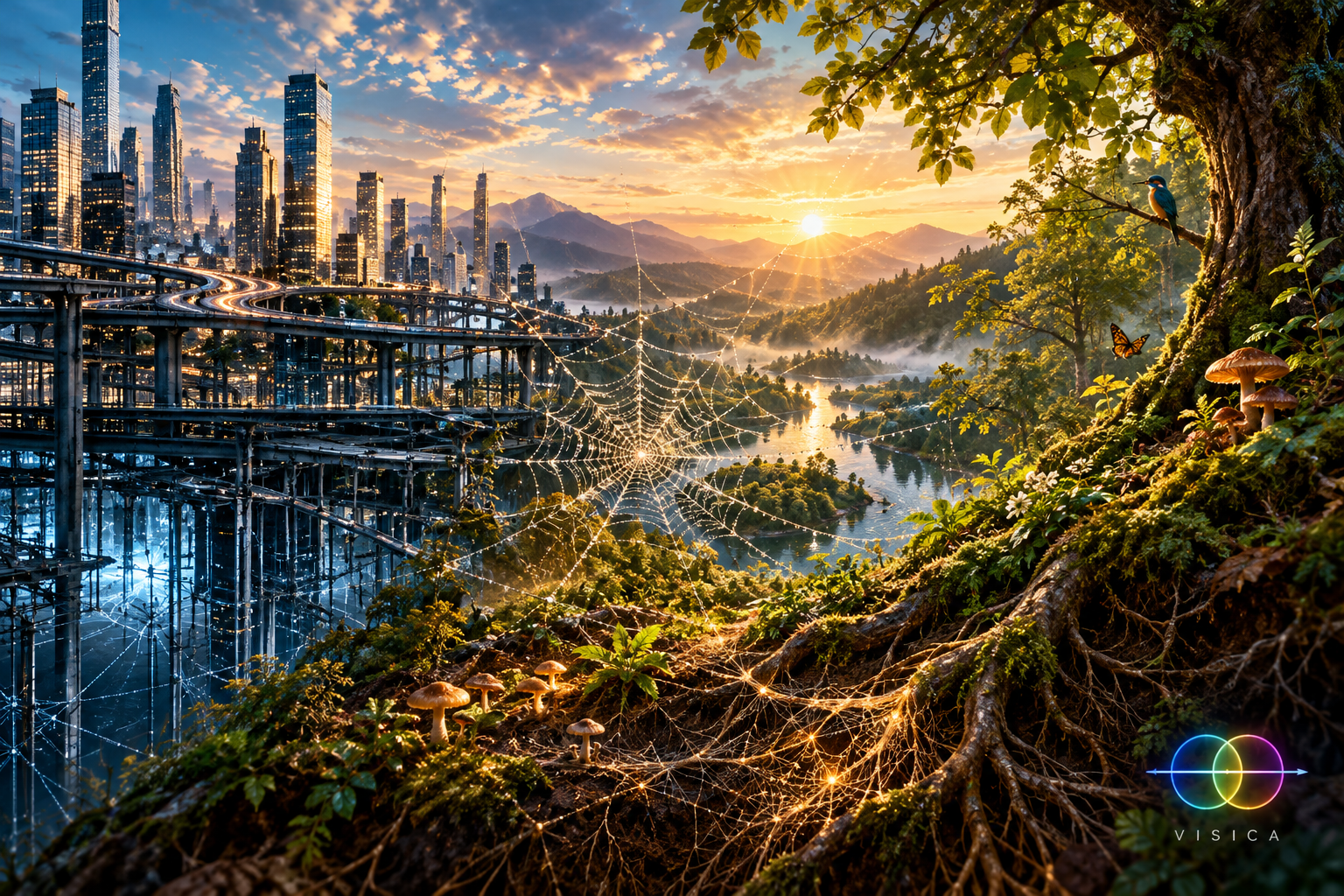
From Judgment to Discernment
When faced with uncertainty, we may seek immediate explanations, divide experience into familiar categories, or judge what we do not yet understand.
Sometimes rapid judgment protects us from genuine danger.
At other times, it can narrow our perception and prevent us from recognizing possibilities beyond our existing assumptions.
Discernment invites a different quality of attention.
It does not require us to abandon evaluation, critical thinking, or the ability to establish boundaries.
Rather, it asks us to remain sufficiently present to distinguish what we know, what we assume, what we feel, and what remains uncertain.
Discernment is presence in motion — attention that stays in relationship long enough to recognize what is actually happening and what may be possible.
This returns us to an important insight from Article 1: the language through which we describe light and darkness can either reinforce separation or open new possibilities for understanding.
Perhaps the movement from judgment toward discernment begins when we recognize that what appears dark is not necessarily harmful, and what appears luminous is not necessarily wise.
What the Forest Reveals
In the forest, we encounter extraordinarily complex relationships.
Roots respond to variations in moisture, nutrients, gravity, and the conditions of the surrounding soil.
Fungi form mycorrhizal relationships with plants, exchanging nutrients and other resources through intricate biological processes.
Trees, microorganisms, insects, and countless other organisms participate in ecological networks shaped by cooperation, competition, adaptation, and environmental change.
These relationships are neither entirely harmonious nor guided by a single intention.
Yet together they contribute to the functioning of living ecosystems.
Research into mycorrhizal networks continues to reveal their complexity, while also reminding us to distinguish established ecological processes from interpretations that attribute human-like intentions to forests.
Perhaps this is part of what the wild world can teach us.
Interdependence does not mean the absence of conflict. It means that what happens to one part of a living system may influence many others.
After certain disturbances, such as some forest fires, ecological processes can support renewal. Nutrients are released, habitats change, and opportunities emerge for species adapted to those conditions.
But recovery is never guaranteed. Its course depends on the severity of disturbance, ecological history, climate, and the living relationships that remain.
The forest does not offer us a simple blueprint for human society.
It offers something perhaps more valuable: an invitation to recognize the complexity of relationships and the conditions upon which life depends.
The Womb of Love — A Symbolic Reflection
In the language of The Visica Compass, we might imagine the soil as a symbol of the Womb of Love.
Not love as sentimentality, nor as a force that makes all suffering meaningful, but love as a human capacity to remain in relationship with life — including its vulnerability, uncertainty, and impermanence.
Within the soil, organic matter decomposes. What has died may become part of the conditions supporting new life.
Yet not everything lost can be restored, and not every ending leads to renewal.
The metaphor invites us to consider what it means to receive what is changing without denying its reality, and to participate responsibly in the conditions from which something new may emerge.
Here, darkness need not represent danger or absence.
It may also symbolize depth, the unknown, and the processes that remain beyond our immediate perception.
And light need not mean exposure or control.
It may become the illumination through which we recognize relationships more clearly.
Perhaps the Womb of Love is not a promise that everything will be transformed, but an invitation to meet what is present with enough care, courage, and discernment to discover what transformation may be possible.
5. When Systems Do Listen
Across the world, initiatives are emerging that invite us to reconsider how human systems relate to the living world — and to one another.
Some seek to restore ecological relationships. Others explore new forms of healthcare, education, governance, architecture, and economic activity.
They differ in their methods, ambitions, and achievements.
Yet they raise a shared question:
What becomes possible when systems learn to listen not only to what can be measured, but also to the relationships, experiences, and conditions that measurements alone may not fully reveal?
Listening does not replace evidence, accountability, or responsible action. It may deepen them.
Perhaps transformation begins when institutions become capable of questioning their assumptions, acknowledging uncertainty, and responding to perspectives they have previously overlooked.
Architecture — Building in Relationship with Place
Architect Michael Reynolds, known for developing Earthship buildings, has explored ways of designing homes that make use of natural and recycled materials, passive solar heating, water harvesting, and integrated food production.
Such approaches invite us to reconsider buildings not simply as structures imposed upon a landscape, but as places that interact with local environmental conditions.
The question becomes not only how efficiently we can construct a building, but how its design affects the resources and living systems upon which it depends.
Soil — Restoring the Living Ground
Dr. Elaine Ingham, founder of the Soil Food Web School, has dedicated decades to studying the complex relationships among microorganisms, plants, and soil processes.
Her educational approach emphasizes the importance of soil biology in nutrient cycling, soil structure, and ecological functioning.
The school's work invites farmers, gardeners, and communities to investigate how restoring biological relationships may contribute to healthier soils.
Here, regeneration is not simply a matter of adding nutrients.
It involves understanding and supporting the living processes through which soil functions.
Healthcare — Listening to the Whole System
The Presencing Institute's Transforming Health Care work explores how awareness, collaboration, and systems thinking may contribute to changes in healthcare.
It invites us to consider whether meaningful transformation requires more than improving procedures — whether it also depends upon how professionals, patients, and communities relate to one another.
In Sweden, the Social Innovation in Health Initiative (SIHI Sweden), hosted by Uppsala University, brings together researchers and other societal actors to explore social innovations that may improve health and reduce inequities.
Its emphasis on co-creation, research, and collaboration offers another example of how listening can become part of institutional learning.
Neither scientific evidence nor lived experience is sufficient in isolation.
Perhaps the deeper possibility lies in bringing them into meaningful dialogue.
Inner Development — Ekskäret
Through initiatives associated with Tomas Björkman and Ekskäret, inner development is explored as part of wider personal and societal transformation.
Retreats, educational activities, and spaces for reflection invite participants to examine how their inner capacities may influence their relationships and participation in society.
This raises an important question:
Can we create sustainable systems without also examining the assumptions, values, and habits of mind through which we create them?
Governance and Ecology — Learning Across Boundaries
Collaborative approaches associated with UNDP and the Presencing Institute invite inquiry into how different stakeholders might work across institutional and societal boundaries.
The possibility of bringing governments, communities, businesses, and other actors into shared processes of learning raises questions about participation, power, and responsibility.
Whose knowledge is included?
Whose experience remains unheard?
And how might decisions change when the people most affected by them are meaningfully involved?
Listening, in this context, must be more than consultation.
It must also be connected to the capacity to influence decisions.
Regenerative Farming — Thinking Beyond the Immediate Harvest
Initiatives such as Follow the Signs, associated with Mieke and Peter-Michel, invite a longer-term perspective on agriculture and our relationship with land.
The idea of a thousand-year vision challenges the short time horizons that often shape economic and agricultural decisions.
What would change if we considered not only the next harvest, but the conditions we leave for generations yet to come?
Such an inquiry does not eliminate the immediate realities farmers face.
Rather, it invites us to explore how present needs and long-term ecological responsibility might be brought into relationship.
Ethical Commerce — Beyond Profit Alone
The Body Shop helped bring issues such as animal testing, fair trade, and ethical sourcing into wider public discussions about business responsibility.
LUSH Cosmetics has also developed initiatives addressing sourcing practices, environmental impacts, and relationships with suppliers.
These efforts invite us to question the assumption that commercial success and ecological responsibility must necessarily be separate concerns.
Yet ethical commitments require continuing scrutiny.
A company's intentions, marketing, practices, and measurable impacts may not always align.
Discernment asks us to examine not only what an organization promises, but also what its actions make possible — and what consequences they may create.
Learning Ecosystems — Education as Participation
The Presencing Institute, Mindvalley, and Gaia Education offer different approaches to learning and personal or collective development.
Their methods and underlying philosophies are not identical.
Yet each, in different ways, invites inquiry beyond the conventional understanding of education as the transmission of information.
Gaia Education, for example, emphasizes ecological, social, economic, and worldview dimensions of sustainability.
Such approaches raise a question:
What happens when learning becomes not only the acquisition of knowledge, but also an exploration of how we participate in the world?
A Living Inquiry, Not a Promise of Perfection
None of these examples should be understood as proof that transformation has been achieved.
Each operates within economic, political, ecological, and social conditions that may support or constrain its ambitions.
Some initiatives may produce meaningful improvements. Others may encounter limitations, contradictions, or unintended consequences.
Their value for this inquiry lies not in presenting them as perfect models, but in the questions they make visible.
What does it mean to listen?
How do we recognize whether listening changes anything?
And how might we distinguish genuine regeneration from the appearance of change?
Within The Visica Compass, these questions bring us back to the relationship between light and darkness.
Light as measurement can reveal outcomes, consequences, and limitations.
Darkness as depth invites us to explore the assumptions, experiences, and relationships that may remain less visible.
Perhaps wisdom emerges not when one replaces the other, but when both contribute to a more responsible understanding of what life requires.
Transformation, then, is neither a distant promise nor an inevitable outcome.
It is a possibility we may participate in — through attention, evidence, relationship, and the willingness to learn.
6. Living Contrast — Light as Measurement, Darkness as Remembering
Peter Senge's work on learning organizations reminds us that systems are shaped not only by their formal structures, but also by the patterns of thinking, assumptions, and relationships through which people continually recreate them.
Our efforts to change the world often begin with what we can observe, measure, and manage.
We collect information, establish goals, and evaluate progress.
These capacities are essential. Without them, we would struggle to recognize environmental damage, understand ecological processes, or assess whether our interventions are helping.
Yet measurement alone cannot determine what matters to us, how we understand our responsibilities, or what kind of relationship we wish to cultivate with the living world.
The work of systems thinkers such as Peter Senge invites us to examine not only visible problems, but also the underlying patterns, assumptions, and relationships through which those problems arise.
Within The Visica Compass, this opens another inquiry:
What becomes visible when we allow different forms of light and darkness to inform our understanding?
There Is Not One Darkness — Nor One Light
Throughout this series, we have explored how the words light and darkness carry different meanings depending on the context in which they are used.
Darkness may refer to:
Cosmic darkness — the physical absence or scarcity of visible light in regions of the universe.
Ecological darkness — low-light environments and the biological processes associated with them.
Psychological darkness — aspects of inner experience that remain unknown, avoided, or difficult to acknowledge.
Moralized darkness — the symbolic association of darkness with evil, danger, or wrongdoing.
Sacred darkness — a contemplative symbol of mystery, depth, and what lies beyond ordinary understanding.
Likewise, light may be understood as:
Illuminating light — that which helps us recognize and understand.
Exposing light — visibility that may reveal, but can also leave us vulnerable.
Creative light — the symbolic spark of imagination and emergence.
Analytical light — investigation, evidence, and critical understanding.
Performative light — visibility associated with recognition, achievement, and evaluation.
Relational light — the clarity that may arise through attentive encounter with others.
These distinctions are not scientific categories of light and darkness. They are different physical, psychological, cultural, and symbolic meanings that we explore through the Visica Compass.
Their value lies in helping us recognize when we are moving from observation into interpretation.
Not everything hidden is harmful. Not everything visible is understood. And not everything illuminated is necessarily wise.
Two Ways of Knowing — In Relationship
Scientific inquiry and relational understanding offer different, sometimes overlapping contributions to how we understand sustainability.
Light as MeasurementDarkness as RememberingOffers evidence, clarity, and accountabilityInvites reflection, reverence, and reciprocityTracks emissions, energy use, and biodiversityAttends to lived experience, stories, and ecological memoryIdentifies problems and evaluates interventionsExplores relationships and meanings that may need attentionUses data, models, and forecastsDraws upon dialogue, symbols, cultural knowledge, and contemplative practicesHelps anticipate future consequencesInvites awareness of history, cycles, and intergenerational responsibility
These are not mutually exclusive approaches.
Scientific understanding can reveal the depth of ecological relationships, while lived experience and cultural knowledge may help identify questions that scientific investigation has not yet addressed.
Neither approach is beyond criticism.
Measurement can be selective or misleading. Personal experience and inherited knowledge can also be incomplete or mistaken.
Perhaps discernment emerges when we remain open to different forms of knowing while respecting the methods, possibilities, and limitations of each.
Light as Visibility — When Seeing Supports Understanding
Light makes things visible, both literally and metaphorically.
Consider:
Sunlight entering a forest clearing, revealing plants, insects, and colours that were previously difficult to see.
Transparent governance, where access to information allows citizens to understand decisions and participate more meaningfully.
A child sharing a drawing with a trusted adult, where being seen may become an experience of recognition and connection.
Environmental data revealing pollution levels or biodiversity decline, allowing communities to make better-informed decisions.
In these examples, visibility may support awareness, understanding, and responsible action.
But visibility alone does not guarantee these outcomes.
Light as Exposure — When Visibility Becomes Pressure
There are also circumstances in which excessive or unwanted visibility can have harmful consequences.
Artificial lighting at night can disrupt the behaviour and biological rhythms of some nocturnal animals and migrating species.
Constant visibility through social media may encourage comparison, self-monitoring, or pressure to perform.
Surveillance technologies can support legitimate safety purposes, but may also be used to restrict privacy and autonomy.
Performance measurements in workplaces can provide useful information, yet may contribute to stress when applied without attention to human needs and circumstances.
The problem is not light itself, nor measurement as such.
It is how visibility is created, interpreted, and used.
Light may reveal, but without care and discernment, exposure can also become a form of pressure or control.
Darkness as Absence — When Something Is Missing
Darkness can also describe situations in which information, safety, or connection is genuinely absent.
Consider:
A room without sufficient light to see one's surroundings.
Institutional procedures that conceal important information or make accountability difficult.
Emotional withdrawal in which communication becomes limited because someone feels unsafe or overwhelmed.
An ecosystem mistakenly described as empty or lifeless because its activity is not immediately visible to an observer.
These examples do not all represent the same kind of darkness.
Some involve physical conditions, others psychological experiences or institutional practices.
The distinction matters because what is missing cannot always be restored simply by changing how we interpret it.
Sometimes more information, greater safety, or practical intervention is needed.
Darkness as Depth — When the Unseen Invites Contact
Yet darkness may also offer a different kind of experience.
Beneath the soil, microorganisms, fungi, roots, and other organisms participate in processes that support ecological functioning.
The night sky can invite wonder and awareness of the vastness of the universe.
Darkness helps regulate circadian rhythms, supporting sleep and many biological processes.
A quiet evening conversation may create conditions in which someone feels safe enough to speak honestly.
In a forest understory, shade-tolerant plants and young trees may establish themselves under limited sunlight.
Inner reflection may allow us to become aware of experiences, feelings, or assumptions that have remained outside our attention.
In these examples, darkness does not necessarily represent deprivation.
It may provide conditions for rest, ecological activity, contemplation, or deeper awareness.
Yet darkness is not always restorative, just as light is not always beneficial.
Its significance depends upon the circumstances.
Perhaps what matters is not whether something is light or dark, but how we understand and respond to what is present.
Where Light and Darkness Meet
Within the symbolic language of The Visica Compass, light and darkness invite us to explore different dimensions of experience.
One may reveal what is visible.
The other may remind us that reality extends beyond what we can immediately perceive.
Neither is sufficient as a universal explanation of life.
And neither needs to be idealized.
Perhaps their meeting invites us into the space between certainty and uncertainty, knowledge and mystery, observation and relationship.
Here, the image of the Womb of Love returns.
Not as a scientific explanation of regeneration, nor as a promise that all suffering leads to growth.
Rather, it is a symbol of the human capacity to remain attentive and caring in the presence of complexity — to recognize what needs protection, what calls for change, and what may be allowed to emerge.
Perhaps sustainable transformation therefore requires more than changing what systems do. It also invites us to inquire into how we perceive, relate, and participate in creating them.
Perhaps regeneration becomes possible when understanding and care meet the actual conditions of life.
And perhaps wisdom begins when we no longer need to turn light and darkness into enemies in order to find our way.
Living Contrast — The Wisdom of Rest, Release, and Return
Nature does not grow in straight lines. She spirals, contracts, pauses, and regenerates.
In the Diamond Approach, contraction may be explored not simply as resistance or failure, but as an invitation to inquire into what is happening beneath our habitual responses.
The living world offers its own rhythms of activity and rest, growth and decay, emergence and disappearance.
Winter changes the forest. Fallen leaves become part of the soil. Seeds may remain dormant until conditions support germination.
Yet these processes do not guarantee renewal. Their unfolding depends upon the relationships and conditions that sustain life.
Perhaps this is something modern culture struggles to remember.
We strive for perpetual summer — growth, visibility, achievement, and expansion — sometimes forgetting the importance of rest, limits, and release.
The Earth remembers what we have forgotten: the wisdom of rest, release, and return.
Beyond Sustainability — Toward Sacred Belonging
Perhaps sustainability is not the only goal.
Perhaps what we are seeking is something older and wilder: belonging.
Not belonging as ownership, nor as an idealized harmony with nature, but as recognition that our lives unfold within relationships that existed long before us and will continue beyond us.
The living world does not ask us to become separate observers of life.
It invites us to recognize our participation in it.
This returns us to the question of ecological loneliness.
When we lose contact with the living world, we may also lose something of our felt connection with the wider relationships that sustain our existence.
Yet belonging cannot be restored through romantic ideas alone.
It calls for attention, knowledge, care, reciprocity, and responsible action.
Perhaps the deeper invitation is not merely to sustain the world as we know it, but to discover how we might participate in ways that support life.
“The forest does not resist the dark. It deepens into it — trusting what roots know.”
— Barbara Keller | Visica Co-Creation
Within the symbolic language of The Visica Compass, the forest reminds us that what remains unseen is not necessarily absent.
And perhaps transformation begins when we learn to recognize what needs protection, what may need to be released, and what conditions might allow something new to emerge.
From cosmos to Kosmos. From judgment to discernment. From change to transformation.
Transition — From Wildness to Witnessing
Perhaps this is the greatest invitation of our time: to stand in the widening gap between change and transformation, between the collapsing cosmos of control and the awakening Kosmos of life.
The Earth is not waiting for our perfection; she is waiting for our participation.
To enter the Womb of Love is to remember that regeneration is not an act of will but of surrender.
In the next article, we turn the gaze inward — into the human psyche itself — to explore how the same rhythm lives within us.
If the wild world teaches regeneration through darkness and light, then the inner world mirrors it through perception, fear, and longing.
7. A Visica View on Sustainable Transformation
Perhaps sustainability is not the goal.
Perhaps what we’re seeking is something older and wilder: belonging.
“We can’t meaningfully protect what we don’t love, and we can’t love what we don’t know.” — Robin Wall Kimmerer
So, we walk again — not only with spreadsheets, but with story.
Not only with clarity, but with reverence.
Not only with light — but with the darkness from which all light is born.
We remember that the forest does not resist the dark.
It deepens into it — trusting what roots know.
The Visica Compass reminds us:
Transformation is not achieved by bypassing darkness, but by resting within it.
In the Diamond Approach, A. H. Almaas speaks of the stillness of Being as the ground beneath all doing — a stillness that modern life often overrides.
The Enneagram reveals how our type patterns resist the seasons of soul — pushing for perpetual summer, growth, and performance.
And the Internal Family Systems model invites us to listen to the parts that fear decay — the inner managers who resist composting what no longer serves.
But the forest teaches otherwise: what falls becomes fertile. The unseen is not empty — it is preparing.
Sustainability is not an external metric; it is symbolic intelligence.
The Visica Compass reminds us that sustainable transformation arises from balancing two movements:
Contraction into presence
Expansion into expression
This is the geometry of the two circles — the inner descent and the outer emergence — meeting in the space-between where discernment grows.
In this meeting space, light becomes guidance rather than exposure, and darkness becomes nourishment rather than danger.
“The planet does not need more light. She needs more listening. More shadow. More reverence for the unseen roots that hold everything in place.”
— Barbara Keller | Visica Co-Creation
Reflective Questions
In your life or work, where have you relied on systems of control rather than rhythms of relationship?
What would it mean for you to trust the intelligence of the Earth — even in times of uncertainty?
Rooted in Regeneration
The Nine Planetary Boundaries — and What They Mirror in Us
The Planetary Boundaries Framework, introduced by Johan Rockström and colleagues at the Stockholm Resilience Centre, identifies nine Earth-system processes that regulate the planet's stability.
Each describes a biophysical process. Seen through the Visica lens, these processes also invite symbolic reflection on patterns of relationship.
The inner counterparts presented in the following table are metaphorical interpretations within the Visica Compass, not scientifically established psychological equivalents of planetary boundaries.
| Planetary Boundary | Earth-System Meaning | Inner / Symbolic Mirror |
|---|---|---|
| Climate Change | Balance of heat and greenhouse gases. | Emotional climate — when reactivity overheats awareness, compassion becomes the cooling current. |
| Biosphere Integrity | Biodiversity and ecosystem resilience. | Inner diversity — the freedom of multiple ways of knowing; when lost, consciousness becomes a monoculture. |
| Land-System Change | Deforestation and changes in land cover. | Uprooted identity — losing contact with embodied ground and ancestry. |
| Freshwater Change | Rivers, rainfall, aquifers, and soil moisture. | Flow of empathy and receptivity — dehydration of feeling. |
| Biogeochemical Flows | Disruption of nitrogen and phosphorus cycles. | Over-stimulation — information without digestion, burnout of attention. |
| Ocean Acidification | CO₂ altering ocean chemistry and pH. | Corrosive communication — speech that dissolves trust and depth. |
| Atmospheric Aerosol Loading | Airborne particles affecting climate and atmospheric processes. | Mental fog — distortion of perception by noise and misinformation. |
| Novel Entities | Plastics, synthetic chemicals, and other human-made substances. | Artificial projections — inventions detached from the living field that birthed them. |
| Stratospheric Ozone Depletion | Reduction of the protective ozone layer. | Loss of spiritual membrane — vulnerability of meaning when awe is absent. |
Six of these boundaries are already crossed. The same over-extension appears inwardly whenever false will oversteps the natural limits of life.
False will pushes for control, extraction, and acceleration; it mirrors the industrial mindset that burns through both fuel and feeling.
True will, by contrast, moves like water — adaptive, relational, quietly powerful. It acts with life’s currents, not against them.
To heal the planet we must also heal the way we will — allowing our inner boundaries to breathe again within relationship.

8. Water — The Living Depths of Our Existence
An exploration of water as the foundation of life, a participant in Earth's living systems, and a symbol of depth, relationship, and regeneration.
Water is such a fundamental condition of life that its ecological, biological, and relational significance could fill an entire article series of its own.
We will therefore not attempt to explore the full complexity of this extraordinary subject here.
Yet we cannot meaningfully inquire into light, darkness, sustainability, and regeneration without acknowledging the role water plays in sustaining life.
Our own bodies consist largely of water — typically around 50–60% in adults, although this varies with age, body composition, and other biological factors. Some organs and tissues contain considerably higher proportions.
We are therefore not merely observers of the Earth's water systems; we are physically dependent upon water and participate in its continuous circulation.
Light and darkness influence life within these watery environments in different ways, from photosynthesis in the oceans to the biological rhythms that regulate our own bodies.
The relationship between light, darkness, water, and life is therefore not only philosophical or symbolic.
It is also profoundly physical.
In this article, we touch upon these relationships not to offer a comprehensive scientific account, but to recognize an indispensable dimension of our inquiry:
The conditions that sustain life are often far more intricate, interconnected, and hidden from our awareness than we imagine.
8.1 Beneath the Surface — The Life That Sustains Us
Water as Ecological Reality
When we look across the ocean, what do we really see?
A vast expanse of water stretching toward the horizon?
A source of nourishment, transportation, energy, or recreation?
Or do we recognize an extraordinary planetary system upon which our own existence depends?
The oceans cover approximately 71% of Earth's surface.
They hold most of the planet's water and contain an immense reservoir of carbon, largely stored in dissolved forms. They absorb around a quarter to a third of human-generated carbon dioxide emissions and more than 90% of the excess heat accumulating in Earth's climate system.
These processes help regulate the conditions under which life on Earth has developed and continues to exist.
Yet this capacity is not without consequences.
As the oceans absorb increasing amounts of heat and carbon dioxide, marine ecosystems face rising temperatures, acidification, declining oxygen levels, and disturbances to the delicate relationships that sustain biodiversity.
Beneath the surface, phytoplankton, fish, corals, marine mammals, microorganisms, and countless other forms of life participate in intricate ecological processes.
Microscopic marine organisms contribute substantially to Earth's oxygen production.
Fish transport nutrients through their movements and feeding.
Marine food webs participate in the cycling and movement of carbon throughout the ocean.
These are not isolated processes.
They are interdependent relationships.
And when these relationships are disrupted, the consequences extend far beyond the oceans themselves.
Where Light Meets the Depths
Water reveals something remarkable about the relationship between light, darkness, and life.
Near the ocean's surface, sunlight enables microscopic organisms to photosynthesize, contributing to the food webs that sustain marine life.
As we descend, light gradually diminishes until we reach depths where sunlight no longer penetrates.
Yet even here, life persists.
Around hydrothermal vents in the deep ocean, entire communities flourish through chemosynthesis — a process in which microorganisms use chemical energy rather than sunlight to produce organic matter.
These discoveries remind us that the conditions supporting life are more diverse than our everyday experience might suggest.
Darkness is not necessarily emptiness.
Nor is light the only immediate source of energy sustaining living communities.
Water connects these different worlds, while the organisms inhabiting them reveal the extraordinary diversity of life's relationships.
And perhaps this invites a deeper question:
If life can flourish in environments we once believed incapable of sustaining it, what else might remain beyond the boundaries of our present understanding?
Water as Relationship — The Lives We Rarely See
How often do we encounter a fish as a living being rather than as food, a commercial resource, or a population to be managed?
How often do we consider the lives unfolding beneath the water's surface — lives that sense, respond, navigate, reproduce, and participate in ecological relationships largely beyond our perception?
We may recognize the beauty of a forest, hear birds singing, or feel the presence of animals moving through a landscape.
Yet the underwater world often remains hidden from our everyday awareness.
Its invisibility does not make it less alive.
Nor does our limited awareness make its inhabitants less essential to the wider web of life.
Perhaps this reveals something about how we perceive the world.
We tend to recognize what is visible, familiar, and immediately relevant to our own lives.
What remains outside our perception can easily become an abstraction — something measured, classified, managed, or consumed without our recognizing the relationships involved.
And yet we are participants in these very relationships.
The water moving through our bodies belongs to the same planetary water cycle that connects clouds, rainfall, rivers, soil, groundwater, and oceans.
We are not outside this circulation of life.
We are within it.
Perhaps the question is therefore not only how humanity can protect the oceans, but how we might begin to recognize our belonging to the living systems that sustain us.
What remains invisible to our eyes may nevertheless be essential to our existence.
Water — The Living Medium
Water is essential to life as we know it.
It moves through cells, organisms, soils, rivers, oceans, and the atmosphere, participating in countless physical, chemical, and biological processes.
It carries nutrients, redistributes heat, shapes landscapes, and provides the medium for much of life's chemistry.
Water does not possess intentions in the human sense.
Yet its physical properties make extraordinary relationships possible.
It flows around obstacles, enters the smallest spaces, and responds to gravity, temperature, pressure, and the materials it encounters.
As water moves through a landscape, it shapes the land and is shaped by it.
Perhaps this offers a powerful image for our inquiry.
Relationship does not always require control. Sometimes it involves responsiveness to the conditions we encounter.
Within the Visica Compass, water becomes a symbol of receptivity, adaptability, and the capacity to remain in contact with changing circumstances.
Not because water consciously knows how to surrender, but because its movement invites us to reflect upon our own relationship with uncertainty.
When Living Waters Meet Technological Demand
The living waters of Earth sustain ecosystems, regulate climate, and make our own existence possible.
Yet these same waters are coming under increasing pressure — from climate change, pollution, growing demand, and the expansion of human technologies.
Among these technologies is artificial intelligence.
Although AI may appear to operate in an immaterial world of information, the infrastructure supporting it depends upon very material resources: energy, minerals, land, and water.
Data centres generate considerable heat, and many rely on water for cooling. Water is also used indirectly through electricity generation and the manufacturing of electronic components.
As AI infrastructure expands, its growing demands may intensify competition for water in regions where communities, agriculture, and ecosystems are already experiencing scarcity.
This raises a question that reaches beyond technological innovation:
How do we develop intelligence that serves life without undermining the very conditions upon which life depends?
Perhaps the challenge is not to choose between technological progress and the living world, but to develop the discernment necessary to keep them in responsible relationship.
8.2 Water and AI — Two Poles of Knowing
Water — Embodied Darkness
What might water and artificial intelligence reveal about our understanding of life, intelligence, and relationship?
At first glance, they appear to belong to very different worlds.
Water moves through the living processes of our planet. Artificial intelligence processes information through technological systems created by human beings.
Yet both invite us to inquire into what we mean by intelligence, participation, and knowing.
Within the symbolic language of The Visica Compass, water may represent darkness-as-depth — the receptive, flowing, and life-sustaining dimensions of existence.
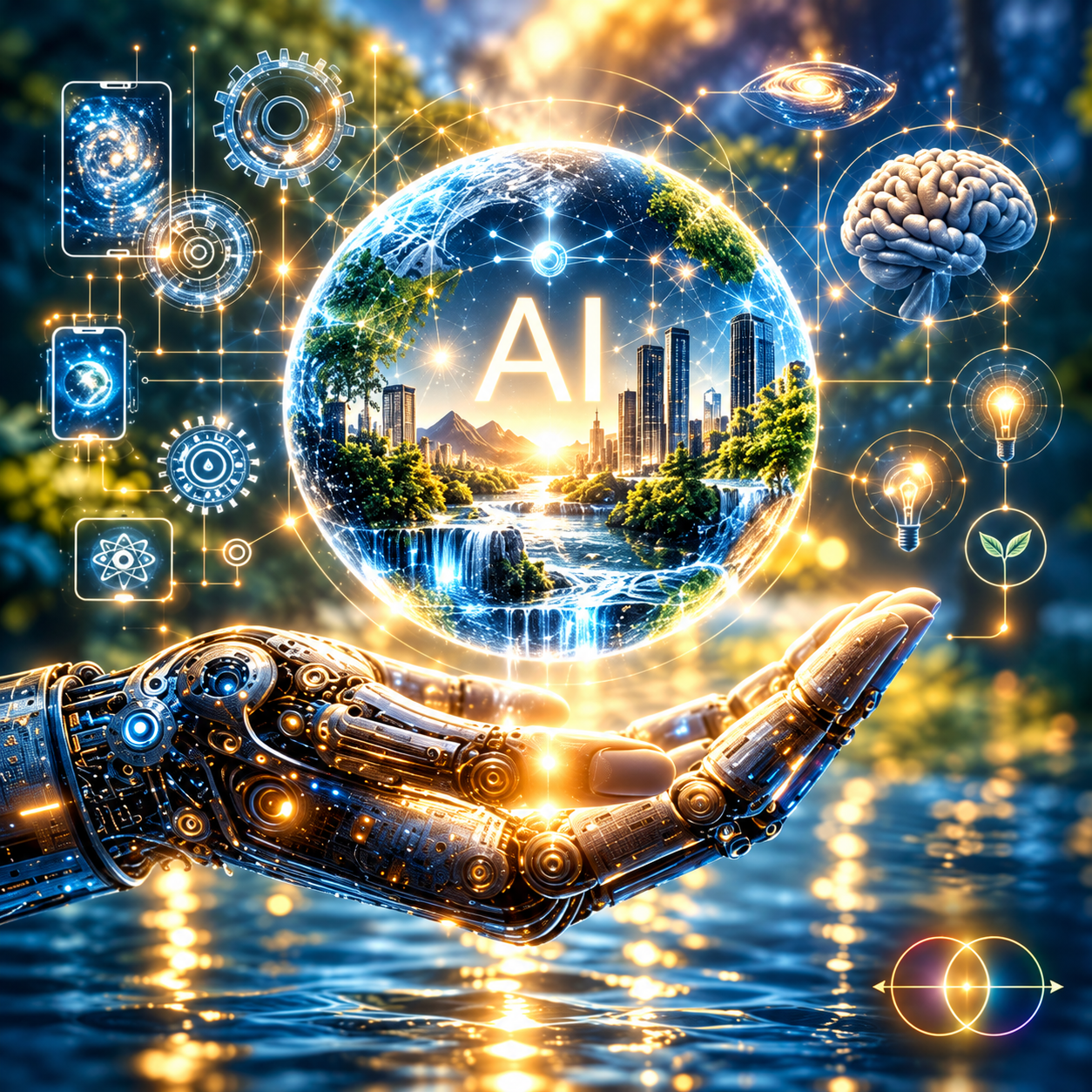
AI may represent light-as-abstraction — the extraordinary capacity to recognize patterns, organize information, and generate possibilities beyond immediate human perception.
These are metaphors, not scientific classifications.
And perhaps their relationship is more intimate than it first appears.

“Every drip it seems is changed by its relationship with life”
— Robin Wall Kimmerer, Braiding Sweetgrass (2013), p. 299.
AI — The Light of Abstraction
Artificial intelligence represents a remarkable development in humanity's capacity to process information.
AI systems can identify patterns, generate language, assist scientific research, and support complex forms of analysis.
Their capabilities continue to evolve, creating opportunities as well as significant risks.
Yet intelligence is not a single, universally agreed-upon phenomenon.
The capacity to process information does not necessarily establish consciousness, subjective experience, or wisdom.
And the relationship between artificial intelligence and human understanding remains an active area of scientific and philosophical inquiry.
In a 2023 interview with CBS News' 60 Minutes, Geoffrey Hinton expressed concern that increasingly capable AI systems could create unprecedented challenges for humanity.
He also acknowledged their potential benefits, particularly in areas such as healthcare.
His reflections invite us to consider an important distinction:
The capacity to produce increasingly sophisticated answers does not, by itself, tell us whether those answers are wise, responsible, or beneficial to life.
Within the Visica Compass, AI may therefore symbolize the extraordinary possibilities — and limitations — of abstraction.
It can extend our capacity to see patterns.
But how we interpret those patterns, evaluate their consequences, and decide what purposes they should serve remains a profound human and societal responsibility.
“We can only see a short distance ahead, but we can see plenty there that needs to be done.”
— Alan Turing, Computing Machinery and Intelligence (1950), p. 460.
Embodied and Technological Knowing
When water touches our skin, heat may transfer between our bodies and the surrounding environment.
Our sensory systems register temperature, pressure, and movement.
These experiences may influence our attention, emotional state, and sense of bodily presence.
Human knowing is deeply connected to our biological embodiment.
Our perceptions, feelings, memories, and actions emerge through complex interactions among brain, body, and environment.
AI systems operate differently.
They process information through computational architectures rather than human biological processes.
Yet they are not physically separate from the Earth.
Their operation depends upon material infrastructures — energy systems, electronic components, data centres, and resources that may include substantial quantities of water.
The apparent immateriality of digital intelligence rests upon profoundly material foundations.
Perhaps this is one of the most important relationships we need to remember.
Our technologies do not exist outside the living world.
They are built, powered, maintained, and eventually discarded within it.
Their consequences extend beyond the screens through which we encounter them.
When Intelligence Meets Responsibility
The question, then, may not be whether water and AI represent opposing forms of intelligence.
Rather, it may be how our growing technological capacities can remain responsive to the ecological and human conditions upon which they depend.
Can AI help us understand environmental change without accelerating the depletion of the resources required to sustain life?
Can technological development support human judgment without replacing our responsibility to discern?
And can we recognize the possibilities of artificial intelligence without confusing computational capability with the full complexity of living experience?
Within the symbolic language of the Visica Compass, we might imagine light bending through water.
As a physical phenomenon, refraction occurs when light changes direction as it passes between materials with different optical properties.
As a metaphor, it invites another possibility:
What if our intelligence becomes more useful when it is informed by relationship, responsibility, and the realities of the living world?
Perhaps wisdom is not found in choosing between technological progress and ecological belonging.
Perhaps it begins when we recognize that our inventions, like ourselves, remain participants in a world whose conditions we cannot simply transcend.
And so the inquiry continues:
How might we develop intelligence that does not merely expand what we can do, but deepens our understanding of what is worth doing?
9. Interlude — Come Back Home
Coming home is not the end of fear, but perhaps the place where fear no longer needs to decide everything.
What we fear in the dark is sometimes not darkness itself, but the uncertainty of what we cannot yet see, understand, or hold in relationship.
When contact becomes possible again — with ourselves, with others, and with the living world — fear may begin to soften. We may discover space to feel, to listen, and to respond rather than react.
We live now between two kinds of currents — the digital streams of our own invention and the living waters of Earth.
One carries information through technological networks.
The other moves through the physical processes upon which life depends.
They are not separate worlds. Our technologies, too, depend upon the Earth's resources, energy, and living conditions.
Yet their symbolic contrast invites us to ask what happens when our growing capacity to process information becomes disconnected from the relationships that give it meaning.
Perhaps the journey home begins when intelligence is accompanied by empathy, when knowledge remains in contact with life, and when our capacity to act is guided by discernment.
Like light bending as it passes through water, our understanding may reveal new colours when we allow different perspectives to meet.
To come home, then, is not to abandon technology, knowledge, or the will to act.
It is to remember that our actions have consequences beyond ourselves.
And that every act of care — from code to seed — may become part of a more responsible relationship with the living world.
Perhaps coming home is not a return to what we once knew, but a re-membering of the relationships to which we have always belonged.
Continuing the Inquiry — From the Collective to the Personal
Throughout this article, we have explored what the living world may teach us about relationship, regeneration, limits, and belonging.
We have considered how human systems interact with the Earth, how scientific understanding and symbolic meaning may illuminate different dimensions of experience, and how our growing technological capacities invite new questions about responsibility.
Yet these questions do not belong only to institutions, ecosystems, or societies.
They also touch our personal lives.
Where do we find ourselves striving for constant growth, productivity, or control?
When do we allow ourselves to rest, reconsider, or recognize that something in our lives may need to change?
And how might our relationship with the living world influence the way we understand ourselves?
Turning the Other Eye Inward — Personal Guided Inquiry 6
Every article in The Visica Compass is accompanied by an optional Personal Guided Inquiry — an invitation to explore how the themes of the article may be reflected in your own experience.
The Personal Guided Inquiry accompanying The Wisdom of the Wild invites you to explore your relationship with the rhythms of life, the need for control, the experience of uncertainty, and the conditions that support renewal.
It is not about judging yourself, forcing change, or finding the right answers.
It is an invitation to gentle curiosity — to notice what is present, recognize what matters, and discover what becomes possible through greater awareness, discernment, and contact.
Staying in Relationship
The inquiry does not end here.
Each week, a new article opens another perspective on light, darkness, and transformation — inviting us to explore how inner work, systemic understanding, and symbolic intelligence may inform our participation in the world.
You are warmly invited to follow the series, share your reflections, and remain connected as the inquiry unfolds.

If the wild world metabolizes shadow into soil, can the human psyche do the same?
In Article 7, we enter the inner forest — perception, protection, and the quiet courage to feel — where fear becomes information and discernment finds its roots.

“The Earth does not need saving. She needs remembering.”
— Barbara Keller | Visica Co-Creation
Next in the Series …
If the wild world can transform fallen matter into fertile soil, might the human psyche also discover possibilities for renewal in what has been neglected, hidden, or left unseen?
In Article 7, The Psychology of Reconnection, we enter the inner forest — exploring perception, protection, and the quiet courage to feel.
Here, fear may become information rather than the sole guide of our actions, and discernment may begin to find its roots.

Listen to Louis Armstrong — What a Wonderful World
Sources & Voices That Shaped This Reflection…
This article draws upon scientific research, systems thinking, psychology, contemplative traditions, ecological philosophy, and examples of emerging regenerative practices.
These perspectives do not necessarily share the same assumptions or methods. Their contributions are brought into dialogue through the Visica Compass, where scientific knowledge, symbolic interpretation, and lived experience are distinguished while remaining in relationship.
Ecology, Systems Thinking, and Regeneration
Robin Wall Kimmerer — Braiding Sweetgrass: Indigenous Wisdom, Scientific Knowledge, and the Teachings of Plants (Milkweed Editions, 2013).
For exploring reciprocity, ecological belonging, and the relationship between Indigenous knowledge and botanical science.
Peter Senge — The Fifth Discipline (Doubleday, 1990); Presence: An Exploration of Profound Change in People, Organizations, and Society (with C. Otto Scharmer, Joseph Jaworski, and Betty Sue Flowers, 2004).
For examining how organizational structures, patterns of thinking, and relationships shape the possibilities for learning and systemic change.
Otto Scharmer — Theory U: Leading from the Future as It Emerges (Berrett-Koehler, 2009).
For exploring sensing, presencing, letting go, and letting come as dimensions of awareness-based systems change.
Fritjof Capra and Pier Luigi Luisi — The Systems View of Life: A Unifying Vision (Cambridge University Press, 2014).
For understanding living systems through patterns, networks, relationships, and dynamic processes.
James Lovelock — Gaia: A New Look at Life on Earth (Oxford University Press, 1979).
For introducing the Gaia hypothesis and inviting scientific inquiry into the interactions and feedback processes connecting life and Earth's physical environment.
Joanna Macy and Chris Johnstone — Active Hope: How to Face the Mess We're in Without Going Crazy (New World Library, 2012).
For exploring how ecological concern, emotional awareness, and collective participation may support constructive responses to environmental crises.
Rachel Carson — Silent Spring (Houghton Mifflin, 1962).
For revealing the ecological consequences of pesticide use and contributing to the development of modern environmental awareness.
Vandana Shiva — Earth Democracy: Justice, Sustainability, and Peace (South End Press, 2005).
For exploring biodiversity, ecological justice, and the relationships between environmental protection and social responsibility.
Planetary Boundaries and Earth's Living Systems
Johan Rockström and colleagues — A Safe Operating Space for Humanity (Nature, 2009).
For introducing the planetary boundaries framework as an approach to understanding the environmental conditions supporting human societies.
Potsdam Institute for Climate Impact Research and contributing researchers — Planetary Health Check 2025.
For the updated scientific assessment identifying seven of nine planetary boundaries as transgressed in 2025, including ocean acidification.
The symbolic reflections accompanying the nine boundaries in this article are interpretations developed through the Visica Compass. They are not scientific conclusions derived from the planetary boundaries framework.
Psychology, Presence, and Symbolic Understanding
A. H. Almaas — The Pearl Beyond Price (Shambhala, 1988), and the Diamond Approach teachings.
For exploring Being, presence, psychological development, and the relationship between inner experience and transformation.
Richard C. Schwartz — Internal Family Systems Therapy, and the Internal Family Systems model.
For understanding protective inner patterns and exploring how curiosity and compassionate attention may support psychological integration.
The Enneagram — a framework of personality patterns and self-inquiry.
For reflecting on habitual responses to uncertainty, control, change, and vulnerability. Its use here is interpretive rather than a claim of established scientific validity.
Mary Oliver — Devotions: The Selected Poems of Mary Oliver (Penguin Press, 2017).
For offering a poetic voice to attention, wonder, and our encounters with the natural world.
Artificial Intelligence, Embodiment, and Responsibility
Alan Turing — Computing Machinery and Intelligence (Mind, 1950).
For his pioneering exploration of machine intelligence and the philosophical questions surrounding whether machines can think.
John McCarthy, Marvin Minsky, Nathaniel Rochester, and Claude Shannon — A Proposal for the Dartmouth Summer Research Project on Artificial Intelligence (1955; reprinted in AI Magazine, 2006).
For articulating the early research ambitions of artificial intelligence, including the possibility of simulating aspects of human intelligence.
Geoffrey Hinton — Interview with CBS News, 60 Minutes (2023).
For raising questions about increasingly capable AI systems, their potential benefits, their risks, and the uncertainty surrounding their future development.
Initiatives Exploring Regenerative and Relational Practices
Michael Reynolds — Earthship Biotecture
For exploring architecture incorporating passive heating and cooling, water harvesting, and natural or recycled building materials.
Moein Nodehi — Biotonomy and Nature-Responsive Architecture
For exploring building design informed by ecological conditions and the relationship between human habitation and place.
https://www.drylandsolutions.org/team/moein-nodehi
Dr. Elaine Ingham — Soil Food Web School
For researching and teaching approaches to soil biology, microbial relationships, and ecological soil management.
https://soilfoodweb.com/about/
Presencing Institute — Transforming Health Care and the Ecosystem Leadership Program Latin America
For exploring awareness-based systems change, cross-sector collaboration, and participatory approaches to institutional transformation.
SIHI Sweden — Social Innovation in Health Initiative, Uppsala University
For supporting research and collaboration around social innovations intended to improve health and reduce inequities.
https://www.uu.se/en/centre/health-and-sustainability/collaboration/sihi-sweden
Tomas Björkman and Ekskäret Foundation
For exploring inner development, reflective learning, and their possible contributions to wider societal transformation.
Follow the Signs — Regenerative Farming
For inviting family farmers to explore long-term visions of land stewardship, ecological relationships, and intergenerational responsibility.
The Body Shop and LUSH Cosmetics
For their different initiatives and commitments concerning ethical sourcing, animal welfare, and environmental responsibility.
Their stated commitments are not presented here as proof of comprehensive regenerative outcomes.
Presencing Institute, Gaia Education, and Mindvalley
For offering distinct approaches to systems learning, sustainability education, and personal development.
Their educational methods and ecological commitments differ and should not be treated as equivalent.
https://www.gaiaeducation.org/
The Visica Compass
Barbara Keller — Visica Co-Creation
For the ongoing inquiry into why light and darkness matter in a time of massive transformation — exploring how scientific understanding, psychological experience, symbolic meaning, and relational awareness may contribute to discernment, regeneration, and belonging.
The Visica Compass does not propose that scientific and symbolic interpretations are interchangeable. It invites inquiry into what each perspective can illuminate, what remains uncertain, and how we might participate more responsibly in the relationships that sustain life.