© By Barbara Keller | Visica Co-Creation
This article draws from The Visica Compass — Navigating Why Light and Darkness Matter in A Time of Massive Transformation — a framework integrating inner work, systemic insight, and symbolic intelligence.
The Journey of Inquiry so Far…
Introduction — The Visica Compass: An Invitation to Inquiry
The journey opened by introducing The Visica Compass as an invitation into inquiry rather than certainty. It proposed that light and darkness are not fixed opposites but relational forces through which transformation unfolds. By exploring the relationship between cosmos and Kosmos, symbolic and scientific ways of knowing, and the practice of seeing with both eyes open, the introduction laid the foundation for a different way of perceiving — one that invites us to pause before we conclude, and to discover wholeness and relationship where modern culture often sees separation.
Prelude — The Sound of Presence: Before the Word, There Was Resonance
We began before words and forms — in the field of vibration itself, the hum of existence. Science explores the primordial vibrations and waves of the early universe; wisdom traditions have long spoken of creation through sound, vibration, or the voice of Being.
Within the symbolic language of this inquiry, presence can be imagined as emerging from that resonance — the silent grammar beneath all language and light. Perhaps transformation begins not only in reaction to what happens, but also in the quality of presence with which we meet it.
Article 1 — The Language of Light and Darkness: How Words Shape What We See
We turned our attention to the subtle force shaping how we perceive and understand the world — language. We asked: What if our very understanding of light and darkness is shaped by the language we use to speak of them? We explored how reclaiming symbolic, soulful, and precise language — especially in the inner world — can help us see the sacredness of both light and darkness with new eyes.
Article 2 — The Spark in the Dark: From Conception to Cosmos
We expanded both outward and inward — from black holes to embryonic light — tracing how the universe and the human body reflect the interplay between spark and shadow. Creation itself emerges from darkness; life begins in hiddenness.
Article 3 — The Mythic Eye: Seeing Through the Stories We Inherit
We entered the living Kosmos of myth, archetype, story, and imagination, encountering light-bearers, shadow-walkers, and weavers of relationship across different cultural and spiritual traditions. Through figures such as Prometheus, Inanna, Kali, the Bodhisattva, and Spider Woman, we explored how light and darkness can carry meanings far beyond the familiar opposition of good and evil. We also considered how the stories we inherit shape our perception, how fear and wonder may meet at the threshold of the unknown, and how suffering has been held through ritual, community, and shared meaning. The inquiry invited us to move from judgment toward discernment — recognizing that not everything luminous is wise, nor everything dark a threat. And perhaps most importantly, we discovered that remaining in relationship with experience does not necessarily mean remaining in circumstances that cause harm. Myth does not always provide an answer. Sometimes it offers another way of seeing.
Article 4 — Religions and Philosophies — Sacred Light and Holy Darkness
We turned toward religious and philosophical traditions to explore how light and darkness have shaped humanity's understanding of the sacred. Through mysticism, philosophy, and symbolic teachings, we encountered darkness not only as something feared, but also as a dimension of mystery, depth, and transformation. Yet we also examined what happens when spiritual teachings become instruments of judgment, hierarchy, and control — when the search for illumination loses contact with compassion and discernment.
Article 5 — Shadow of the System: Light and Darkness in Societal Structures
We turned our attention toward the structures shaping our collective lives — institutions, economies, systems of governance, and the often-invisible assumptions beneath them. We explored how systems can become collective myths, how the promise of progress may conceal loneliness and disconnection, and how our identification with roles can shape the ways we think, feel, and relate. Through systems thinking, Theory U, and the distinction between judgment and discernment, we asked how the shadows of our systems might also live within us — and what becomes possible when we begin to recognize them.
Article 6 — The Wisdom of the Wild — Light, Darkness, and the Cycles of Regeneration
We turned toward the living world to explore regeneration not simply as an ecological process, but as a relationship of participation, reciprocity, and responsibility. From soil and forests to the living waters of Earth, we examined how cycles of growth, decay, adaptation, and renewal sustain life. We also explored regenerative initiatives and the tensions between technological progress and the ecological conditions upon which it depends. Nature became both a living reality and a source of metaphor — inviting us to reconsider what it means to belong to, rather than stand apart from, the web of life.
Article 7 — The Psychology of Reconnection — Healing the Split Between Inner and Outer Light
We explored how the psyche often mirrors the societal rift between inner experience and outer expectation — and how loneliness, fragmentation, and certain mental health conditions are not solely pathological, but often the result of disconnection from one’s inner light and the natural cycles of wholeness. We reflected on how healing involves re-weaving the relational field — within ourselves, with others, and with nature — and how psychological development evolves from egocentric to world-centric awareness. Reconnection is not just therapeutic — it is evolutionary.
This is Article 8, Perceiving Light, Embracing Shadow — A Neuroscientific View on Contrast, Transformation, and Consciousness

“We don’t see things as they are, we see them as we are.”
— Quoted in Anaïs Nin, The Seduction of the Minotaur (1961); original attribution uncertain.
What if our experience of light — literal and metaphorical — is impossible without darkness?
Neuroscience invites us to explore:
how perception depends upon contrast and context;
how the brain learns through differences, patterns, and changing expectations;
how neural rhythms and oscillations participate in the dynamic processes associated with consciousness.
Yet these discoveries open another question:
If our perception is shaped by what the brain has learned to expect, how much of what we experience as reality is influenced by what we have already lived?
And what becomes possible when we begin to recognize those patterns?
In this article, we turn our gaze inward once more — this time through the biological lens of neuroscience — exploring the neural architecture of contrast, adaptation, and anticipation, and how these processes may illuminate our individual and collective potential for transformation.
Neuroscience can investigate the mechanisms through which we perceive and experience the world. But whether those mechanisms fully explain consciousness itself remains an open question.
1. The Brain as a Contrast Machine
Our visual system doesn’t just detect light — it detects differences in light. What we consciously see is shaped by contrasts in brightness, edges, motion, and novelty.
One of the mechanisms involved is called lateral inhibition. When certain nerve cells respond to light, they reduce the activity of neighbouring cells. This makes differences between lighter and darker areas more pronounced, helping us distinguish edges, shapes, and boundaries.
Imagine looking at a dark tree against a bright sky. The contrast between the two helps you recognize the outline of its branches.
What we see is not only what is, but also what shifts.
This is Perceptual light — one of the six lights introduced in Article 1:
Clarity arising through contrast.
And contrast requires a partner.
The retina detects light, while our visual system distinguishes shapes and boundaries through differences in illumination.
Yet, looking beyond the biological mechanism, we encounter Cosmic Darkness — the primordial darkness against which the first light of the universe emerged.
Symbolically, darkness becomes the field in which light articulates itself and visual meaning emerges.
Without contrast, much of what light reveals would remain indistinguishable.
As cell biologist Bruce Lipton reminds us, even a single living cell responds to its environment through its membrane — receiving signals, exchanging information, and adapting to changing conditions.
Lipton invites us to consider how deeply biological life is shaped by its relationship with the environment. His broader interpretations of perception and belief remain subjects of scientific debate, yet they open an intriguing question:
If sensitivity and responsiveness to the environment are fundamental characteristics of living cells, where does perception begin — and at what point, if any, does responsiveness become conscious experience?
The living brain belongs to the waters of perception, adaptive, fluid and relational.
The nervous system learns through an ongoing exchange with the living body and its environment.
Artificial intelligence offers another form of information processing. Its computational architectures can recognize patterns, generate responses, and adapt to changing inputs, yet they do not possess the same biological organization and self-regulating processes as living nervous systems.
Perhaps we might imagine the distinction through water and ice:
Where the living brain flows like water — embodied, relational, continuously reorganizing — artificial intelligence operates through computational structures designed and trained to process information.
Both can be dynamic, yet their forms of organization differ.
Water reminds us of life's ongoing processes of adaptation, metabolism, and relationship. Ice reminds us of structure, pattern, and constraint.
But perhaps the deeper question is not whether one is fluid and the other fixed.
What distinguishes the intelligence of a living organism from the information-processing capacities of a machine?
The brain's sensitivity to contrast is foundational to detecting differences and changes in our environment, including:
sound — changes in vibrations, rhythm, and intensity;
temperature — differences between warmth and cold;
emotion — changes in emotional expression and bodily sensations;
social signalling — shifts in facial expression, voice, and behaviour;
danger — signals that something may threaten our safety;
safety — signals that allow us to recognize more secure conditions.
But detecting differences is only part of the story.
The brain is also a predictive organ.
It does not simply register what is. It continually interprets incoming information in relation to:
expectations,
past experiences,
stored knowledge.
In other words, the brain not only detects differences in the environment; it also compares incoming information with what it has learned to expect.
To perceive meaningfully, we depend upon contrast — biologically through differences in sensory information, and symbolically through the relationship between light and darkness.
Neuroscience helps us understand how periods of reduced stimulation, rest, and stillness can create conditions in which attention settles and experiences are processed.
Within the symbolic language of the Visica Compass, darkness — as silence, stillness, or the unknown — is not necessarily absence, but may become a condition for clarity.
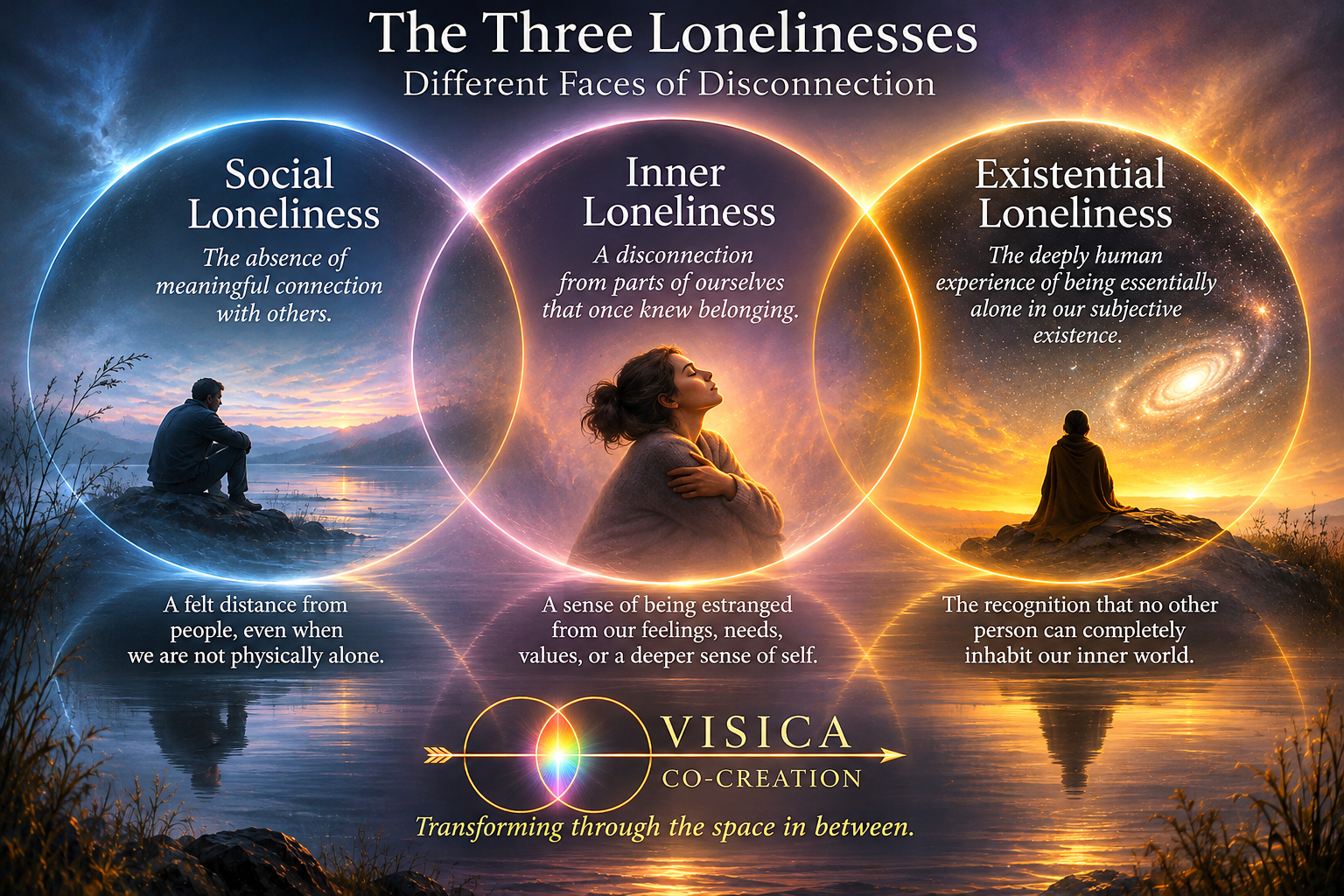
Loneliness as Neural Contrast Deprivation
Modern neuroscience confirms what psychology has long recognized: loneliness is not merely psychological — it has neurobiological and relational dimensions.
Within the symbolic language of the Visica Compass, we might understand certain experiences of loneliness as a form of neural contrast deprivation — a loss of the relational feedback through which we recognize ourselves in connection with others.
It can feel like neural overexposure: an inner world without sufficient relational contact to offer another perspective.
Without meaningful connection — without the felt experience of another person with whom we can share, respond, and sometimes regulate our emotional states — our nervous system may become increasingly influenced by its own expectations and patterns of interpretation.
Prolonged loneliness can influence how the brain interprets and responds to the world:
The amygdala, involved in detecting emotionally significant information, may become more sensitive to potential social threats.
The prefrontal cortex, involved in attention and emotional regulation, may find it more difficult to regulate stress responses under conditions of prolonged distress.
The nervous system may remain in a heightened state of vigilance, making it harder to experience safety and relaxation.
Predictive processing may become increasingly influenced by expectations of rejection or disconnection, affecting how ambiguous social signals are interpreted.
Internal attention may become dominated by worry, rumination, or self-monitoring, leaving less room for new relational experiences.
These are possible patterns associated with loneliness, not inevitable consequences for everyone who experiences it.
In other words, loneliness may mirror perceptual blindness: too much inner light without relational shadow to soften it.
There may be a felt absence of:
contact — the experience of being genuinely met;
contrast — encountering perspectives and experiences beyond our familiar inner world;
feedback from another nervous system — the possibility of emotional resonance and co-regulation.
Yet loneliness does not necessarily mean being physically alone.
A person may be surrounded by people and still experience profound loneliness. What is missing is not necessarily physical proximity, but the felt experience of meaningful connection.
And sometimes, even when meaningful relationships are available, earlier experiences of rejection, loss, or disconnection may shape what the nervous system expects. We may anticipate separation even when another person is reaching toward us.
This is where loneliness and predictive processing meet.
The nervous system may continue to anticipate disconnection even in the presence of opportunities for connection.
Within the language of the Visica Compass, this may be experienced as Existential Darkness — the felt gap between self and world.
Yet existential loneliness is not identical to social isolation. It may also arise from the deeply human experience that no other person can completely inhabit our subjective world.
Neuroscience and relational psychology suggest that meaningful contact, experiences of co-regulation, and opportunities for rest can help support emotional regulation and a sense of safety.
But contact is not simply stimulation, and solitude is not necessarily loneliness.
Sometimes what restores our capacity to connect is the presence of another person. Sometimes it is the possibility of resting safely within ourselves.
Darkness — as embodied stillness, rest, and the possibility of safety — may become a space in which relationship can be rediscovered.
Perhaps the question is not only whether we are alone, but whether we can remain in contact — with ourselves, with others, and with the living world — even when familiar forms of connection are absent.
2. Change, Plasticity, and the Shadow of Predictive Coding
“Emotions are not reactions to the world; they are your constructions of the world.”
— Lisa Feldman Barrett, How Emotions Are Made
Modern neuroscience has increasingly moved beyond viewing the brain as a passive receiver of information toward understanding it as an active predictor.
Predictive coding offers one explanation of how this happens.
Rather than simply waiting for information to arrive through our senses, the brain continually anticipates what it is likely to encounter. It compares incoming sensory information with these expectations and adjusts its predictions when something unexpected occurs.
This may sound complicated, but its basic principle can be understood through everyday experience.
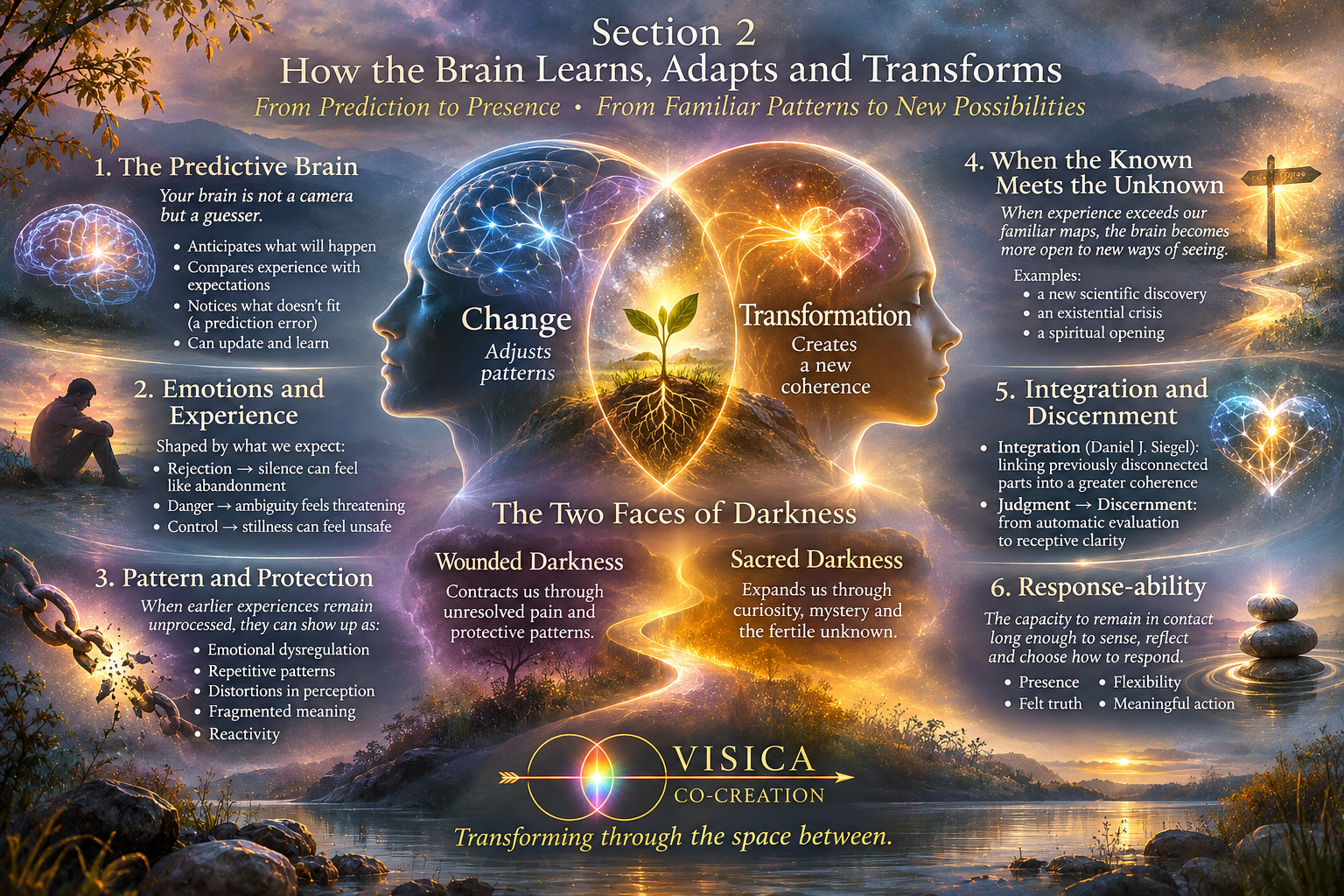
Your brain is not simply a camera. It is also a guesser.
It does not merely record the world as it appears. It uses previous experiences and learned patterns to anticipate what is likely to happen next.
A simple example
Imagine walking into your kitchen in the dark.
Although you cannot clearly see every object, you know where the furniture usually stands. Your brain uses this familiar arrangement to guide your movements.
But suppose someone has moved a chair.
You unexpectedly bump into it.
Suddenly, your attention sharpens. Something is different from what you anticipated.
The difference between what your brain predicted and what actually occurred is called a prediction error.
Your brain now has an opportunity to update its expectations.
This helps explain something familiar in everyday life: we often pay less attention to what has become predictable, while unexpected changes attract our awareness.
And what about our emotions?
Predictive processes also participate in how we interpret emotional and social experiences.
Imagine that you have repeatedly experienced rejection.
When someone remains silent, you may interpret that silence as abandonment, even though the other person may simply be tired or preoccupied.
If your brain has learned to anticipate danger, an ambiguous situation may feel threatening.
And if maintaining control has become associated with safety, stillness and uncertainty may feel uncomfortable rather than restful.
In each case, what we experience is influenced not only by the present situation, but also by what our nervous system has learned to expect.
This helps us understand why:
Trauma can make certain experiences hyper-visible. Situations resembling earlier threats may attract heightened attention, even when the present circumstances are different.
Familiar patterns can become almost invisible. We may continue repeating established ways of thinking, feeling, or behaving without consciously recognizing them.
Change can feel harder than remaining with what is familiar. Even an uncomfortable pattern may seem more predictable than an unfamiliar possibility.
As psychiatrist and trauma researcher Bessel van der Kolk explores in The Body Keeps the Score, overwhelming experiences can leave lasting traces in the body's stress responses, emotional regulation, and ways of interpreting the environment.
Although these processes are particularly evident in trauma, they also remind us of a broader principle: our past experiences participate in shaping how we meet the present.
The brain often relies on predictability to navigate the world efficiently. Yet familiar expectations are not necessarily accurate reflections of present reality.
Sometimes, something unexpected interrupts the pattern and creates an opportunity for learning.
Why does this matter for transformation?
Here we encounter an important distinction between change and transformation.
Change may involve adjusting particular expectations, reactions, or behaviours.
Transformation may involve a more profound reorganization of how we understand ourselves, others, and the world.
In neuroscientific terms, learning and repeated experience can alter neural connections and patterns of activity. This capacity is known as neuroplasticity.
Yet not every neural change represents the deeper psychological or existential transformation we have been exploring throughout the Visica Compass.
Transformation, in this broader sense, may involve questioning assumptions that once seemed unquestionable, encountering experiences that challenge our familiar identity, and discovering possibilities that our previous understanding could not accommodate.
And what does this have to do with light and darkness?
Within the symbolic language of the Visica Compass, we might consider how different qualities of light and darkness influence our openness to change.
Too much light — understood as constant explanation, exposure, certainty, or the insistence on knowing — may leave little room for questioning familiar assumptions.
Darkness — understood as pause, not-knowing, rest, or silence — may offer space in which those assumptions can loosen and unfamiliar possibilities can be explored.
This does not mean that the brain requires literal darkness to reorganize itself, nor that uncertainty always leads to growth.
Rather, periods of rest, reflection, and openness can sometimes support learning and new understanding, particularly when we experience sufficient safety.
Darkness is not failure.
Perhaps it is sometimes where we begin to relearn how to see.
As Lisa Feldman Barrett argues through her theory of constructed emotion, emotions are not merely automatic, hardwired reactions. They emerge through processes involving bodily sensations, prior experience, learned concepts, language, and cultural context.
Her theory invites us to consider how the brain actively constructs meaning from what we experience.
In this light, both the “shadow we fear” and the “light we long for” may be influenced by interpretations and expectations shaped by what we have previously lived.
Yet this does not mean that everything we perceive is imaginary or that our emotions are unreal. Rather, our experience of reality involves an ongoing relationship between what is happening and how our brain has learned to interpret it.
“Your brain is constantly guessing what's going on in the world. Those guesses are your reality.”
— Attributed to Lisa Feldman Barrett, Seven and a Half Lessons About the Brain
When the Known Meets the Unknown: How the Brain Navigates What It Has Never Seen
Predictive coding describes how the brain continuously compares incoming information with expectations shaped by previous experiences, learned patterns, and existing knowledge.
But what happens when we encounter something for which our familiar patterns offer no adequate explanation?
Consider:
A new scientific discovery that challenges what we previously believed to be possible.
An existential crisis for which our familiar explanations and language no longer seem sufficient.
A spiritual opening that does not fit within our existing conceptual maps.
Such experiences may challenge not only what we know, but also the very frameworks through which we interpret reality.
When experience exceeds our familiar understanding, the brain does not necessarily collapse. It may begin to reorganize how it interprets what is happening.
From Prediction to Presence
Our brain continually combines two interacting processes:
Top-down processing — drawing upon previous knowledge, expectations, and experiences to interpret incoming information.
Bottom-up processing — allowing sensory information from the body and environment to influence, challenge, and update those expectations.
These processes do not simply switch on and off. They operate together, continually shaping perception.
Yet when familiar explanations prove insufficient, we may become more attentive to what is actually unfolding rather than relying exclusively on what we expected to encounter.
In the language of contemplative inquiry, this may be experienced as a movement toward presence — an openness to what is not yet understood.
Here, contrast takes on another dimension.
We move:
From familiar categories → toward the threshold of knowing and not-knowing.
From sensory contrast → toward existential contrast, where our understanding of ourselves and the world is challenged.
From clarity → toward mystery, where meaning has not yet taken form.
The contrast is no longer only between differences in sensory information. It may also arise between what we believe we know and what our experience is inviting us to discover.
Sacred Darkness — The Fertile Unknown
Within the symbolic language of the Visica Compass, we may recognize this encounter as Sacred Darkness.
Not darkness as absence, but as the depth of the fertile unknown.
A luminous void where new meaning is gestating.
This resonates with A. H. Almaas' exploration of the Luminous Black — a dimension of Being associated with stillness, depth, and the mysterious unfolding of Essence.
In this understanding, darkness is not necessarily something to overcome. It may become a space in which familiar identifications loosen and something previously unrecognized can emerge.
Neuroscience offers a complementary, although different, perspective.
When expectations are challenged, the brain may adjust its existing models, redirect attention, or engage in further learning. Such processes can involve neuroplasticity — the nervous system's capacity to change through experience.
Yet not every unexpected experience produces transformation. The way we respond to uncertainty, including whether we experience sufficient safety and openness, can influence what becomes possible.
Curiosity, exploration, and a willingness to question familiar assumptions may support new learning and creative thinking.
This helps us understand how human beings can engage in:
Existential inquiry — questioning the assumptions through which we understand our lives.
Scientific discovery — exploring observations that existing theories cannot adequately explain.
Philosophical wonder — remaining open to questions that resist immediate answers.
Spiritual realization — encountering dimensions of experience that may challenge our familiar sense of identity and meaning.
These experiences are not neurologically identical, nor can neuroscience establish the spiritual meaning we may attribute to them.
Nevertheless, each can involve a willingness to encounter what is not yet known.
The unknown becomes an incubator.
Bridging to a Different Darkness
We must now name an important distinction.
Not every encounter with the unknown feels expansive or creative.
Sometimes uncertainty invites curiosity. At other times, it awakens fear, protection, and patterns shaped by earlier experiences.
Within the Visica Compass, we distinguish between Sacred Darkness and Wounded Darkness.
Sacred Darkness may open us toward curiosity, allowing perception to widen and new meaning to gestate.
In neuroscientific terms, unexpected information can create what predictive-processing theories call a prediction error — a difference between what was anticipated and what is encountered.
Such differences may invite learning and revision of existing expectations.
Yet prediction error does not automatically produce transformation, nor is it the neurological equivalent of Sacred Darkness.
The symbolic and neuroscientific perspectives illuminate different dimensions of the same inquiry: how we meet what we do not yet understand.
Wounded Darkness, by contrast, may contract our experience through unresolved pain, fear, and protective responses.
When earlier experiences remain difficult to integrate, they may continue influencing how we perceive, interpret, and respond to the present.
This can become visible through:
Emotional dysregulation — difficulty recognizing, tolerating, or regulating emotional responses.
Repetitive patterns — returning to familiar ways of thinking, feeling, or behaving, even when they no longer serve us.
Distortions in perception or interpretation — experiencing present situations through expectations strongly influenced by earlier experiences.
Fragmented meaning — difficulty connecting experiences into a coherent understanding of ourselves and our lives.
Reactivity — responding automatically to perceived threats before we have had the opportunity to reflect.
These patterns are not inevitable, nor do they necessarily indicate trauma or psychological disorder. They illustrate ways in which earlier learning and protective responses may influence present experience.
The unprocessed past recycles into the present.
Healing, then, may involve more than gaining intellectual insight. It can also involve gradually developing new experiences and responses through:
Presence — becoming aware of what is happening without immediately reacting or withdrawing.
Flexibility — discovering that familiar expectations and responses are not the only possibilities.
Felt truth — recognizing what is genuinely experienced in the body and psyche, while remaining curious about how that experience is interpreted.
In this way, previously established patterns may become available for reflection, revision, and integration.
From Change to Integration — Daniel J. Siegel
Neuropsychiatrist Daniel J. Siegel places integration at the centre of his understanding of mental health and well-being.
Integration involves linking differentiated elements of experience and functioning — allowing aspects of the nervous system, mind, and relationships to work together without losing their distinct qualities.
This offers another perspective on the distinction between change and transformation.
Change may alter particular neural pathways, expectations, or behavioural responses.
Transformation, in the broader psychological and existential sense explored in the Visica Compass, may involve a new coherence in how we experience ourselves and relate to the world.
These are not two strictly separate neuroscientific processes. Rather, they are different ways of describing the depth and significance of change.
When previously disconnected aspects of experience become more integrated, people may discover greater flexibility, emotional regulation, and the capacity to respond rather than react.
The movement from fragmentation toward integration can be understood as one important dimension of transformation.
From Judgment to Discernment — The Relationship Between Brain and Heart
Here we return to a distinction that has accompanied us throughout the Visica Compass.
Judgment often arises through rapid evaluation, comparison, and previously learned expectations.
Such processes are not inherently harmful. They help us recognize danger, make decisions, and navigate everyday life.
Yet when automatic evaluation becomes rigid, it may narrow our ability to perceive what is actually happening.
Discernment invites another quality of attention.
Rather than immediately categorizing an experience as good or bad, right or wrong, safe or threatening, we may become curious about what is unfolding.
This does not mean abandoning judgment or ignoring genuine danger. It means developing the capacity to recognize our reactions without being entirely governed by them.
Neuroscience suggests that attention, emotional regulation, and bodily awareness involve interacting neural and physiological processes.
The relationship between the heart and brain is one aspect of this larger system.
Research on heart-rate variability (HRV) examines changes in the timing between heartbeats and their relationship to autonomic nervous-system regulation.
The HeartMath Institute has explored physiological coherence, including patterns of heart rhythm associated with breathing and emotional regulation.
Some of its broader interpretations concerning heart–brain coherence and expanded perceptual capacities remain scientifically debated.
Nevertheless, research into autonomic regulation, breathing, and attention provides a basis for exploring how bodily states may influence our capacity to regulate emotion and respond reflectively.
Within the Visica Compass, this opens an intriguing possibility:
When our attention is less dominated by automatic threat responses, and our bodily state allows greater regulation, we may find more room to recognize subtle differences, consider alternative perspectives, and remain present with complexity.
Not because the heart literally replaces the brain as an organ of discernment, but because our capacity to reflect is deeply connected with our embodied experience.
Perhaps discernment is judgment once it has learned to breathe.
Response-ability — Remaining in Contact
Here we encounter another dimension of transformation.
Response-ability, in this light, is not simply willpower or the capacity to control our reactions.
It is also the developing capacity to remain in contact with our experience long enough to recognize what is happening, sense what matters, and choose how we respond.
Sometimes that capacity requires action.
Sometimes it requires restraint.
Sometimes it begins with recognizing that we are frightened, overwhelmed, or uncertain — without immediately allowing those experiences to determine what happens next.
The nervous system's capacity for regulation can support this process, but response-ability also involves awareness, relationship, ethical discernment, and the conditions in which we live.
Perhaps transformation begins not when we eliminate our automatic responses, but when we discover that they are no longer the only possibilities available to us.
3. Consciousness: Rhythms, Coherence, and Inner Light
What Do We Mean by Consciousness?
Before exploring the neuroscience of consciousness, perhaps we should ask a more fundamental question:
What do we actually mean when we speak of consciousness?
The word conscious has its roots in the Latin conscius, related to con- (with, together) and scire (to know). The related word conscientia originally carried meanings associated with shared knowledge, awareness, and knowing one's own actions.
There is something intriguing in this linguistic history: the idea of knowing-with.
Yet language alone cannot tell us what consciousness fundamentally is.
Today, the word carries different meanings across neuroscience, psychology, philosophy, and contemplative traditions.
In neuroscience, consciousness commonly refers to our capacity for subjective experience — not merely processing information, but actually experiencing sensations, feelings, thoughts, and the world around us from our own perspective.
But consciousness is not necessarily the same as attention, awareness, or self-awareness.
Awareness refers to our experience or recognition of something — a sound, a sensation, an emotion, a thought, or the environment around us. The term is sometimes used interchangeably with consciousness, although researchers do not always define them in the same way.
Attention concerns how the brain selects and prioritizes information. We can attend to something without necessarily becoming consciously aware of every aspect of that processing.
Self-awareness involves recognizing ourselves as the ones having an experience. Yet we can have conscious experiences without continuously reflecting upon ourselves.
Feeling, as explored by Antonio Damasio, connects consciousness with the living body's experience of its own changing states.
Presence, in contemplative inquiry, points toward the quality of being immediately in contact with experience, without necessarily interpreting or judging everything that arises.
And Being, particularly in the work of A. H. Almaas, invites an inquiry into the nature of existence and the possibility that awareness is inseparable from our deepest nature.
These distinctions matter because the same word — consciousness — may refer to different dimensions of human experience.
When neuroscience investigates the brain, it asks how neural and bodily processes contribute to conscious experience.
When philosophers inquire into consciousness, they may ask why subjective experience exists at all.
And when contemplative traditions explore consciousness, they may ask what becomes apparent when we turn awareness toward the nature of experience itself.
These questions are related, but they are not identical.
Perhaps the challenge is not to reduce them to one explanation, but to recognize what each way of knowing can illuminate — and where its limitations begin.
This brings us back to the invitation of the Visica Compass: to look with both eyes open, remaining attentive to scientific evidence while allowing space for philosophical and experiential inquiry.
The brain is not static. It pulses in oscillations — rhythmic patterns of electrical activity occurring at different frequencies. These rhythms help coordinate activity across neural networks and are involved in attention, perception, memory, and processes associated with conscious awareness.
Yet how these processes give rise to subjective experience remains one of neuroscience's most profound unanswered questions.
Current neuroscience has not identified a single location in the brain responsible for consciousness. Instead, researchers investigate how interacting neural networks contribute to conscious experience — including relationships between cortical and subcortical structures, the two cerebral hemispheres, and networks involved in internally directed thought and focused attention.
Consciousness Begins with Feeling — Antonio Damasio
Neuroscientist Antonio Damasio, whose research bridges neuroscience and embodied consciousness, places bodily feeling at the heart of our experience of being conscious.
In his work, consciousness is not simply the product of abstract thought. It is deeply connected to the living body's ongoing relationship with its environment.
Our brains continually represent changes occurring within the body — changes associated with sensations, emotions, and the regulation of life itself.
Damasio proposes that a basic form of consciousness emerges when the organism becomes aware, in a nonverbal way, that something is happening to it.
We do not need words to experience the warmth of sunlight, the tightening of fear, the comfort of another person's presence, or the quiet sense that we are alive.
Within the symbolic language of the Visica Compass, this invites us to consider Essential Light — the inner luminosity of coherent presence.
Essential Light is not simply intellectual clarity. It points toward the felt sense of aliveness that may emerge when body, feeling, and awareness are experienced in relationship.
Damasio's understanding offers a neuroscientific perspective on the importance of bodily feeling, while Essential Light remains a contemplative and experiential dimension of our inquiry.
Two Hemispheres — Different Ways of Attending to the World
Drawing on Iain McGilchrist’s insights, we encounter another dimension of how human beings experience and interpret reality.
McGilchrist suggests that the cerebral hemispheres differ not simply in what they do, but in the ways they attend to the world.
In his interpretation, the left hemisphere tends toward focused attention, categorization, analysis, and the manipulation of familiar information.
The right hemisphere is more associated with broad, contextual attention — remaining receptive to relationships, novelty, and the larger whole within which individual details acquire meaning.
These are not two separate brains, nor does one hemisphere exclusively possess reason while the other possesses creativity. Both participate in complex mental processes, and the extent of McGilchrist’s broader interpretation remains scientifically debated.
Nevertheless, his work raises an important question about the kinds of attention we cultivate.
Modern life often rewards analysis, measurement, categorization, and control.
But what happens when these ways of knowing become so dominant that we lose contact with context, relationship, ambiguity, and the unexpected?
Within the Visica Compass, we might recognize this broader, receptive dimension of awareness through the symbolic language of Creative Darkness — the space in which imagination, possibility, and meanings not yet fully articulated may emerge.
Electromagnetic Fields — Consciousness and the Living World
The human body is not electrically silent.
Every heartbeat involves electrical activity, and billions of neurons communicate through electrical and chemical processes. These activities generate electromagnetic fields that can be measured with sufficiently sensitive instruments.
The heart's magnetic field can be detected outside the body, while the brain's magnetic activity can be measured through magnetoencephalography.
We also live within Earth's magnetic field — a planetary environment that surrounds us whether or not we are consciously aware of it.
For many animals, this field is more than a physical background. Birds, sea turtles, and certain other organisms can detect magnetic information and use it for orientation.
But what about human beings?
In 2019, Connie Wang and colleagues reported that controlled changes in magnetic fields comparable to Earth's field produced measurable changes in human brain activity.
These findings raise questions about possible human magnetoreception, although they do not demonstrate conscious perception of Earth's magnetic field.
And what happens when the electromagnetic fields generated by living organisms encounter one another?
Physical fields can overlap and interact. Yet this does not automatically establish that they transmit thoughts, emotions, or conscious experiences between individuals.
Here we need to distinguish physical interaction, biological responsiveness, meaningful communication, and conscious experience.
These are related possibilities, but they are not interchangeable.
Could the Brain's Electromagnetic Field Contribute to Consciousness?
Researcher Johnjoe McFadden has proposed that the brain's electromagnetic field may play a causal role in conscious experience.
His Conscious Electromagnetic Information Field Theory (CEMI) suggests that the electromagnetic field generated by coordinated neural activity might participate in integrating information across the brain.
The theory remains scientifically debated and has not been established as an explanation of consciousness.
Nevertheless, it raises an intriguing question:
Could consciousness involve not only the activity of individual neurons, but also the electromagnetic relationships emerging from their collective activity?
The HeartMath Institute has investigated heart-rate variability, physiological coherence, and relationships between cardiac rhythms and emotional regulation.
Through its Global Coherence Initiative, it has also explored hypotheses concerning human physiology, collective experience, and Earth's magnetic environment.
Other thinkers, including Bruce Lipton, Joe Dispenza, Gregg Braden, Joseph Chilton Pearce, and Robert Edward Grant, have approached relationships between consciousness, biology, and fields from different perspectives.
Their inquiries emerge from different disciplines, methods, experiences, and understandings of consciousness. Rather than requiring these perspectives to fit within a single explanatory framework, we might ask what each contributes to questions that remain open.
Scientific knowledge develops not only through accumulating evidence, but also through questioning the assumptions that shape what we investigate, how we investigate it, and what we recognize as meaningful findings.
This does not require us to abandon critical examination. It invites us to distinguish between what has been demonstrated, what has been experienced, what has been proposed, and what remains unknown — while remaining open to the possibility that our existing frameworks may not yet be sufficient to explain everything we encounter.
Yet the questions they raise invite further investigation.
What kinds of biological interaction might occur through electromagnetic processes that we do not yet fully understand?
And how might we distinguish such interactions from the psychological, sensory, and relational processes through which human beings already influence one another?
From Electromagnetic Fields to Relational Fields — Is the Space Between Empty?
In Space Is Not Empty, Alan Briskin and Mary V. Gelinas explore the significance of fields in human relationships and collective life.
Their work invites us to recognize that what happens between people cannot always be understood by examining individuals separately.
They explore personal, social, and noetic fields as ways of understanding how patterns of attention, relationship, shared meaning, and collective knowing may emerge.
A personal field concerns patterns of experience, attention, and influence associated with an individual.
A social field concerns what emerges through interaction — the atmosphere, expectations, relationships, and patterns that develop within groups and communities.
A noetic field points toward a more elusive dimension of knowing and shared meaning, inviting inquiry into experiences that may not be adequately explained through individual cognition alone.
These fields should not automatically be equated with the electromagnetic fields measured by physics. Briskin and Gelinas offer a relational and interpretive framework rather than an established physical theory of consciousness.
Yet their work invites another question:
Might what emerges between us influence not only how we relate, but also how we perceive, interpret, and experience the world?
Consciousness as a Fundamental Field — An Open Scientific and Philosophical Question
From another direction, Norwegian-born materials scientist Maria Strømme proposed that consciousness might be a foundational field of reality rather than something generated exclusively by the brain.
Her theoretical model, published in 2025, was subsequently retracted in 2026 following concerns about its scientific validity and testability.
The model therefore cannot be presented as established scientific evidence for a universal consciousness field.
Yet the retraction of a particular model does not settle the deeper question it sought to explore.
It also invites us to examine the assumptions underlying our methods of knowing.
Modern science has developed extraordinary capacities to investigate measurable phenomena and causal relationships. Yet does everything that matters in human experience necessarily reveal itself through these methods alone?
Phenomenology, contemplative inquiry, and first-person investigations of consciousness remind us that lived experience is also a domain of knowledge — one that deserves rigorous exploration without automatically being reduced to its measurable biological correlates.
This does not mean abandoning scientific standards or accepting every subjective interpretation as an explanation of reality. It means recognizing that different questions may require different methods of investigation.
Could our understanding of consciousness remain limited not only by what we have yet to discover, but also by the assumptions through which we decide what is worth investigating?
And might scientific inquiry become more comprehensive by entering into dialogue with phenomenology, philosophy, and contemplative traditions — without losing its commitment to critical examination?
Perhaps the challenge is not to choose between scientific precision and openness to mystery, but to recognize that our present understanding of reality is not the measure of everything that may yet be discovered.
From Fields to Presence — Returning to the Living Experience
These different inquiries do not establish that electromagnetic, relational, and consciousness fields are manifestations of the same underlying phenomenon.
But they encourage us to consider consciousness from more than one perspective.
Neuroscience investigates the biological processes associated with conscious experience.
Physics investigates the properties and interactions of measurable fields.
Phenomenology investigates the structures of lived experience.
And contemplative inquiry explores what becomes apparent when awareness turns toward the nature of experience itself.
If our bodies participate in physical and relational environments, where does individual experience end and shared experience begin?
Perhaps the space between is not simply something to be crossed.
Perhaps it is also something to be explored.
Heart, Brain, and the Experience of Coherence
Our experience of awareness is not disconnected from the rhythms of the body.
Breathing, heart rate, emotional arousal, and attention continually interact through the autonomic nervous system and other physiological processes.
One way researchers investigate these relationships is through heart-rate variability (HRV) — the natural variation in the time intervals between heartbeats.
These variations provide information about aspects of autonomic regulation, although their meaning depends on context and cannot be reduced to a simple measure of emotional or spiritual well-being.
The Heart Math Institute has explored physiological coherence, particularly patterns of heart rhythm associated with breathing, emotional regulation, and attention.
Some of its broader claims concerning heart–brain coherence and expanded perceptual capacities remain scientifically debated.
Nevertheless, research on breathing and autonomic regulation offers important insights into how bodily states can influence attention, emotional experience, and our capacity to respond to the world.
When breathing becomes calmer and attention less dominated by stress, some people experience greater emotional steadiness and a more spacious quality of awareness.
It is as if the nervous system momentarily rests in a Womb of Love, held in an unseen harmony between pulse and perception.
Yet it invites us to consider how safety, embodied awareness, and presence may change the quality of our experience.
Light and Darkness — Complementary Modes of Knowing
Here light and darkness reveal themselves not as opposites, but as complementary dimensions of knowing:
Light as focused, structured, analytic clarity.
Darkness as spacious, associative, non-linear depth of knowing.
These are symbolic distinctions rather than two exclusive neurological states.
Both focused attention and open receptivity have their place in human experience.
To cultivate a fuller awareness is not to suppress one side, but to discover how both may participate in our understanding — allowing the Essential Light of clarity and the Sacred Darkness of deep knowing to dance together.
Perhaps wholeness does not emerge by eliminating contrast, but by remaining in relationship with it.
Consciousness — From Observation to Participation
Neuroscience investigates the neural and bodily processes associated with conscious experience. Yet the question of what consciousness fundamentally is remains open.
A. H. Almaas approaches consciousness through the direct experience of Being. Within the Diamond Approach, consciousness is not merely awareness of thoughts, feelings, and sensations. At its deepest level, Presence and consciousness are inseparable.
Through inquiry, we may discover that awareness is not necessarily experienced as something standing apart from what it knows. In moments of essential presence, knowing and being can be experienced as intimately connected.
Almaas' exploration of the Luminous Black offers another dimension of this inquiry — darkness not as absence or unconsciousness, but as a mysterious depth of Being in which familiar identifications may loosen and new understanding can emerge.
Ken Wilber approaches consciousness through an integral perspective, distinguishing subjective experience from its biological, cultural, and systemic dimensions.
His understanding of the Kosmos invites us to consider consciousness within a reality that cannot be adequately described through physical mechanisms alone.
Wilber also distinguishes between states of consciousness and stages of psychological development. A profound experience of unity or transcendence does not automatically imply psychological maturity or integration.
This distinction matters when we explore transformation.
Both Almaas and Wilber invite us to question whether consciousness can be fully understood by examining neural activity alone. Their approaches arise from contemplative and philosophical inquiry, however, and do not constitute experimental proof that consciousness exists independently of the brain.
If consciousness is not merely something we observe through its biological expressions, but also something we encounter directly through presence, what changes in our understanding of ourselves and the world?
And when we experience ourselves as participants rather than separate observers, are we discovering something about the nature of consciousness — or about the ways consciousness can experience reality?
Perhaps both questions deserve to remain open.
Consciousness and the Space Between — An Open Inquiry
The question of consciousness does not end with understanding the brain.
Nor does our inquiry into fields end with the physical fields investigated by science.
In Space Is Not Empty, Alan Briskin and Mary V. Gelinas explore how personal, social, and noetic fields may influence our experience of relationship, shared meaning, and collective awareness.
Their work invites us to consider the space between individuals not merely as an empty interval, but as a relational dimension in which patterns of attention, interaction, and meaning may emerge.
From another direction, Norwegian-born scientist Maria Strømme has raised the possibility that consciousness itself might be fundamental to reality rather than exclusively generated by the brain.
Her proposed physical model was subsequently retracted in 2026 following concerns about its scientific validity and testability. The retraction means that this particular model cannot be treated as established scientific evidence, although it does not resolve the wider philosophical question of whether consciousness is fundamental or emergent.
Nevertheless, the broader philosophical question of whether consciousness is fundamental or emergent remains unresolved.
These approaches are not equivalent. Physical fields, relational fields, and the contemplative experience of awareness belong to different forms of investigation and should not be treated as interchangeable explanations.
Yet placing these inquiries alongside one another invites us to ask:
If consciousness is experienced individually, how might it also be shaped by the fields of relationship in which we participate?
Could the space between us be more than an absence — a living dimension of relationship through which meaning emerges?
And if consciousness were more fundamental than our present scientific models can explain, what might that mean for how we understand separation, belonging, and the boundaries of the self?
Perhaps the task is not to rush toward an answer, but to remain attentive to the differences between what science can demonstrate, what philosophy can propose, and what experience may invite us to explore.
From the Inner Spotlight to Participatory Awareness
We usually experience awareness as a kind of inner spotlight — something shining outward from behind our eyes, illuminating what is "out there."
Yet this familiar experience of being an observer does not necessarily exhaust the ways consciousness can be experienced.
In moments of embodied presence, when breathing settles, emotional tension softens, and attention becomes more receptive, the quality of awareness may change.
The spotlight softens.
Rather than experiencing ourselves exclusively as observers standing apart from the world, we may begin to sense ourselves as participants within it.
Awareness no longer seems merely to look at the world, but from within it — less a beam of attention, more a gentle warmth that permeates everything it touches.
This does not establish that consciousness and the world are neurologically one. It describes a possible quality of lived experience — one that contemplative traditions have explored through different languages and practices.
In such moments, the distinction between observer and observed may become less rigid.
The body is no longer experienced merely as an object we possess, but as part of how we encounter and participate in life.
In this experiential homecoming, perception and presence may feel inseparable — the body, the world, and the light of consciousness belonging to the same field.
4. Inner Work as Neuroplastic Inquiry
Practices such as mindfulness, somatic sensing, and guided inquiry — including the approach developed by A. H. Almaas in the Diamond Approach — invite us to explore our inner experience with curiosity rather than judgment.
These practices do not necessarily change only how we think. They may also influence how we attend to sensations, regulate emotions, and respond to familiar patterns.
Neuroscience describes the brain's capacity to change through learning and experience as neuroplasticity.
This involves changes in the strength and organization of neural connections and, under certain conditions, changes in brain structure and function.
Research suggests that some contemplative and psychological practices can influence neural processes associated with attention, emotional regulation, and self-awareness. However, the specific neurological effects of the Diamond Approach have not been established in the same way.
Attention and curiosity may create opportunities for new learning — allowing familiar patterns to be recognized, questioned, and gradually reorganized.
When shadow is met with presence rather than avoidance, we may begin to recognize protective responses that previously operated outside our conscious awareness.
With sufficient safety and support, the nervous system may develop greater flexibility in responding to experiences that once automatically triggered fear or withdrawal.
Internal Family Systems — Meeting the Parts We Have Learned to Protect
Internal Family Systems (IFS), developed by Richard Schwartz, offers a complementary psychological perspective.
IFS understands the psyche as a relational system of parts, each with its own feelings, beliefs, protective intentions, and ways of responding to experience.
Some parts may carry experiences of rejection, shame, grief, or fear. Within IFS, these are often described as exiled parts — aspects of ourselves that have become difficult to approach because of the pain associated with them.
Other parts may attempt to protect us by controlling situations, avoiding vulnerability, or maintaining familiar patterns.
These parts are not literally separate neural circuits, nor have exiled parts been identified as specific neurological structures.
Yet the IFS model offers a meaningful way of exploring how previously learned emotional and protective patterns may influence present experience.
Through inquiry, presence, and somatic sensing, we may gradually become aware of experiences that were previously avoided or difficult to recognize.
Rather than forcing these parts into awareness, we invite them into relationship through curiosity, compassion, and respect for their protective functions.
Within the Visica Compass, this movement can be understood as bringing aspects of our Shadow Darkness into Creative Light — not by exposing or eliminating them, but by allowing new understanding and possibilities for integration to emerge.
Spiritual Intelligence — Acting from Meaning Rather Than Impulse
Danah Zohar and Ian Marshall, in their work on Spiritual Intelligence, explore another dimension of human intelligence: our capacity to engage with questions of meaning, values, purpose, and the larger context of our lives.
They propose that spiritual intelligence enables us to question established assumptions and orient our actions toward what we experience as meaningful.
Their framework brings together psychological, philosophical, and neuroscientific ideas, although spiritual intelligence is not an independently established neural system.
Within the Visica Compass, this raises an important question:
What happens when our actions arise not merely from habitual reactions or the need to maintain control, but from a deeper recognition of what matters?
Here we encounter a distinction explored within A. H. Almaas' Diamond Approach: True Will and False Will.
False Will may be understood as an effort to control experience through familiar ego structures, often shaped by fear, insecurity, or the need to maintain a particular identity.
True Will, by contrast, refers to an essential capacity for action and steadfastness arising from contact with Being rather than from defensive striving.
These are contemplative and psychological distinctions, not two identifiable neurological circuits.
Yet they invite us to explore how the quality of our inner contact may influence the way we act.
The Heart, Intelligence, and Embodied Agency
Joseph Chilton Pearce, whose work explored the relationship between human development, intelligence, and the heart, offered another perspective on the importance of embodied experience.
He understood the heart as more than a mechanical pump, exploring its significance in emotional life, relationship, and human development.
His broader interpretations of heart-centred intelligence extend beyond what contemporary physiology has established.
Nevertheless, the heart and brain are physiologically connected through complex neural, hormonal, and autonomic pathways.
Changes in bodily states can influence emotional experience, attention, and our capacity for regulation.
This does not establish that the heart independently produces higher intelligence. It does, however, remind us that human experience cannot be understood by considering abstract thought alone.
Within the symbolic language of the Visica Compass, we might say:
When thought, feeling, bodily awareness, and intention become more integrated, doing may begin to flow from being.
False Will fires from the circuitry of control; True Will flows from coherence.
Here, circuitry of control is a metaphor for habitual protective processes, while coherence refers to the experienced integration of our capacities rather than a single measurable neural state.
From Neural Regulation to Embodied Transformation
From a neuroscientific perspective, several processes may support the psychological changes we associate with inner work.
These include:
Developing interoception — the capacity to sense and interpret signals arising from within the body, such as breathing, heartbeat, muscular tension, and other internal sensations. Interoception can help us recognize emotional and physiological states, although greater sensitivity does not automatically mean greater accuracy or well-being.
Supporting autonomic regulation and social connection — the autonomic nervous system participates in regulating physiological arousal, recovery, and responses to social situations. The vagus nerve plays an important role in these processes. Polyvagal theory offers one interpretation of the relationship between autonomic states and social engagement, although aspects of that theory remain scientifically debated.
Developing greater flexibility between prefrontal and limbic processes — networks involved in attention, evaluation, memory, and emotion continually interact. Psychological learning and regulation may help us respond with greater flexibility rather than relying exclusively on automatic reactions.
These processes do not constitute a complete neuroscientific explanation of transformation, nor are they required in exactly the same way for every individual.
They do, however, offer biological perspectives on how experiences of awareness, regulation, learning, and relationship may influence our capacity to respond.
Within the Visica Compass, they become embodied bridges between light and shadow, clarity and emotion, insight and safety.
And perhaps this is one of the deepest invitations of inner work:
Not to force ourselves into becoming someone different, but to discover what becomes possible when we can remain in relationship with what we previously feared, rejected, or could not yet understand.
“Your brain is always controlling your body and your body is always sending sense data back to your brain.”
— Lisa Feldman Barrett, Speaking of Psychology, American Psychological Association. https://www.apa.org
5. The Visica Compass: Perception as Participation
In the Visica Compass, we learn to discern which dimensions of light and darkness we are encountering — within ourselves and in the world around us.
Mystics, artists, and depth psychologists have long explored these different dimensions of human experience. Neuroscience now offers another lens through which we can deepen our understanding of how we perceive, interpret, and respond to them.
Not all darkness is the same. Nor is all light.
fertile — sacred
primordial — cosmic
human — existential
unresolved — wounded
hidden — shadow
Likewise, not all light is the same:
physical — photons of science, the measurable radiance of the cosmos
perceptual — clarity through attention, awareness & the brain’s creation of contrast
mythic — light of revelation
essential — essence as described by A.H. Almaas
moral /ethical — light confused with goodness
creative — generative spark of creativity
Transformation arises not by polarising and judging light and darkness — but by remaining present to their different qualities — allowing contrast, tension, and relationship to become part of an unfolding process of integration.
Consciousness is a participatory act. To truly see, we must include the unseen. To evolve, we must hold the tension of contrast and allow it to teach us how to change.
“What we attend to, and how we attend to it, changes it and changes us.”
— Iain McGilchrist
Neurotheology researcher Andrew Newberg and writer Mark Robert Waldman have explored how contemplative practices, including prayer and meditation, relate to brain activity, attention, emotional regulation, and experiences of meaning.
Their work belongs to a wider body of research investigating how repeated experiences and practices may influence the brain's functioning.
Other research into meditation, psychological treatment, trauma recovery, and learning has identified measurable changes associated with neuroplasticity.
Examples include:
Changes in grey matter volume or density in certain brain regions.
Changes in functional connectivity between brain networks.
Changes involving regions such as the amygdala, hippocampus, and prefrontal cortex, which participate in emotion, memory, attention, and regulation.
Changes in patterns of neural oscillations associated with attention and other cognitive processes.
These findings vary across studies, individuals, and practices. They do not mean that every experience of psychological or spiritual transformation produces the same measurable neural changes.
Yet they remind us that inner experience and biological processes are not separate worlds.
The brain participates in our ongoing learning, adaptation, and relationship with life.
It is as if the brain, too, holds a pause — a biological pointer orienting us toward coherence, toward home.
Reflective Questions
Where does your attention resist contrast — and where is it hungry for it?
How might your nervous system respond differently if darkness were welcomed as teacher, not threat?
Closing Thought
To perceive is to participate in the world’s becoming.
To embrace the different dimensions of darkness is to unlock new dimensions of light.
This is Article 8: Perceiving Light, Embracing Shadow — A Neuroscientific View on Contrast, Transformation and Consciousness
What We Explored
In this eighth article of the series, we journeyed into the landscape of neuroscience — not just as a biological science, but as a map of perception, contrast, and conscious transformation.
We looked at how light and darkness function as polarities in the brain itself: through mechanisms of contrast detection, pattern recognition, and predictive coding. From the shadows of implicit memory to the illumination of new neural pathways, we explored how perception is shaped less by “what is” and more by “what the brain expects to see.”
Drawing on the work of thinkers like Antonio Damasio, Iain McGilchrist, and Lisa Feldman Barrett, we reflected on how consciousness is not a static light switch, but an unfolding process of integration — where the mind, body, and nervous system co-create our experience of reality.
We asked:
How does the brain filter what we see based on prior experience?
What parts of ourselves have become neurologically “invisible” due to trauma or habituation?
And how might embracing contrast — not erasing it — be the key to deeper awareness?
We also connected the dots back to language (Article 2), psychology (Article 7), and symbolic intelligence, showing how words, emotions, and internal imagery shape our neural architecture — just as darkness shapes the light we can see.
“Where attention goes, neural firing flows and neural connection grows.”
— Dr. Daniel J. Siegel, Mind: A Journey to the Heart of Being Human (2017), PsychAlive
When perception ceases to fight what it sees, awareness finds its way home — not by escaping the dark, but by seeing through it.
Stay in Contact & Continue the Inquiry — From Understanding to Experience
Throughout this article, we have explored how the brain perceives contrast, how expectations shape our experience, and how awareness may open possibilities beyond familiar patterns of thinking, feeling, and responding.
But understanding these processes intellectually is only one part of the journey.
What happens when we turn our attention toward our own experience?
— Where do we recognize familiar predictions, protective responses, or judgments shaping what we perceive?
— What happens when we encounter something within ourselves that we do not yet understand?
— And can we remain curious about what emerges — without immediately needing to explain, change, or resolve it?
The Visica Compass Personal Guided Inquiry for Article 8 — Perceiving Light, Embracing Shadow invites you to explore these questions through gentle reflection, embodied awareness, and personal inquiry.
Not to correct yourself or force transformation, but to discover how perception, presence, and discernment may unfold in your own experience.
And perhaps this article has awakened a question, challenged a familiar understanding, or invited you to explore a different perspective.
I welcome your reflections, questions, and experiences. The Visica Compass is an evolving inquiry, and meaningful dialogue can reveal possibilities that none of us might discover alone. Whether you wish to deepen your personal inquiry, share your reflections, or explore opportunities for co-creation, you are warmly invited to stay in contact.
Because inquiry does not end with knowing an answer. It continues through our willingness to explore — within ourselves and in relationship with one another.
Transforming through the space between.


Transition to the Lived Rhythm of Transformation
If perception arises through contrast — through rhythm, pause, and difference — then transformation cannot be forced. Article 9 turns toward the lived rhythm of this process.
From neural contrast to human breath.
From perception to presence.
From knowing about change to inhabiting transformation.
Next in the Series…
Article 9 — Breathing Through the Dark — Rhythms of Contraction and Expansion in Psychological and Spiritual Development
Here we explore the rhythms of contraction and expansion that shape psychological and spiritual development — how fear tightens, how presence softens, and how darkness becomes not an obstacle, but a passage.
Here, transformation is no longer a concept — it becomes a rhythm the body must learn to trust.

“Every perception is an act of creation.”
— Gerald Edelman, Nobel Prize–winning neuroscientist
Sources & Voices That Shaped This Reflection…
This article stands at the intersection of neuroscience, depth psychology, embodied experience, and contemplative inquiry — drawing on researchers, psychologists, philosophers, and thinkers who explore perception, consciousness, relationship, and meaning.
These voices do not necessarily share the same assumptions, methods, or conclusions. Some contribute empirical findings, others offer psychological models, philosophical perspectives, or insights from contemplative experience.
Together, they invite us to explore what we know, what we experience, what we interpret, and what remains open to inquiry.
Neuroscience — Perception, Emotion, and Consciousness
Antonio Damasio — The Feeling of What Happens
For exploring how bodily feeling contributes to consciousness and our experience of being alive. His work helps us understand why perception cannot be separated from the living body's ongoing relationship with its environment.
Lisa Feldman Barrett — How Emotions Are Made
For illuminating how the brain uses previous experience, bodily information, and predictions to construct emotional experience. Her work helps us explore why we do not simply react to reality, but participate in how we experience and interpret it.
Iain McGilchrist — The Master and His Emissary; The Matter with Things
For investigating differences in how the cerebral hemispheres attend to the world, and for questioning the dominance of narrow, analytical ways of knowing. His work invites us to consider the relationship between focused attention, context, and the larger whole.
Daniel J. Siegel — Mindsight
For exploring integration, awareness, and the relationship between brain, mind, and human connection. His work contributes to our understanding of how attention and interpersonal experience may support psychological flexibility and well-being.
Gerald M. Edelman — Bright Air, Brilliant Fire; The Remembered Present
For developing a biological understanding of consciousness and perception in which neural selection, memory, and experience participate in the ongoing organization of awareness. His work supports our exploration of perception as an active process rather than passive reception.
Andrew Newberg and Mark Robert Waldman — How God Changes Your Brain
For exploring relationships between contemplative practices, brain activity, emotional experience, and meaning. Their work invites inquiry into how repeated practices of attention may influence neural functioning and psychological experience.
Depth Psychology, Trauma, and Inner Integration
Carl Gustav Jung — The Archetypes and the Collective Unconscious
For illuminating the symbolic and collective dimensions of the psyche, and for exploring how unconscious patterns and shadow aspects may influence perception, identity, and human relationships.
Richard Schwartz — No Bad Parts
For developing Internal Family Systems as a way of understanding the psyche through relationships among parts. His approach contributes to our exploration of protective responses, exiled experiences, curiosity, compassion, and integration.
Peter Levine — Waking the Tiger
For emphasizing the role of bodily sensation, defensive responses, and physiological regulation in trauma recovery. His somatic approach invites us to explore how safety and embodied awareness may support healing.
Bessel van der Kolk — The Body Keeps the Score
For bringing together research and clinical observations concerning trauma, memory, bodily responses, and the nervous system. His work helps explain how previous experiences may continue to shape perception and protective patterns.
Tara Brach — Radical Acceptance
For exploring mindfulness and compassion as ways of meeting difficult inner experiences without immediate judgment or avoidance. Her work contributes to our understanding of acceptance as an active relationship with experience rather than resignation.
Presence, Spiritual Intelligence, and Embodied Agency
A. H. Almaas — The Unfolding Now; Diamond Approach teachings on Essence and the Luminous Black
For exploring inquiry as a direct engagement with experience, and for distinguishing defensive ego activity from essential qualities of Being. His understanding of Presence, True Will, and the Luminous Black deepens our exploration of Sacred Darkness as a dimension of consciousness rather than merely an absence of light.
Ken Wilber — Integral Psychology
For offering an integral framework that considers subjective, biological, cultural, and systemic dimensions of human experience. His distinctions between states and stages of consciousness help us explore why profound experiences do not automatically imply psychological integration.
Danah Zohar and Ian Marshall — Spiritual Intelligence
For exploring the capacity to orient our actions through meaning, values, and purpose. Their framework contributes a philosophical and psychological perspective on agency beyond habitual reaction and defensive control.
Joseph Chilton Pearce — Evolution's End
For exploring relationships among human development, bodily experience, the heart, and intelligence. His interpretations invite reflection on embodied agency and resonance, while some of his broader physiological proposals remain speculative.
Electromagnetic Fields, Coherence, and the Open Questions of Consciousness
HeartMath Institute — Research on Heart-Rate Variability and Physiological Coherence
For investigating relationships among cardiac rhythms, breathing, emotional regulation, and physiological coherence. Its broader hypotheses concerning interpersonal electromagnetic communication and Earth's magnetic environment invite further investigation and should be distinguished from established HRV findings.
Connie Wang and colleagues — Transduction of the Geomagnetic Field as Evidenced from Alpha-band Activity in the Human Brain (2019)
For reporting changes in human brain activity during controlled exposure to Earth-strength magnetic-field changes. Their findings contribute to the open investigation of possible human magnetoreception without establishing conscious perception of the geomagnetic field.
Johnjoe McFadden — Integrating Information in the Brain's EM Field: The CEMI Field Theory of Consciousness (2020)
For proposing that the electromagnetic field generated by neural activity may contribute causally to conscious experience. His theory offers a scientifically formulated but unproven perspective on how information might be integrated within the brain.
Bruce Lipton — The Biology of Belief
For emphasizing cellular responsiveness to environmental signals and exploring broader relationships between biology, perception, and belief. His interpretations concerning consciousness and biological change invite inquiry while requiring distinction from established findings in cell biology.
Joe Dispenza — Becoming Supernatural
For exploring meditation, attention, altered states, and proposed relationships between brain activity, bodily regulation, and consciousness. His broader interpretations are included as questions for exploration rather than established neuroscientific conclusions.
Gregg Braden — The Divine Matrix
For exploring ideas concerning interconnectedness, fields, and the relationship between consciousness and physical reality. His interpretations invite philosophical inquiry but should not be confused with experimentally established mechanisms of electromagnetic communication.
Robert Edward Grant — Explorations of Mathematics, Geometry, and Consciousness
For bringing mathematical and geometrical interpretations into questions concerning patterns, perception, and the nature of reality. His broader connections between geometry and consciousness are exploratory rather than established neuroscientific explanations.
Relational Fields and the Boundaries of Knowing
Alan Briskin and Mary V. Gelinas — Space Is Not Empty
For exploring personal, social, and noetic fields as dimensions of human relationship, shared meaning, and collective experience. Their work helps us investigate what emerges between individuals and groups without assuming that relational fields are identical to measurable electromagnetic fields.
Maria Strømme — Universal Consciousness as Foundational Field (2025; retracted 2026)
For proposing a theoretical model in which consciousness is fundamental rather than exclusively emergent from neural activity. Although the paper was retracted because its central theoretical claims could not be empirically verified or falsified, the wider philosophical question of whether consciousness is fundamental or emergent remains open.
Her contribution also invites reflection on the assumptions, possibilities, and limitations of different methods of investigating consciousness.
The Visica Perspective
Barbara Keller — Visica Co-Creation; The Visica Compass
For bringing these perspectives into an ongoing inquiry into the different dimensions of light and darkness — across neuroscience, psychology, philosophy, systems, and symbolic experience.
The Visica Compass does not seek to reduce these different perspectives to one explanation. It invites us to explore their relationships while recognizing the distinctions between scientific evidence, psychological interpretation, philosophical inquiry, and direct experience.
At its heart is the movement from judgment toward discernment, from separation toward relationship, and from perception as passive observation toward perception as participation.
Transforming through the space between.